
Two identical gates on the same die never have exactly the same delay. Small differences in channel length, threshold voltage, local supply and temperature make some cells a little faster and some a little slower, even within one corner. Sign-off timing accounts for this on-chip variation (OCV) with derates: late paths are made slower and early paths faster by a few percent. For the physical designer, OCV is not just a sign-off setting. It changes which paths fail, how much the clock tree costs, and when to turn it on in the flow. This article runs real derates on the lab's routed multiplier and shows what changes.
8 min read | Intermediate
What You'll Learn
- Apply timing derates in OpenROAD and read their effect on a routed design
- Explain clock reconvergence pessimism removal (CRPR) with real numbers
- Describe how clock tree structure changes the cost of OCV
- Choose corners and derates for each stage of the flow
Corners and Variation
A corner, as in Post-Route STA: What Changes from Synthesis, moves every cell on the die the same way: at the slow corner all transistors are slow. On-chip variation describes the differences that remain between cells inside one corner. The STA tutorial explains the models in detail, in On-Chip Variation and Timing Derates, AOCV: Depth and Distance Derating and POCV and the Liberty Variation Format. In short:
- A setup check is pessimistic if the launch clock and the data path are late and the capture clock is early. A late derate above 1 slows the first two; an early derate below 1 speeds up the third.
- A hold check uses the opposite combination.
- Flat derates apply the same percentage everywhere; advanced methods make it depend on path depth, distance or each cell's own statistical data.
The Experiment
The design is the 16 x 16 multiplier routed by the lab's flow at a 10 ns clock in the typical corner, with its extracted parasitics. The timing is rerun in OpenROAD with the lab's constraints and different derates added on top:
set_timing_derate -late 1.05
set_timing_derate -early 0.95
report_checks -path_delay max -format full_clock_expanded
set_timing_derate can be limited to clock paths with -clock or data paths with -data, and to cell or net delays. The results:
| Derates | Worst setup slack | Worst hold slack |
|---|---|---|
| none | +0.134 ns | +0.990 ns |
| 5 % on everything | -0.353 ns | +0.929 ns |
| 5 % on data paths only | -0.352 ns | +0.945 ns |
| 5 % on clock paths only | +0.134 ns | +0.974 ns |
| 10 % on everything | -0.840 ns | +0.867 ns |
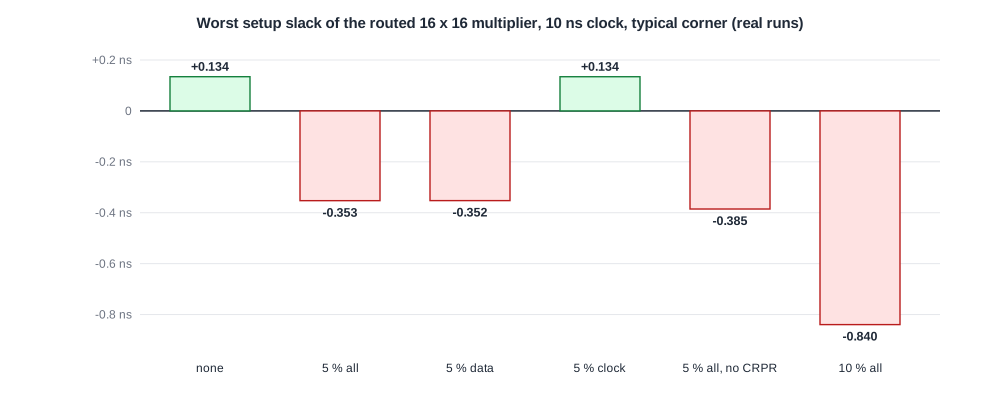
A design that met timing with 0.134 ns to spare fails by 0.353 ns once 5 % of variation is assumed, and at 10 % the total negative slack is 1.630 ns. The 5 % case loses 0.487 ns of slack, which is exactly 5 % of the critical data path: the path from the launching flip-flop's clock pin to the capturing flip-flop's input is 9.736 ns long. On a long data path, the derate on the data dominates.
Quick Check
Q: Without derates a path has 0.134 ns of slack and a 9.736 ns data path. What is the largest flat late derate on the data path that it can tolerate, ignoring the clock?
Show Answer
The derate may add at most 0.134 ns, which is 0.134 / 9.736 = 1.4 % of the data path. A late derate of about 1.014 would bring the slack to zero; anything above fails.
Why the Clock Derate Cost Nothing
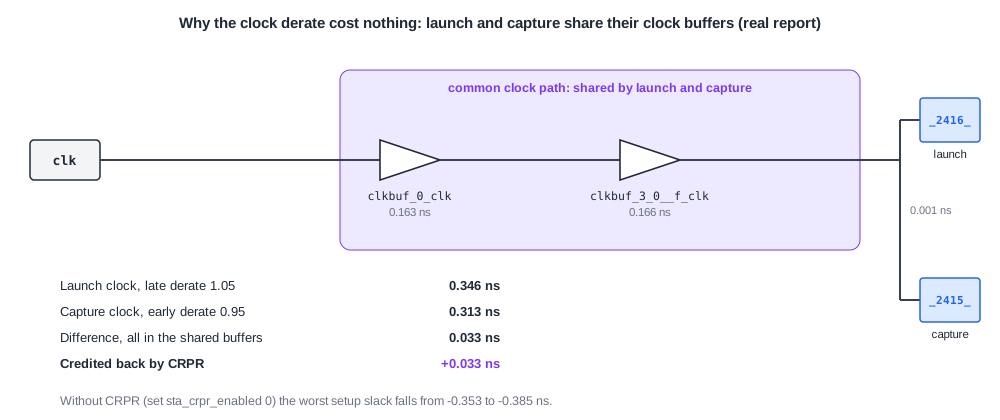
The derated report shows why. The launch clock passes clkbuf_0_clk and clkbuf_3_0__f_clk and arrives at 0.346 ns with the late derate. The capture clock passes the same two buffers and arrives at 0.313 ns with the early derate. But the same physical buffers cannot be slow for one edge and fast for the other at the same time: they are one piece of silicon. STA therefore gives the difference back:
   0.001   10.313 ^ _2415_/CLK (sky130_fd_sc_hd__dfxtp_1)
   0.033   10.346   clock reconvergence pessimism
  -0.129   10.217   library setup time
The 0.033 ns credit is clock reconvergence pessimism removal (CRPR), also called common path pessimism removal, explained in Common Path Pessimism Removal. Here the whole clock path is shared except a 0.001 ns wire, so the credit cancels the clock derate almost completely. Switching CRPR off in OpenROAD with set sta_crpr_enabled 0 shows its value: the worst setup slack drops from -0.353 to -0.385 ns, and the worst hold slack from 0.929 to 0.912 ns.
What This Means for the Clock Tree
CRPR only credits the shared part of the launch and capture clock paths. After the paths split, every buffer on either branch is derated in the pessimistic direction. Two consequences for CTS in OpenROAD and the floorplan:
- Related flip-flops should share as much of the tree as possible. Flip-flops that talk to each other, placed close together, end up on the same branch, so their critical paths have a long common clock path and a small OCV penalty. In the multiplier, the critical path's two flip-flops share every buffer.
- Long separate branches cost margin. A path between flip-flops at opposite ends of a large chip has clock branches that split near the root. Each branch might be 1 ns long; at 5 % each side, the uncredited pessimism approaches 0.1 ns, before any data path derate.
The same reasoning explains why a low-latency clock tree helps under OCV: the derate is a percentage of the delay, so a shorter tree has less delay to derate.
Quick Check
Q: Two flip-flops share the first 0.4 ns of their clock tree; after that, the launch branch is 0.6 ns and the capture branch 0.6 ns. With 5 % late and early derates, how much clock pessimism remains after CRPR for a setup check?
Show Answer
CRPR credits the shared 0.4 ns. On the separate branches, the launch side gains 0.6 x 0.05 = 0.03 ns and the capture side loses 0.6 x 0.05 = 0.03 ns, so 0.06 ns of pessimism remains.
When to Turn Derates On
If the implementation tools optimize without derates and sign-off applies them, the design that looked closed fails at the end, as the multiplier did. Common practice:
- From placement on, timing optimization runs with the sign-off derates, or with a clock uncertainty that covers them early in the flow, before the clock tree exists.
- After CTS, propagated clocks and CRPR make the clock part of the derate accurate, and the extra uncertainty can be reduced.
- After routing, extracted parasitics and the real derates give sign-off numbers; the fixes of Fixing Setup in Layout then work against the right target.
Derate values are not chosen by the physical designer. They come from the foundry or library team, sometimes as a flat percentage, often as depth-dependent tables or statistical library data, and the sign-off methodology fixes them per corner.
Corners in the Flow
Derates sit on top of corners. A typical set for sign-off covers setup at the slow corner, hold at the fast corner, and each of these at the RC corners of the interconnect described in RC Corners, across the operating modes of Multi-Corner Multi-Mode Analysis. Running all combinations through every optimization step is slow, so flows pick a few dominant scenarios for placement and CTS and run the full set after routing. The multiplier's own three-corner results are in Post-Route STA: What Changes from Synthesis.
Running It in ChipVerify Lab
The lab's flow reports timing without derates. With PRO, a custom script can add set_timing_derate before the final timing reports, or before repair_timing to make the optimization see them. The numbers in this article come from rerunning timing on the lab's routed multiplier in the same OpenROAD version, outside the lab.
Common Mistakes
Mistake #1: Closing timing without the sign-off derates
A few percent on a long data path can be more than the whole margin. Optimize against the derated timing.
Mistake #2: Judging the clock derate without CRPR
Shared clock buffers cannot be both slow and fast. Check that CRPR is enabled before blaming the clock tree.
Mistake #3: Splitting related flip-flops across the tree
Flip-flops on a critical path that sit on different branches pay OCV on both branches. Keep them close.
Practice Exercise
Challenge: Derates on a Hold Path
A hold path has a 0.900 ns data path from clock pin to D, a hold time of 0.088 ns, and launch and capture clocks that share their whole tree of 0.328 ns. Without derates its slack is 0.900 - 0.088 = 0.812 ns. With a 0.95 early derate on the data path and the clock fully credited by CRPR, what is the slack?
Hint
For hold, the data path is derated early, making it faster.
Solution
The data path becomes 0.900 x 0.95 = 0.855 ns, so the slack is 0.855 - 0.088 = 0.767 ns, 0.045 ns less than before. The clock adds nothing because CRPR removes the pessimism on the fully shared tree.
Summary
- OCV derates make late paths slower and early paths faster within one corner.
- A 5 % derate turned the multiplier's +0.134 ns into -0.353 ns of setup slack, losing 5 % of its 9.736 ns data path.
- CRPR credited 0.033 ns on the shared clock buffers; without it the slack was -0.385 ns.
- Keeping related flip-flops on shared, short clock branches reduces the OCV cost.
- Optimize with the sign-off derates from placement onward; derate values come from the library and sign-off methodology.
