
Setup and hold are the two fundamental timing checks. Every other check in STA is a variation of one of them. Think of a camera taking a photo: the subject must stand still for a moment before the shutter clicks and for a moment after it. A flip-flop is the camera, the clock edge is the click, and the data is the subject. The data must be stable in a small window around the clock edge. Setup is the part of the window before the edge, and hold is the part after it.
8 min read | Intermediate
What You'll Learn
- State the setup and hold requirement of a flip-flop
- Write and apply the setup and hold inequalities for a register-to-register path
- Explain why hold slack does not depend on the clock period
- Describe how clock uncertainty and process corners affect the two checks
The Flip-Flop Requirement
A flip-flop captures the value at its D pin on the active clock edge. To do so reliably, D must not change inside a window around that edge.
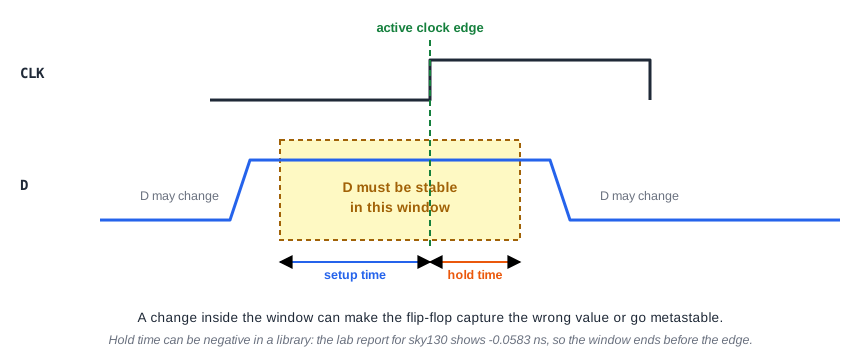
- The setup time is how long
Dmust be stable before the clock edge. - The hold time is how long
Dmust stay stable after the clock edge.
Both values come from the library. In our run, the sky130 flip-flop has a setup time of 0.1174 ns, and a hold time of -0.0583 ns. A negative hold time just means the window ends slightly before the clock edge.
A setup check verifies the front of the window for every path that ends at a flip-flop, and a hold check verifies the back of it.
The Setup Check
Data launched by one clock edge must arrive and settle before the next capture edge, minus the setup time. The setup check runs from the launch edge to the closest following capture edge, so the clock period is part of it.
The diagram shows the clock twice. The launch clock is what the first flip-flop r1 sees, and the capture clock is what the second flip-flop r2 sees. It is the same clock, but they play different roles: the launch clock starts the data on its way, and the capture clock decides when the data is taken in. For setup, the capture edge that counts is the next one, one period after the launch edge.
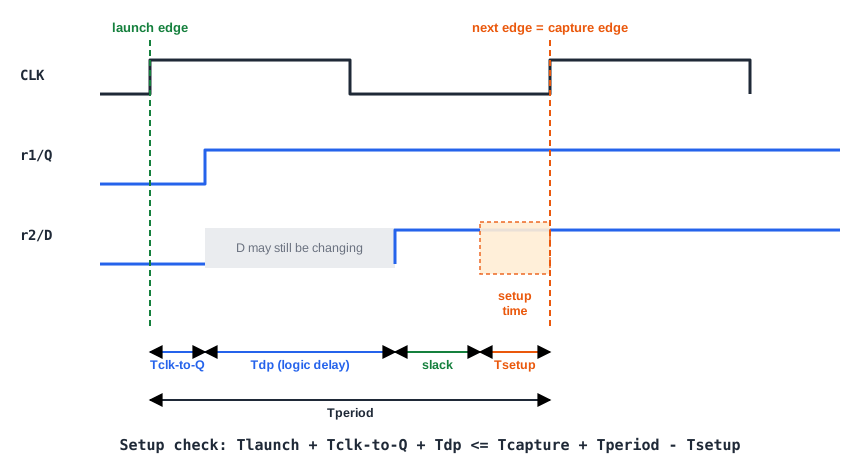
Tlaunch + Tclk-to-Q + Tdp <= Tcapture + Tperiod - Tsetup
Here Tlaunch and Tcapture are the clock arrival times at the two flip-flops, and Tdp is the delay of the logic between them. This is the check that limits the speed of the design, and it always uses the longest, or max, path. For our path from r1 to r2 with ideal clocks, the left side is 0 + 0.2874 + 0.1450 = 0.4323 ns. The right side is 0 + 2.0 - 0.1174 = 1.8826 ns, and the difference is the slack.
             0.0000    2.0000    2.0000   clock clk (rise edge)
                       0.0000    2.0000   clock network delay (ideal)
                       0.0000    2.0000   clock reconvergence pessimism
                                 2.0000 ^ _6_/CLK (sky130_fd_sc_hd__dfxtp_1)
                      -0.1174    1.8826   library setup time
                                 1.8826   data required time
                                -0.4323   data arrival time
                                 1.4502   slack (MET)
The Hold Check
The hold check guards against data racing through. When a clock edge launches new data from the first flip-flop, the second flip-flop is capturing its own data on that same edge. In the diagram, the launch clock and the capture clock show the same edge at time 0, so the capture flop is still taking in the old data at the moment the new data starts its journey. The new data must not reach it too soon, or it overwrites the data it is supposed to capture.
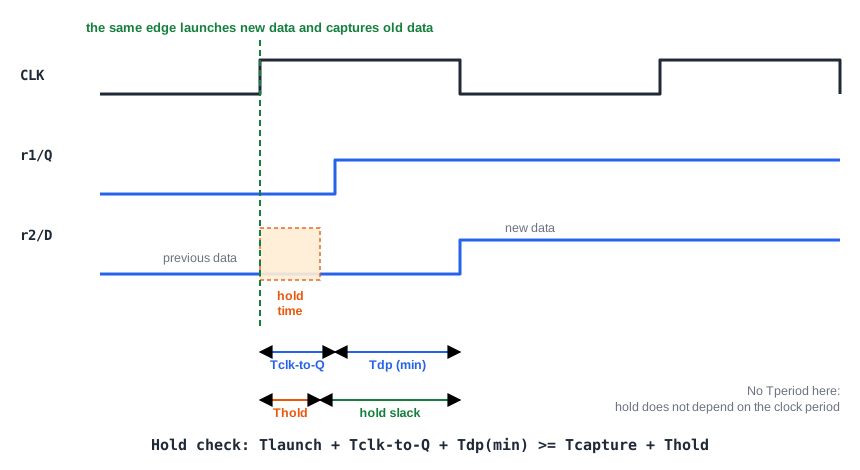
Tlaunch + Tclk-to-Q + Tdp >= Tcapture + Thold
The hold check uses the same clock edge at both ends and the shortest, or min, path. In our design the earliest data reaches r2 after 0.3058 + 0.0599 = 0.3657 ns, and the requirement is -0.0583 ns, so the hold slack is 0.4241 ns.
                                 0.3657   data arrival time
             0.0000    0.0000    0.0000   clock clk (rise edge)
                       0.0000    0.0000   clock network delay (ideal)
                       0.0000    0.0000   clock reconvergence pessimism
                                 0.0000 ^ _6_/CLK (sky130_fd_sc_hd__dfxtp_1)
                      -0.0583   -0.0583   library hold time
                                -0.0583   data required time
                                 0.4241   slack (MET)
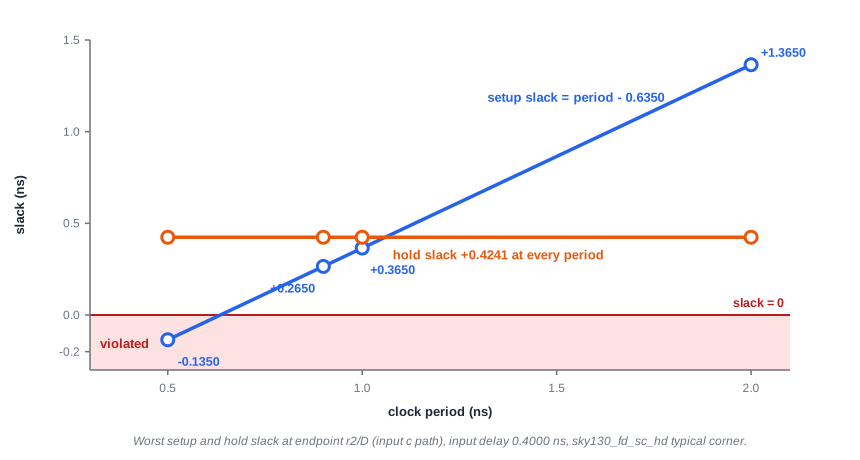
There is no clock period in the inequality. That is the key difference between the two checks.
Setup and Hold Side by Side
| Setup | Hold | |
|---|---|---|
| Data must be stable | Before the next capture edge | After the same capture edge |
| Path used | Longest (max) | Shortest (min) |
| Depends on the clock period | Yes | No |
| Corner that is usually worst | Slow | Fast |
| Consequence of a violation | The design must run slower | The design may not work at any frequency |
Slowing the clock cures setup violations, because it gives the data more time. It cannot cure a hold violation. The data race happens within one clock edge, whatever the period. The chart below shows the worst slack at the data pin of r2 as the period changes.
Margin and Corners
Real designs keep a safety margin on both checks. The constraint file (SDC) holds the margin as set_clock_uncertainty, which, with a single value, makes both the setup and the hold requirement harder by the same amount. Separate values for setup and hold can be given, and the hold value is usually smaller, because clock jitter does not matter for hold. A corner is a set of operating conditions, such as a hot chip with a low supply voltage, in which cells run slower or faster than usual. Corners work in opposite directions on the two checks. Cells are slowest at the slow corner and fastest at the fast corner, so setup is tightest at the slow corner and hold at the fast one. These are the worst setup and hold slacks of our design in the three sky130 corners, with a 2.0 ns period:
| Corner | Worst setup slack (ns) | Worst hold slack (ns) |
|---|---|---|
| Slow (100 C, 1.60 V) | 0.7856 | 0.5966 |
| Typical (25 C, 1.80 V) | 1.0326 | 0.4241 |
| Fast (-40 C, 1.95 V) | 1.0994 | 0.2681 |
Setup slack shrinks toward the slow corner, hold slack shrinks toward the fast one. Sign-off therefore checks setup at the slow corner and hold at the fast one. A later chapter covers corners in depth.
Common Mistakes
Mistake #1: Trying to fix a hold violation by lowering the clock frequency
The hold check has no period term. A hold violation stays the same at 10 ns and at 1 ns, and it is fixed only by slowing the data path, for example by adding delay, or by changing the clock arrival times.
Mistake #2: Checking setup at the fast corner and hold at the slow corner
It is the other way round. Setup needs the slowest delays and hold needs the fastest delays. Checking each one at the wrong corner gives results that look good and are wrong.
Quick Check: Why do the launch and capture edges of a hold check coincide?
The hold check protects the data that the capture flip-flop is capturing on an edge from the new data launched by that same edge. If the new data arrived before the hold time had passed, the old data would be overwritten, so both are the same clock edge.
Practice Exercise
Challenge: Create a Hold Violation From the SDC Alone
Use the sta_demo design with a 2.0 ns period. Add a clock uncertainty of 0.5 ns, which acts as margin on both checks, and re-run STA:
set_clock_uncertainty 0.5 [get_clocks clk]
Find the hold slack of the register r2 data pin. Then change the period to 10.0 ns and re-run. Predict what happens to the setup slack and to the hold slack.
Open the ready-made example in the lab, run synthesis, and then run STA. Editing constraints.sdc and re-running only STA, and choosing another library or corner, are PRO features.
Hint
Uncertainty is subtracted from the setup required time and added to the hold required time. Ask which of the two checks contains the clock period.
Solution
At 2.0 ns the worst hold slack is -0.0759 ns at the data pin of r2 (violated), and the worst setup slack is 0.5326 ns (met). Hold required time rises from -0.0583 to 0.4417 ns while the data still arrives at 0.3657 ns. At 10.0 ns the worst setup slack grows to 8.5326 ns, but the hold slack stays at -0.0759 ns. Only a faster clock path or a slower data path fixes it, not the period.
Summary
- A flip-flop needs its data stable for the setup time before and the hold time after the active clock edge.
- The setup check goes from a launch edge to the next capture edge on the longest path: Tlaunch + Tclk-to-Q + Tdp <= Tcapture + Tperiod - Tsetup.
- The hold check uses the same edge at both flip-flops and the shortest path: Tlaunch + Tclk-to-Q + Tdp >= Tcapture + Thold.
- Setup slack depends on the clock period, and hold slack does not.
- Clock uncertainty reduces both setup and hold slack.
- Setup is checked at the slow corner and hold at the fast corner.
