
A hold violation means the new data arrives too early. The main way to fix it is the opposite of a setup fix: make the data path slower. This article shows a real hold violation, the fix that tools use, the price of that fix, and the order in which a design flow handles hold.
8 min read | Intermediate
What You'll Learn
- Recognize which paths are likely to violate hold
- Explain how adding a delay cell fixes a hold violation
- Say what a hold fix costs in setup slack, area and power
- Explain why hold is fixed late in the design flow and why it cannot be fixed by the clock period
Where Hold Violations Appear
The hold check asks whether the new data is late enough. It fails when the data path is very fast, or when the capture clock is late. The paths most at risk are:
- A flip-flop that feeds another flip-flop directly, with no logic in between. The only delay is the clock-to-Q delay of the first flip-flop.
- Paths where the capture flip-flop receives its clock later than the launch flip-flop.
- Paths checked at the fast corner of the library, where all cells are at their quickest.
A Real Hold Violation
Take two flip-flops connected directly, a 2.0 ns clock, and a capture clock that arrives 0.4 ns later than the launch clock, as can happen in a real clock tree:
create_clock -name clk -period 2.0 [get_ports clk]
set_input_delay  0.4 -clock clk [get_ports d]
set_output_delay 0.4 -clock clk [get_ports q]
set_clock_latency 0.4 [get_pins r2/CLK]
The new data leaves the first flip-flop at the launch edge, and needs 0.2749 ns to reach the second one. The second flip-flop needs the old data until 0.4 - 0.0346 = 0.3654 ns. The data comes 0.0904 ns too early:
   0.0000    0.0000    0.0000 ^ r1/CLK (sky130_fd_sc_hd__dfxtp_1)
   0.0017    0.0329    0.2749    0.2749 ^ r1/Q (sky130_fd_sc_hd__dfxtp_1)
             0.0329    0.0000    0.2749 ^ r2/D (sky130_fd_sc_hd__dfxtp_1)
                                 0.2749   data arrival time

   0.0000    0.0000    0.0000   clock clk (rise edge)
             0.4000    0.4000   clock network delay (ideal)
             0.4000 ^ r2/CLK (sky130_fd_sc_hd__dfxtp_1)
  -0.0346    0.3654   library hold time
             0.3654   data required time
            -0.2749   data arrival time
            -0.0904   slack (VIOLATED)
The Fix: Delay the Data
The data must arrive at least 0.0904 ns later. The usual way is to put a delay cell, or a chain of buffers, into the data path. A delay cell is a cell that does nothing except take time. The sky130 library has a family of them. A cell called dlygate4sd3_1 adds 0.5205 ns in this path:
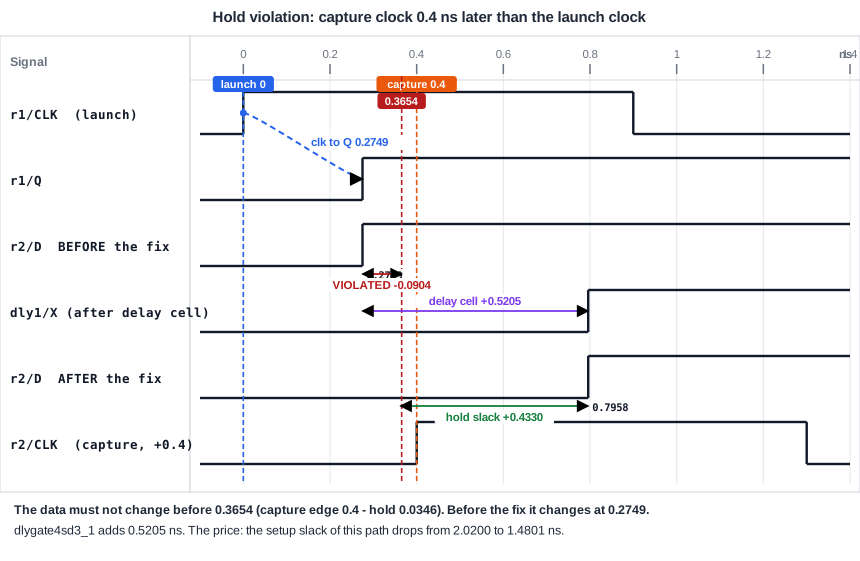
The diagram shows the two clocks, with the capture clock 0.4 ns later, and the data pin of the capture flip-flop before and after the fix. Before the fix, the new data arrives before the red line, which is the required time. After the fix, it arrives at 0.7958 ns, long after the line. The report now says:
   0.0017    0.0333    0.2753    0.2753 ^ r1/Q (sky130_fd_sc_hd__dfxtp_1)
   0.0017    0.0451    0.5205    0.7958 ^ dly1/X (sky130_fd_sc_hd__dlygate4sd3_1)
             0.0451    0.0000    0.7958 ^ r2/D (sky130_fd_sc_hd__dfxtp_1)
                                 0.7958   data arrival time
                                 0.3628   data required time
                                 0.4330   slack (MET)
The hold slack is now +0.4330 ns. That is more than needed, because this particular cell is large. A tool chooses the smallest delay that is enough, and it can use a smaller cell or a chain of small buffers.
What a Hold Fix Costs
The delay cell sits in the data path, so it also delays the data for the setup check. In the same design, the setup slack of this path falls from 2.0200 ns to 1.4801 ns. A hold fix is therefore only possible if the setup slack of the path can pay for it. If a path has a hold violation and almost no setup slack, the clock tree itself must be changed instead. A hold fix also adds cells, so it costs area and power. A design with thousands of short paths can need thousands of delay cells.
Other Ways to Fix Hold
- Change the clock arrival times. An earlier capture clock, or a later launch clock, gives more hold slack. This is the useful skew from the article about skew used in the other direction.
- Use a slower version of a cell on the data path. It fixes the path without adding a cell.
The clock period cannot help. The hold slack stays the same whether the clock runs at 10 ns or at 1 ns.
When Hold Is Fixed
Hold fixing is done late. The reason is that the skew between flip-flops only becomes known when the clock tree is built. Fixing hold before that would waste cells on violations that may not exist, or miss the ones that do. The flow is: first make setup pass, then build the clock tree, then fix hold on the real clock arrival times, and then check setup again. At sign-off, hold is checked at the fast corner of the library, because the fast corner has the shortest delays.
Common Mistakes
Mistake #1: Fixing hold at the wrong stage
With ideal clocks, the hold slack of a path between two flip-flops looks fine. The real violations appear after clock tree synthesis, and that is when they have to be fixed.
Mistake #2: Adding more delay than needed
Every delay cell reduces the setup slack of the path and uses area and power. Add enough to get a small positive hold slack, not as much as possible.
Quick Check: A path has a hold slack of -0.05 ns and a setup slack of 0.30 ns. Is it safe to add 0.15 ns of delay to the data path?
Yes, as a first estimate. The hold slack becomes -0.05 + 0.15 = +0.10 ns, and the setup slack becomes 0.30 - 0.15 = 0.15 ns. Both are positive.
Practice Exercise
Challenge: How Much Delay Is Needed?
Use the sta_demo design at a 2.0 ns period, and delay the clock of the capturing flip-flop (_6_ in our run) by 0.5 ns:
set_clock_latency 0.5 [get_pins _6_/CLK]
Run STA and note the hold slack and the setup slack of the path from _7_ to _6_. Then calculate how much extra delay on the data path would give a hold slack of +0.05 ns, and what the setup slack would be after that.
Open the ready-made example in the lab, run synthesis, and then run STA. Editing constraints.sdc and re-running only STA, and choosing another library or corner, are PRO features.
Hint
Extra delay on the data path raises the arrival time by the same amount for both checks. It adds to the hold slack and subtracts from the setup slack.
Solution
The hold slack is -0.0759 ns and the setup slack is 1.9502 ns. To reach +0.05 ns the data needs 0.05 + 0.0759 = 0.1259 ns more delay. The setup slack then becomes about 1.9502 - 0.1259 = 1.8243 ns. It is an estimate, because a real delay cell also changes the slew of the data. In the lab you cannot add a cell from the constraints alone, but the calculation tells you which cell to look for.
Summary
- A hold violation means the new data arrives too early. It is most likely on short paths and on paths whose capture clock is late.
- The usual fix is a delay cell or buffer chain in the data path, which raises the arrival time.
- The fix lowers the setup slack of the same path by the same amount, and it costs area and power.
- Changing the clock arrival time, or using a slower cell, also fixes hold.
- The clock period does not affect hold, so a slower clock never helps.
- Hold is fixed after clock tree synthesis, once the real skew is known, and it is checked at the fast corner at sign-off.
