
A flip-flop takes its data at one instant, the clock edge. A latch is different. While its enable is active it is transparent, which means that its output follows its input. Data that arrives late, after the latch has opened, still goes through. This changes how STA does the arithmetic: the arrival time at a latch does not have to be before the opening edge, and the time that the data takes beyond it is passed on to the next stage. This is called time borrowing. This article explains latches in STA, with the numbers of a real run.
9 min read | Intermediate
What You'll Learn
- Explain how a level-sensitive latch differs from an edge-triggered flip-flop
- Calculate the time borrowed by a latch and its maximum
- Read a latch report: time borrowed, time given to the startpoint
- Explain what happens when the data arrives after the latch has closed
A Latch Is Transparent
A positive level-sensitive latch is transparent while its enable is high. In this design the enable is the clock, so the latch is open from the rising edge at 0 to the falling edge at 1.0 ns, and closed from 1.0 ns to 2.0 ns. While it is open, its output follows its input. When it closes, the output keeps the last value:
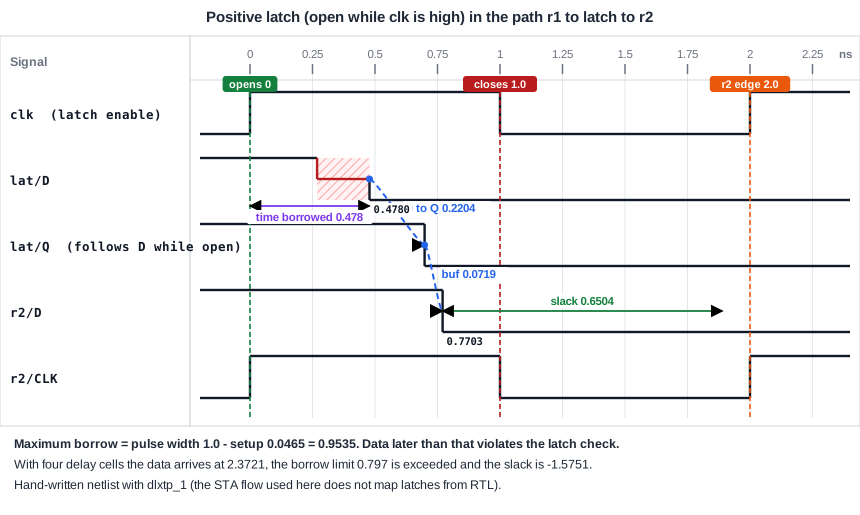
The example has a rising-edge flip-flop r1, a delay cell, a latch lat, a buffer, and a second flip-flop r2. The netlist is written by hand with library cells, because the STA flow behind these examples does not map latches from RTL. The latch cell of the library is dlxtp_1.
The Setup Check at a Latch
For a flip-flop, the data must arrive before the edge. For a latch, the data has a window. It can arrive up to the time when the latch closes, minus the setup time of the latch. The check is made against the closing edge. For the latch above:
- The latch opens at 0 and closes at 1.0 ns. The pulse width is 1.0 ns.
- The library setup time of the latch is 0.0465 ns.
- The maximum time that the data may arrive after the opening edge is 1.0 - 0.0465 = 0.9535 ns. This is the maximum time borrow.
Time Borrowing
If the data arrives before the latch opens, nothing is borrowed, and the next stage starts at the opening edge. If it arrives after the opening edge but before the closing limit, the data passes through, and the part after the opening edge is borrowed from the next stage. In the example, the data from r1 arrives at the latch at 0.4780 ns:
Startpoint: r1 (rising edge-triggered flip-flop clocked by clk)
Endpoint: lat (positive level-sensitive latch clocked by clk)

   0.0000    0.0000 ^ r1/CLK (sky130_fd_sc_hd__dfxtp_1)
   0.2682    0.2682 v r1/Q (sky130_fd_sc_hd__dfxtp_1)
   0.2098    0.4780 v dl1/X (sky130_fd_sc_hd__dlygate4sd1_1)
   0.0000    0.4780 v lat/D (sky130_fd_sc_hd__dlxtp_1)
             0.4780   data arrival time

   0.0000    0.0000 ^ lat/GATE (sky130_fd_sc_hd__dlxtp_1)
   0.4780    0.4780   time borrowed from endpoint
             0.4780   data required time
             0.0000   slack (MET)

Time Borrowing Information
clk pulse width                         1.0000
library setup time                     -0.0465
max time borrow                         0.9535
actual time borrow                      0.4780
The row time borrowed from endpoint adds the borrowed time to the opening edge, and the required time becomes equal to the arrival time. The slack of the path is zero, as long as the borrow is within the limit. This is not a problem. The borrowed time is not lost: it shows up in the next path.
Time Given to the Startpoint
The path that starts at the latch now has a late start. STA adds the time that was borrowed to the start of the next path. In the report of the path from the latch to r2, the row is named time given to startpoint:
Startpoint: lat (positive level-sensitive latch clocked by clk)
Endpoint: r2 (rising edge-triggered flip-flop clocked by clk)

   0.0000    0.0000   clock clk (rise edge)
   0.4528    0.4528   time given to startpoint
   0.0000    0.4528 ^ lat/D (sky130_fd_sc_hd__dlxtp_1)
   0.3113    0.7641 ^ lat/Q (sky130_fd_sc_hd__dlxtp_1)
   0.0688    0.8329 ^ b1/X (sky130_fd_sc_hd__buf_1)
   0.0000    0.8329 ^ r2/D (sky130_fd_sc_hd__dfxtp_1)
             0.8329   data arrival time

   2.0000    2.0000   clock clk (rise edge)
  -0.0576    1.9424   library setup time
             1.9424   data required time
             1.1095   slack (MET)
The next stage starts 0.4528 ns after the clock edge (the rising transition is a little faster than the falling one, so the number differs from 0.4780 ns) and then adds the delay of the latch, from D to Q, and the buffer. The slack of the second stage is 1.1095 ns. A path that crosses a latch is therefore split into two checks, and the time moves from the first to the second one.
When the Borrow Is Too Large
The data can arrive too late for the latch. Replace the single delay cell by a chain of four slower delay cells, and the data arrives at 2.3721 ns, long after the latch has closed at 1.0 ns. The borrowing limit of this latch for that transition is 0.797 ns, and the check fails:
   0.0000    0.0000 ^ lat/GATE (sky130_fd_sc_hd__dlxtp_1)
   0.7970    0.7970   time borrowed from endpoint
             0.7970   data required time
            -2.3721   data arrival time
            -1.5751   slack (VIOLATED)
The required time is the maximum borrow, and the violation is the difference. In this case there is no help from the next stage. When the borrow is too much, the path has to be made faster, as for a normal setup violation, for example with a shorter chain of cells.
Hold at a Latch
The hold check of a latch is made at the closing edge. New data must not reach the latch before it has closed on the old data. In the example, the hold check uses the falling edge at 1.0 ns, with a hold time of 0.0353 ns, so that the required time is 0.9647 ns, and the data launched at the next edge (2.0 ns) arrives at 2.4780 ns. The hold slack is 1.5133 ns.
Why Use Latches
Latches use less area than flip-flops, and time borrowing evens out the delay between stages: a stage that is a little too slow can borrow from the next one, which is a little too fast. For this reason, designs that use latches deliberately, such as some processors, can reach higher speeds. The price is a more complicated analysis, and the risk that an unintended latch appears. A latch in RTL that was not meant to be there, from an incomplete if, is a common coding error.
Common Mistakes
Mistake #1: Reading a slack of zero at a latch as a problem
A latch with borrowing shows a slack of zero in the first path. The borrowed time appears as a late start in the next path, so look there for the real margin.
Mistake #2: Forgetting that the borrow is limited
The data must arrive before the latch closes, minus the setup time. Data that is later than that violates the check, and no other stage can help.
Quick Check: A latch is open from 0 to 1.0 ns and has a setup time of 0.05 ns. What is the maximum time that the data may borrow?
1.0 - 0.05 = 0.95 ns after the opening edge.
Practice Exercise
Challenge: Check the Borrowing Budget
This is a pencil and paper exercise, because the STA flow behind these examples does not map latches. A latch is open from 0 to 1.0 ns, and its setup time is 0.0465 ns. The data arrives at the latch at 0.6 ns. The path after the latch has a delay of 0.4 ns from D to the next flip-flop, which captures at 2.0 ns with a setup time of 0.06 ns. Find the borrowed time and the slack of both checks.
Hint
The borrowed time is the arrival minus the opening edge, if it is within the limit. The next path starts at the arrival time.
Solution
The limit is 1.0 - 0.0465 = 0.9535 ns, and 0.6 ns is within it, so the borrow is 0.6 ns and the slack of the first path is 0. The second path starts at 0.6 ns, arrives at 0.6 + 0.4 = 1.0 ns, and is required at 2.0 - 0.06 = 1.94 ns, so its slack is 0.94 ns.
Summary
- A level-sensitive latch is transparent while its enable is active, so late data passes through.
- The setup check is against the closing edge. The maximum time borrow is the pulse width minus the setup time.
- Data that arrives after the opening edge borrows the difference from the next stage, and the first path shows a slack of zero.
- The next path starts late, by the borrowed time, which the report shows as
time given to startpoint. - Data that arrives after the borrow limit is a setup violation.
- The hold check of a latch is made at its closing edge.
