
Validation learns what can go wrong with a chip; production test must catch it on every part, in seconds, at low cost. Much of what post-silicon validation discovers ends up in the production test program: speed tests aimed at real speedpaths, minimum-voltage checks, trims, bins, and screens for the weaknesses validation found.
This article explains the stages of production test, what moves from validation into them, and how teams keep the two in step after release. Manufacturing test itself is a large subject with its own tutorial; here the focus is the hand-over.
6 min read | Intermediate
What You'll Learn
- Name the stages of production test
- List what validation hands over to production test
- Explain the trade-off between test time and coverage
- Describe how system-level failures feed back into the test program
Stages of Production Test
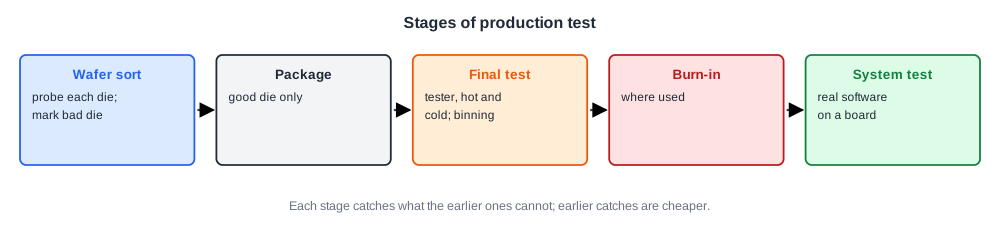
- Wafer sort: each die is probed on the wafer, and bad die are marked so they are not packaged.
- Final test: the packaged part runs structural, functional and parametric tests on a tester, often at hot and cold temperatures, and is binned.
- Burn-in: where used, as in Burn-In.
- System-level test: many products also boot real software on a board, catching problems the tester's patterns miss.
What Validation Hands Over
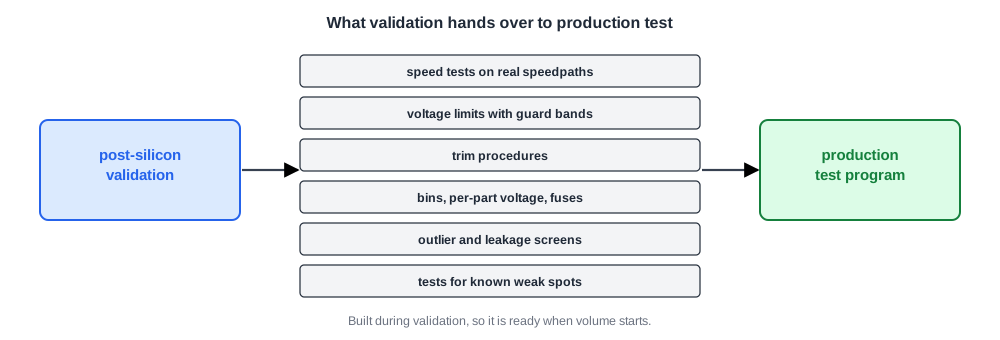
- Speed tests that exercise the real speedpaths found in Speedpaths, with frequency limits including guard bands.
- Voltage limits: minimum and maximum operating voltage checks.
- Trim procedures for references, oscillators and sensors.
- Bins and fuse settings: speed bins, per-part voltages, disabled features.
- Screens for weaknesses found during debug: a pattern that catches a marginal memory cell, a leakage outlier limit.
Quick Check
Q: Validation found that parts fail a system workload 3 % below the Fmax measured by the tester's speed pattern. What should change in production test?
Show Answer
Either the speed pattern must exercise the path the workload uses, or the speed test limit must include the 3 % difference in its guard band. Otherwise parts binned by the tester may fail in systems.
Test Time and Coverage
Every second on a tester costs money for every part. Validation can run a test for hours; production test may have a few seconds per part for everything.
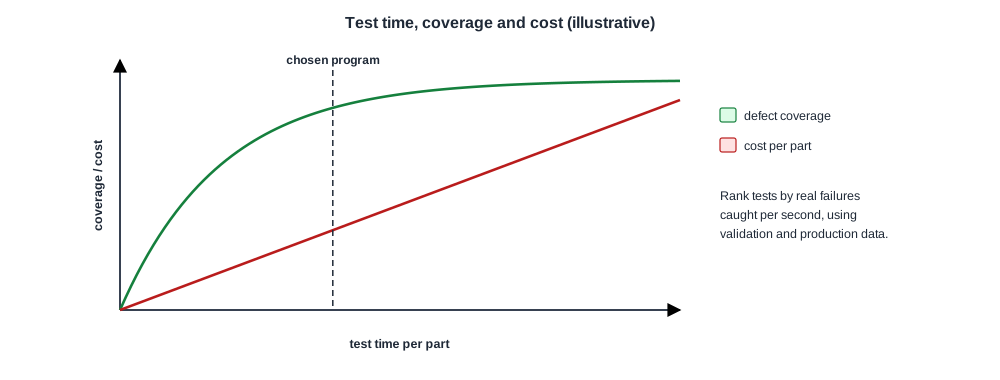
Teams therefore choose the tests that catch the most real failures per second, using validation and production data to rank them. Tests that never fail are candidates for removal; tests that catch field returns are added even if they are slow.
Quick Check
Q: A 2-second test has not failed a single part in a million. What could be done with it, and what is the risk?
Show Answer
It could be removed or run on samples only, saving 2 seconds per part. The risk is that it guards against a rare weakness that may appear later, for example after a process change, so its removal should be reviewed and sometimes reversed.
Keeping in Step
After release, failures in system-level test or in the field show where production test has gaps. Each one is analysed and, where possible, a test is added that catches it earlier, at final test or wafer sort. Correlation between the tester and real systems is checked continuously, since process drift or a new stepping can change which test catches what.
In Practice
Validation and product engineering teams work together from the first characterization data onward. The production test program is built during validation, not after it, so that it is ready when volume starts. Feedback after release is covered in Yield and Field Returns.
Common Mistakes
Mistake #1: Building the test program after validation ends
Start during characterization so it is ready for volume.
Mistake #2: Speed tests that miss the real speedpaths
Use what speedpath debug found, or guard band for the gap.
Mistake #3: Never revisiting the test list
Use failure data to drop useless tests and add ones that catch escapes.
Practice Exercise
Challenge: Cost of a Test
A product ships 20 million parts a year. Tester time costs 0.02 per second per part, in arbitrary currency units.
Validation proposes a 3-second test that would catch a defect affecting 50 parts per million, each field failure costing 500. Is the test worth it? The numbers are assumptions for the exercise.
Hint
Compare test cost with avoided field failure cost.
Solution
Test cost: 20 million x 3 x 0.02 = 1.2 million. Failures avoided: 20 million x 50 / 1,000,000 = 1,000 parts, costing 1,000 x 500 = 0.5 million. The test costs more than it saves, so teams would look for a faster test or a cheaper screen for the same defect, unless reputational cost changes the balance.
Summary
- Production test runs at wafer sort, final test, burn-in and system-level test.
- Validation hands over speed tests, voltage limits, trims, bins and targeted screens.
- Test time is costly, so tests are chosen for failures caught per second.
- System and field failures keep feeding new tests back into the program.
