
When a test fails on silicon, the first job is to decide what kind of problem it is: a logic bug in the design, an electrical weakness, a manufacturing defect in one part, or not a chip problem at all. Each kind needs different people, tools and fixes, so a wrong classification wastes days. This article shows how to classify failures quickly, using a few simple experiments on parts and conditions.
6 min read | Intermediate
What You'll Learn
- List the classes of silicon failure, including non-chip causes
- Use parts and conditions to separate the classes
- Apply a simple decision flow to a new failure
- Avoid common classification traps
The Classes
- Logic bug: the design does the wrong thing. Every part fails, at every condition.
- Electrical: the logic is right but some conditions of voltage, temperature or frequency make it fail.
- Defect: a manufacturing flaw in a particular part. Other parts pass.
- Not the chip: a test error, a board or setup problem, a software bug, or a known issue seen again.
Two Questions
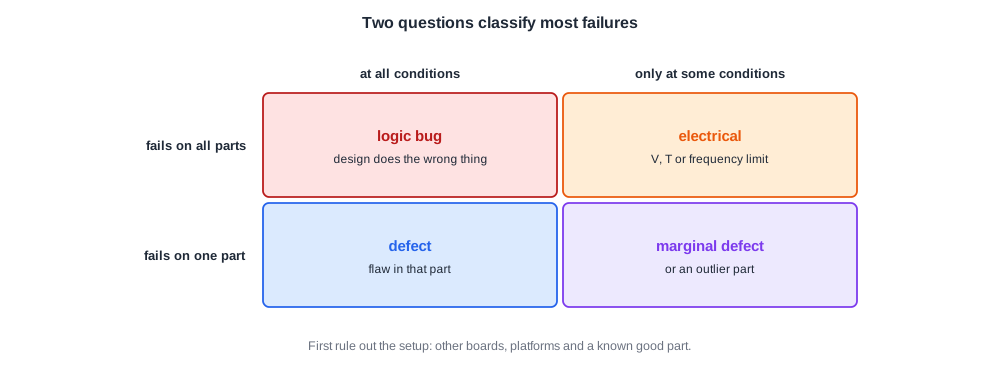
Two experiments separate most cases:
- Does it fail on other parts? Run the test on several parts, ideally from different wafers.
- Does it depend on conditions? Shmoo it across voltage, frequency and temperature.
Failing on every part at every condition points to logic. Failing on every part only at some conditions points to electrical. Failing on one part points to a defect in that part.
Quick Check
Q: A test fails on 1 of 12 parts, at every voltage and frequency. What is the most likely class, and what should not be done next?
Show Answer
A manufacturing defect in that part. Logic debug of the design should not start, since 11 parts run the same design correctly. The part may go to failure analysis, and production test coverage for that kind of defect may be reviewed.
Ruling Out the Setup
Before any of this, check that the failure is real. Run the test on another board and another platform.
Rerun with a known good part. Check that the test passes in simulation or on emulation, and that the software and firmware are the expected versions.
A surprising share of sightings end here. Board faults, loose sockets, wrong firmware and test bugs are common in early validation.
A Decision Flow
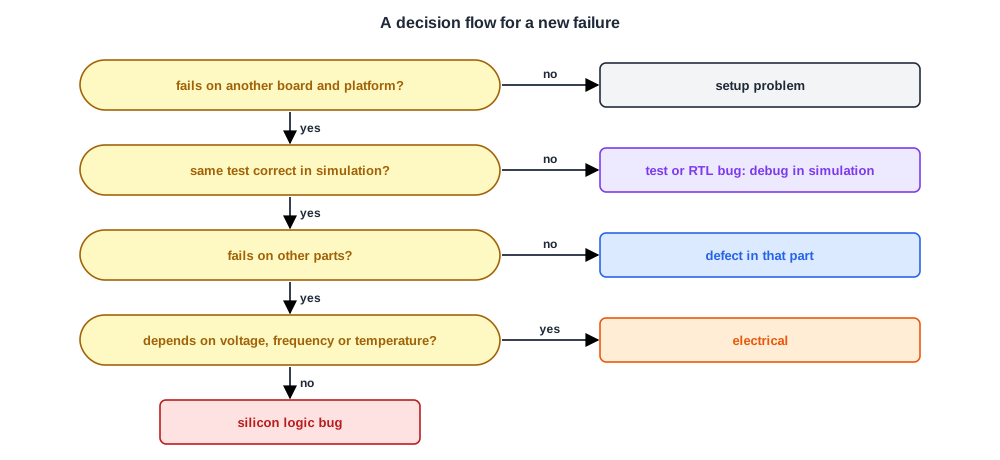
- Fails on another board and platform? If not, suspect the setup.
- Same test correct in simulation? If not, the test or the RTL itself is wrong, and pre-silicon tools take over.
- Fails on other parts? If not, suspect a defect.
- Depends on voltage, frequency or temperature? If yes, electrical; otherwise, a silicon logic bug.
The flow is a starting point. Some electrical failures happen at the nominal point on every part and look like logic bugs until a shmoo shows a boundary nearby.
Quick Check
Q: A test fails on every part at nominal conditions, and also fails in RTL simulation. Which class is it, and where should debug continue?
Show Answer
A logic bug, since the RTL itself shows it. Debug continues in simulation, which is much faster and more visible than silicon. Silicon is needed only to confirm the fix or workaround.
In Practice
Triage teams apply these checks daily to every new sighting, often within hours. The classification routes it: logic bugs to design teams, electrical issues to circuit and electrical validation teams, defects to the product and test engineers, and setup problems back to the lab. Defects in particular lead to Physical Failure Analysis when the cause is not obvious.
Common Mistakes
Mistake #1: Debugging a single failing part as a design bug
Check other parts first. One failing part usually means a defect.
Mistake #2: Skipping the setup check
Swap boards, platforms and parts before blaming the chip.
Mistake #3: Classifying from nominal conditions only
A nearby shmoo boundary turns an apparent logic bug into an electrical one.
Practice Exercise
Challenge: Classify Three Sightings
Sighting A fails on all 10 parts, only above 95 °C. Sighting B fails on one board with any part, and never on other boards.
Sighting C fails on all parts at all conditions, and the same test passes in RTL simulation. Classify each and name the next step.
Hint
Ask what changes when the failure appears.
Solution
A is electrical: all parts, condition dependent. Next, shmoo across temperature and frequency to find the mechanism.
B is a setup problem: it follows the board, not the part. Next, debug the board.
C is a silicon logic difference: every part fails but the RTL works, so the netlist or the silicon differs from the RTL. Next, compare silicon state with simulation, and check the netlist against the RTL.
Summary
- Failures are logic bugs, electrical problems, defects, or not chip problems.
- Testing other parts and sweeping conditions separates most classes.
- Rule out boards, platforms, software and test errors first.
- Classification routes each sighting to the right team and tools.
