
Every feature that helps validation see and control the inside of a chip can also help an attacker. JTAG, scan chains, trace and debug registers give deep access to internal state, memory and configuration, which is exactly what someone trying to steal keys or run unauthorized code wants. This article describes the security risks that debug features create, with the classic attack patterns, so that the protections in the next articles make sense.
6 min read | Intermediate
What You'll Learn
- Explain why debug access conflicts with security
- Distinguish integrity and confidentiality hazards
- Describe how a scan-based attack recovers a key
- Explain how hazards combine in a real attack
The Conflict
Validation needs observability and controllability: reading internal state, stopping the chip, changing registers, loading code. Security needs the opposite for anything sensitive: keys must not be readable, firmware must not be replaceable, and protected modes must not be entered by outsiders.
Debug features built for the first goal stay on the chip when it ships. Unless they are controlled, they undo the second.
Two Kinds of Hazard
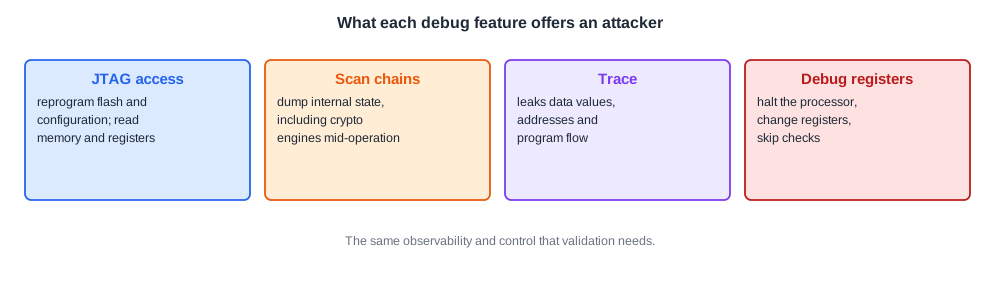
- Integrity hazards: debug interfaces can write configuration and firmware. An attacker can load modified firmware that skips authentication, or change security settings. Games consoles, set-top boxes and phones have all been unlocked through exposed JTAG in this way.
- Confidentiality hazards: debug instruments observe internal signals. Simply watching them, or steering the chip into a revealing state and then reading it out, can expose keys and other secrets.
Quick Check
Q: A device lets JTAG write its flash memory. Why can new firmware releases not fix a vulnerability in old firmware?
Show Answer
An attacker can use JTAG to write the old, vulnerable firmware back. As long as the debug path can reprogram flash without authentication, the device can always be returned to the insecure version.
Scan-Based Attacks
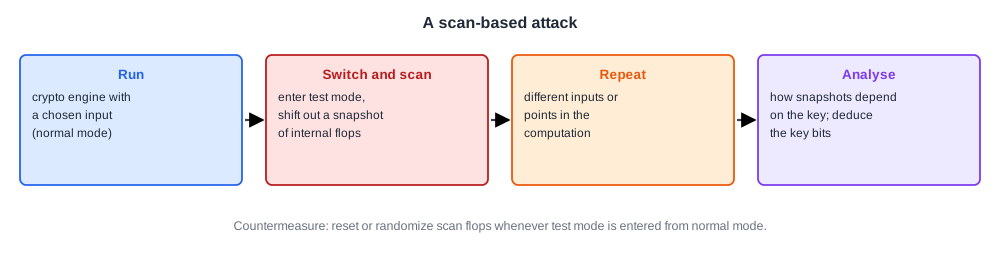
Scan chains connect nearly every flip-flop, for test and for state dumps. An attacker can run a cryptographic engine on a chosen input in normal mode, switch to test mode, and scan out the internal state partway through the computation.
Repeating this with chosen inputs reveals how the state depends on the key. Published attacks have recovered keys from several common ciphers this way, even with compressed or partial scan structures.
Quick Check
Q: A crypto engine never stores its key in a flip-flop that is on a scan chain. Is it safe from scan attacks?
Show Answer
Not necessarily. Intermediate results of the computation depend on the key, and those are in scan flops. Snapshots of them, taken with chosen inputs, can let an attacker deduce the key without ever reading it directly.
Hazards Combine
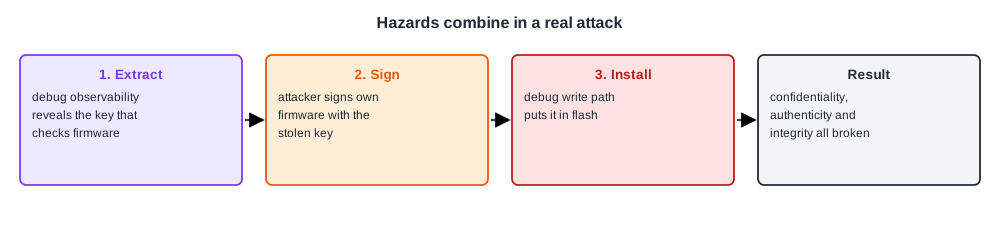
Real attacks often chain both kinds. An attacker might use debug observability to extract the key that checks firmware signatures, sign their own firmware with it, and then use the debug write path to install it. Debug instruments can also be misused from inside the chip, for example by malicious logic in a third-party block, without any external port at all.
In Practice
Security teams list every debug feature as an asset to protect and every debug path as an attack surface. They decide what each lifecycle stage may access, which leads to the controls in Locking Debug. Disabling everything is not the answer: field returns and in-field problems still need debug, as described in Yield and Field Returns.
Common Mistakes
Mistake #1: Leaving debug ports open in production parts
An open port gives attackers the same access validation had.
Mistake #2: Protecting the key register but not intermediate state
Scan snapshots of intermediate values can reveal the key.
Mistake #3: Considering only external ports
Internal blocks can misuse debug instruments too.
Practice Exercise
Challenge: Find the Hazards
A product ships with JTAG enabled, scan chains reachable through JTAG, a trace buffer that records memory addresses and data, and firmware stored in flash. List the hazards and classify each as integrity or confidentiality.
Hint
Ask what each feature lets an outsider write and what it lets them read.
Solution
JTAG write to flash: integrity, attackers can replace firmware. JTAG memory and register reads: confidentiality, secrets in memory are exposed.
Scan access: confidentiality, scan attacks on crypto engines, and integrity, since loading scan state can change the chip's state. Trace of addresses and data: confidentiality, secret data and access patterns leak.
Summary
- Debug features give the observability and control that attackers want.
- Integrity hazards let attackers change firmware and configuration; confidentiality hazards let them read secrets.
- Scan-based attacks deduce keys from snapshots of intermediate state.
- Attacks chain hazards, and internal blocks can misuse debug features too.
