
This checklist collects the key items of post-silicon validation in the order a program meets them, from preparation before tapeout to production release. It is a summary of this tutorial: each item links to the article that explains it. Use it to plan a program, to review readiness before a milestone, or to check that nothing important has been forgotten.
6 min read | Beginner
What You'll Learn
- List the readiness items needed before first silicon
- Check bring-up, functional and electrical validation coverage
- Review debug, fix, reliability and security items
- Know what must be complete before production release
The Phases
Before Tapeout
- Validation plan with features, owners, platforms and exit criteria: The Validation Plan.
- Debug features: scan dump, trace, triggers, monitors, clock stretching, chicken bits: Design for Debug.
- Spare cells for metal fixes: Metal Fix or Full Respin.
- Platforms, boards, sockets and test programs ordered: Validation Platforms.
- Skew lots planned with the fab: Skew Lots.
- Bring-up rehearsed on emulation: Bring-Up Rehearsal.
Bring-Up
- Power, clocks, reset and debug access confirmed: First Power-On.
- First code runs from reset: First Code.
- Bring-up checklist complete and blocking issues worked around: Bring-Up Checklist.
Quick Check
Q: Which pre-tapeout items cannot be added once silicon arrives?
Show Answer
Anything in the silicon itself: debug features, trace and triggers, monitors, chicken bits, scan dump support and spare cells. Plans, boards and software can still change after first silicon; hardware hooks cannot without a new stepping.
Functional and Electrical Validation
- Directed, random and exerciser tests running with self-checking: Tests on Silicon.
- Operating systems and real software stress: Running Real Software.
- Coverage measured and gaps closed: Coverage on Silicon.
- Interface compliance passed: Interfaces and Compliance.
- Shmoos, power, power integrity, I/O and analog characterized: Electrical Validation.
Characterization and Margins
- Corner parts measured, Fmax distribution known, bins set: Fmax and Binning.
- Guard bands built from measured terms: Margins and Guard Bands.
- Silicon correlated with pre-silicon models: Silicon Correlation.
Debug and Fixes
- Every sighting tracked, classified and root-caused: From Failure to Root Cause.
- Workarounds validated, errata published: Errata.
- New steppings validated: Validating a New Stepping.
Reliability, Security and Release
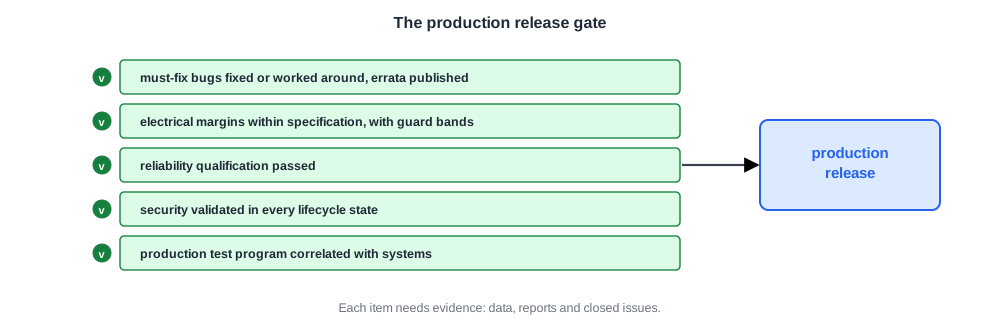
- Reliability qualification passed: Reliability Qualification.
- Aging covered by guard bands: Aging on Silicon.
- Debug locked and security validated in every lifecycle state: Security Validation on Silicon.
- Production test program handed over and correlated: From Validation to Production Test.
Quick Check
Q: Every functional test passes, but reliability qualification has two months left. Can the product be released to production?
Show Answer
Usually not for full production. Reliability qualification is part of the release gate. Some programs ship limited samples or early units to customers with agreement while qualification finishes, but volume release waits for it.
In Practice
Teams turn a list like this into a tracked readiness review, with an owner and status for each item, reviewed at each milestone. Items that slip are visible early, which is the main value of the checklist.
Common Mistakes
Mistake #1: Using the checklist only at the end
Most items need to start before tapeout. Review it from the planning stage.
Mistake #2: Treating items as boxes to tick
Each item needs evidence: data, reports and closed issues.
Mistake #3: Forgetting security and reliability until release
Both take months and often need silicon changes if found late.
Practice Exercise
Challenge: Readiness Review
Three weeks before planned release: one must-fix bug has a validated workaround but no erratum yet; guard bands use a 2 % aging estimate with no stress data; security tests passed in production state but not in return-analysis state. Which items block release, and what is needed for each?
Hint
Ask what evidence is missing for each.
Solution
The erratum is quick to write and must be published with the release. The aging estimate needs stress data or a conservative guard band agreed by reliability engineers; without either, release is at risk.
The return-analysis state must be tested, since an untested unlock path is a security hole. All three need closure; the last two may block release.
Summary
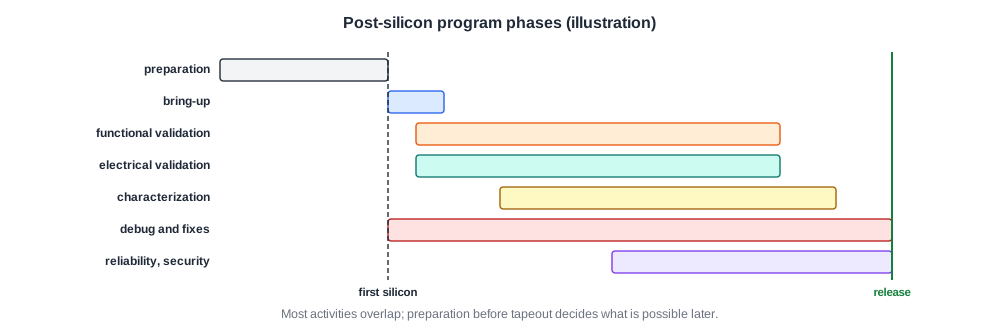
- Preparation before tapeout decides what is possible on silicon.
- Bring-up, functional and electrical validation run largely in parallel.
- Characterization, debug and fixes continue throughout.
- Release needs fixes, margins, reliability, security and a correlated test program.