
Most chips talk to the outside world through standard interfaces: PCI Express, USB, DDR memory, Ethernet, MIPI and others. Working correctly with the chip's own tests is not enough; each interface must follow its standard closely enough to work with any compliant device. This article describes the three levels at which interfaces are validated on silicon: compliance with the specification, interoperability with other vendors' devices, and compatibility with the software and peripherals of real products.
6 min read | Intermediate
What You'll Learn
- Distinguish compliance, interoperability and compatibility
- Describe the layers of interface compliance testing
- Explain why interoperability testing is needed even after compliance
- Estimate the size of a compatibility test matrix
Three Levels
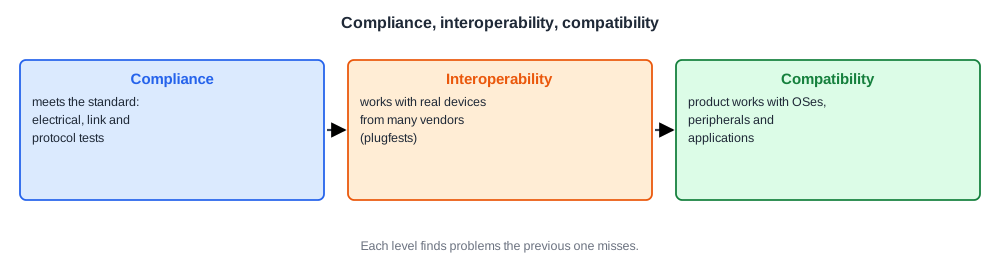
- Compliance: the interface meets its standard's requirements, checked with the test procedures and equipment the standard defines.
- Interoperability: it actually works with real devices from other vendors, which all interpret the standard slightly differently.
- Compatibility: the whole product works with the operating systems, peripherals and applications it will meet.
Compliance Testing
Standards organizations publish compliance requirements and test procedures for their interfaces, often with certified test equipment and logo programs. Compliance is usually tested in layers:
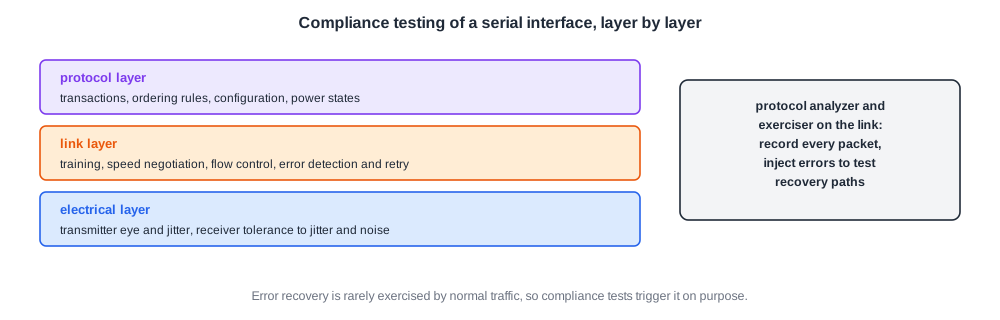
- Electrical: transmitter signal quality, receiver tolerance to jitter and noise, eye diagrams, covered in I/O Characterization.
- Link layer: link training, speed negotiation, flow control, error detection and retry.
- Protocol layer: transactions, ordering rules, configuration and power-state behaviour.
Protocol analyzers and exercisers sit on the link, record every packet, and can inject errors to check the recovery paths, which ordinary devices almost never trigger.
Quick Check
Q: Why do compliance tests inject errors on purpose, when a working link rarely sees them?
Show Answer
Error detection, retry and recovery paths are rarely exercised by normal traffic, so bugs in them survive ordinary testing. In the field, noise, marginal boards and hot-plug events do cause errors, and a broken recovery path then turns a correctable error into a failure.
Interoperability
Passing compliance tests does not guarantee that a chip works with every other device. Standards leave room for interpretation, devices have their own bugs, and timing and electrical behaviour differ.
So teams test against many real devices: hosts, cards, drives, memories and cables from different vendors. Industry events where vendors test their products against each other, often called plugfests, serve the same purpose.
Compatibility
At the product level, the chip must work with the software and peripherals of real systems. For a large system-on-chip, compatibility validation commonly covers over a dozen operating systems, more than a hundred peripherals and hundreds of applications.
The combinations grow quickly, which is the main challenge. Teams pick representative and high-risk combinations rather than all of them, and add combinations that customers report.

Quick Check
Q: A USB controller passes every compliance test but one popular keyboard fails to work. Is the chip at fault?
Show Answer
Possibly not in the strict sense: the keyboard may be the one bending the standard. In practice it does not matter much, because users blame the product. Teams analyse the traffic, decide which side is wrong, and often add a workaround so the chip works with the device anyway.
In Practice
Interface validation spans electrical, functional and software teams, so failures are handed between them often. A link that drops at high temperature may be electrical, a driver timing issue or a protocol bug. Recording the link's training results, error counters and retry counts with every failure helps decide quickly which team should own it.
Common Mistakes
Mistake #1: Treating compliance as the finish line
Compliance shows the standard is met. Interoperability and compatibility show the product works.
Mistake #2: Never exercising error recovery
Inject errors on purpose; recovery paths hide bugs.
Mistake #3: Testing only the vendor's own reference devices
Real devices interpret standards differently. Test against many vendors.
Practice Exercise
Challenge: Size the Matrix
A product must support 12 operating system versions, 150 peripherals and 40 key applications. How many combinations would a full matrix have?
If each combination takes 2 hours and 50 systems run in parallel around the clock, how long would it take? What does that suggest?
Hint
Multiply the three counts.
Solution
12 x 150 x 40 = 72,000 combinations, 144,000 hours of testing. With 50 systems that is 2,880 hours, about 120 days. A full matrix is impractical within a validation schedule, so teams test each item thoroughly with representative partners and choose high-risk combinations rather than all of them.
Summary
- Interfaces are validated for compliance, interoperability and compatibility.
- Compliance tests cover electrical, link and protocol layers, including injected errors.
- Interoperability testing against many vendors' devices finds problems compliance misses.
- Compatibility covers operating systems, peripherals and applications; the matrix is too large to test fully.
