
Locking debug means controlling who can use the chip's debug features, and when. Simply blowing a fuse to turn debug off forever is secure but leaves no way to analyse field failures. Modern chips instead tie debug access to lifecycle states and to authentication, so that trusted engineers can still debug when needed.
This article covers permanent fuses, lifecycle states, authenticated debug and protection of scan chains, and the trade-offs between them.
7 min read | Intermediate
What You'll Learn
- Explain the trade-off of permanently disabling debug
- Describe lifecycle states and how they restrict debug
- Compare password, signed-command and challenge-response unlocking
- Explain how scan chains are protected
Permanently Disabling Debug
The simplest lock is a fuse that disables the debug interface once manufacturing test and validation are done. Many microcontrollers offer this.
The cost is that debug is gone for good. Reopening it, for example by editing the fuse with a focused ion beam, is expensive, often fails, may destroy the package, and may not last. Field returns then cannot be analysed with the debug tools validation relied on.
Lifecycle States
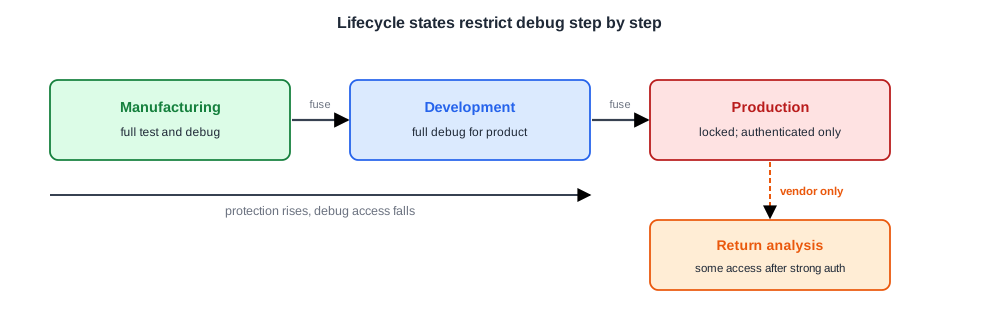
A chip moves through stages: manufacturing and test, product development, deployment in the field, and sometimes return for analysis. As it moves on, the need for protection outweighs the need for debug, so access is restricted step by step.
Each transition is usually made by blowing fuses, so it cannot be undone. A return-analysis state may lower protection temporarily, but only after strong authentication, and without changing the default protection for everyone else.
Quick Check
Q: Why are lifecycle transitions made with one-way fuses?
Show Answer
If a transition could be reversed, an attacker could move a production part back to a development state and regain full debug access. One-way fuses make the protection permanent for the default path.
Authenticated Debug
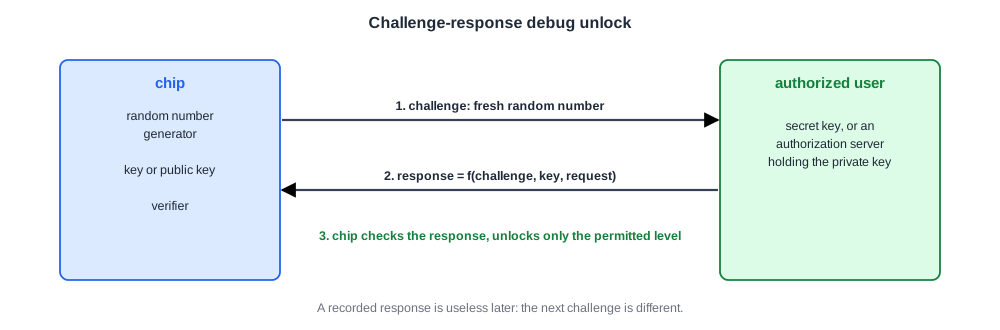
Authentication lets trusted users unlock debug on a locked part. The schemes grew stronger over time:
- Password: the user shifts in a key that the chip compares with a stored one. Anyone listening to the debug link learns the key.
- Signed commands: each command carries a signature computed from the command and a shared key. Eavesdropping no longer reveals the key, but a recorded command can be replayed.
- Challenge-response: the chip sends a fresh random challenge, and the user must return a response computed from that challenge and the key. A recorded response is useless next time.
Keys can be shared secrets or public-key pairs, where the chip holds only a public key and an authorization server holds the private one, so engineers never see it.
Levels and Keys
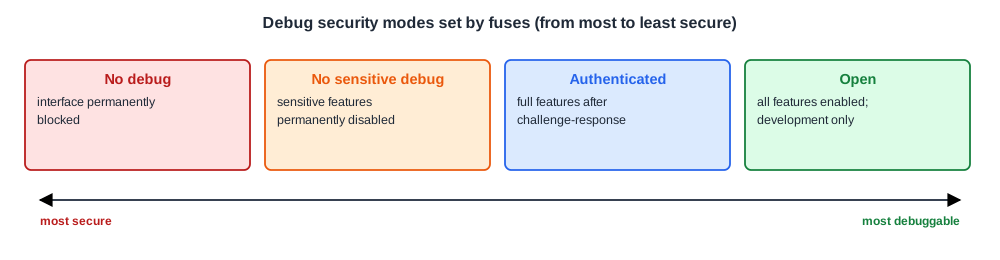
Access is often split into levels. Each debug command has a required level and each authenticated user receives a permission level; a command runs only if its level is within the user's permission.
Key management is the hard part. One key for a whole product family means one leak unlocks every device; a unique key per device means maintaining a database of keys for every part ever shipped.
Quick Check
Q: Why is challenge-response safer than signing each debug command with a shared key?
Show Answer
With signed commands, an attacker who records a valid command and its signature can send the same pair again. With challenge-response, every session uses a new random challenge, so an old response does not match and replay fails.
Protecting Scan
Scan chains need their own protection because they bypass much of the logic. A common countermeasure resets or randomizes all scan flops whenever the chip switches from normal mode to test mode, so state from a secret computation cannot be shifted out. The cost is debug capability: authorized users also lose the state they wanted to dump, so the reset is often skipped only after authentication.
In Practice
Security architects define, for each lifecycle state, which debug features are available and to whom, as part of the security requirements, not as an afterthought. Validation then checks every state on silicon, as described in Security Validation on Silicon.
Common Mistakes
Mistake #1: Plain passwords over the debug link
Anyone listening learns the key. Use challenge-response.
Mistake #2: One key for every device
A single leak unlocks the whole product family. Plan key management.
Mistake #3: Locking JTAG but not scan or trace
Every debug path needs a policy for each lifecycle state.
Practice Exercise
Challenge: Design a Policy
Define debug access for four states: manufacturing, development, production and return analysis. For each, say whether JTAG, scan dumps and trace are open, locked, or available after authentication.
Hint
Restrictions grow as the part moves toward the field.
Solution
Manufacturing: all open, for test. Development: JTAG and trace open, scan open with crypto keys absent or test keys only.
Production: JTAG locked except basic non-sensitive functions, scan reset on test entry, trace off; all available only after challenge-response. Return analysis: entered only with strong authentication by the vendor; scan and trace opened for that part, with production keys erased first.
Summary
- Permanently disabling debug is secure but blocks field failure analysis.
- Lifecycle states, changed by one-way fuses, restrict debug as a part moves toward the field.
- Challenge-response authentication resists eavesdropping and replay; key management is the hard part.
- Scan chains are protected by resetting state on entry to test mode.
