
Margin is the distance between what a part can actually do and what the specification promises. A guard band is a deliberate tightening of the production test limit, so that a part which passes the test in the factory still meets the specification years later, in a hot system with a noisy supply.
Setting guard bands is a trade: too little and bad parts escape to customers, too much and good parts are thrown away. This article explains what margins must cover, how guard bands are built, and how validation data sets them.
6 min read | Intermediate
What You'll Learn
- Distinguish margin, specification limit and test limit
- List the effects a guard band must cover
- Build a simple guard band budget
- Explain the trade between escapes and yield loss
Three Limits
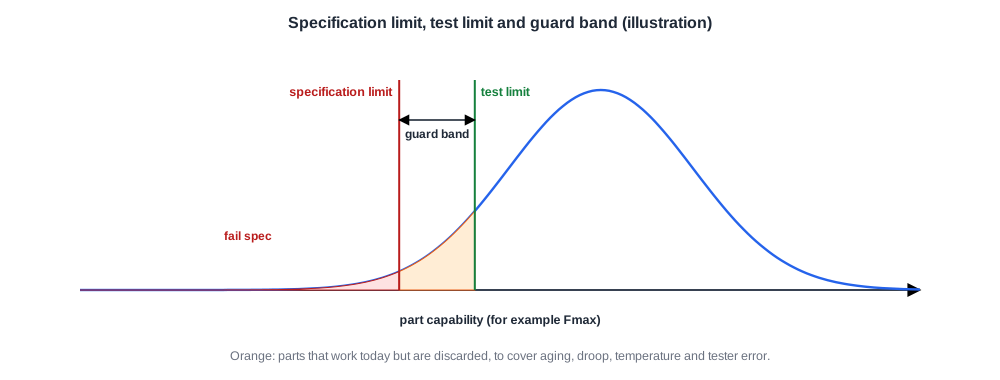
- The specification limit is what the customer is promised, for example 3.0 GHz at the minimum specified voltage and maximum temperature.
- The test limit is what production test actually checks, for example 3.15 GHz under test conditions.
- The guard band is the gap between them, here 5 %.
A part's margin is how far its real capability sits beyond the specification. Validation measures margin; production test enforces it through the guard band.
What a Guard Band Covers
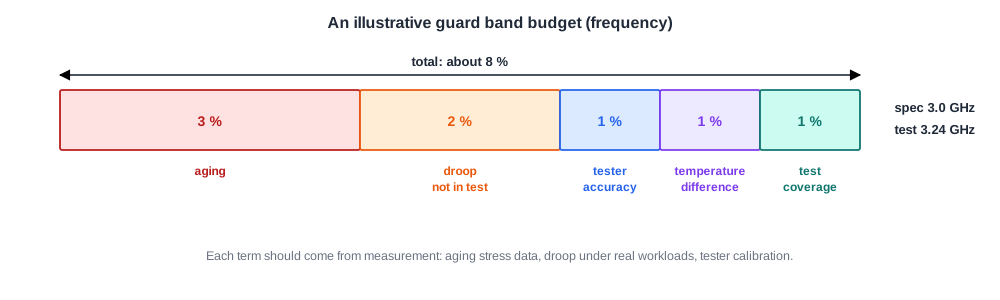
A part tested once in a factory must keep working in conditions the tester never reproduced. The guard band covers the differences:
- Aging: transistors slow over years of use, covered in Aging on Silicon.
- Tester accuracy: the tester's voltage, timing and temperature are only accurate to some tolerance.
- Temperature difference: the junction in a system may run hotter, or colder, than during the test.
- Supply droop: real workloads cause droops that a short test does not, as in Power Integrity on Silicon.
- Test coverage: the production test may not exercise the very slowest path.
Quick Check
Q: The specification is 2.5 GHz and the guard band budget adds up to 6 %. At what frequency should production test check the part?
Show Answer
2.5 x 1.06 = 2.65 GHz, under the test's voltage and temperature conditions. A part that passes there should still meet 2.5 GHz after aging, in a hot system, with real supply droop.
Escapes and Yield Loss

Too small a guard band lets through parts that will fail in the field, called escapes. Field failures are very costly: returns, replacements and customer trust.
Too large a guard band rejects parts that would have worked, lowering yield and moving parts into lower speed bins. Every percent of guard band on frequency can cost a measurable share of the top bin. Validation data narrows the guard band honestly: measured aging rates instead of worst-case guesses, measured droop under real workloads, and correlation between the production test and system-level tests.
Quick Check
Q: System tests show that parts lose 4 % of Fmax under real workloads compared with the production test, but the guard band assumes 2 %. What is the risk?
Show Answer
Escapes. Parts that pass the test with less than 2 % extra margin may fail in systems, because the test underestimates the loss by 2 %. The guard band must grow, or the test must be changed to include the effect.
In Practice
Guard bands are not only for frequency. Minimum voltage, leakage, I/O timing and analog values all have test limits tighter than the specification. Teams often start production with generous guard bands and reduce them as field data and long-term stress results build confidence, recovering yield over the life of the product.
Common Mistakes
Mistake #1: Testing exactly at the specification limit
Aging, temperature and droop then turn passing parts into field failures. Add a guard band.
Mistake #2: Stacking worst-case guesses for every effect
Over-large guard bands waste yield. Use measured data for each term.
Mistake #3: Ignoring the difference between test and system conditions
Correlate the production test with system-level testing before fixing the guard band.
Practice Exercise
Challenge: Cost of a Guard Band
Fmax is normal with a mean of 3.3 GHz and a standard deviation of 0.1 GHz. The specification is 3.1 GHz.
What fraction of parts fails with no guard band, and with a 3.2 GHz test limit? Assume about 2.3 % of a normal distribution lies more than 2 standard deviations below the mean and 16 % more than 1 standard deviation below.
Hint
Count standard deviations from 3.3 GHz.
Solution
At 3.1 GHz, two standard deviations below the mean, about 2.3 % fail. At 3.2 GHz, one standard deviation below, about 16 % fail. The guard band costs roughly 14 % of parts, which is why each term in the budget should be measured, not guessed.
Summary
- Margin is capability beyond the specification; the guard band is the test limit's extra tightness.
- Guard bands cover aging, tester accuracy, temperature differences, droop and test coverage.
- Too little guard band causes escapes; too much causes yield loss.
- Validation measurements replace worst-case guesses and let guard bands shrink safely.
