
Reliability qualification shows that a chip will keep working for its intended life, often ten years or more, in the conditions customers will use it. Nobody can test a part for ten years before selling it, so qualification stresses many parts at higher voltage and temperature for weeks, and uses the known acceleration of wear-out to predict the lifetime at normal conditions.
This article explains the language of reliability, the main stress tests, and how a small number of tested parts supports a claim about millions of shipped ones.
7 min read | Intermediate
What You'll Learn
- Define FIT, MTBF and the bathtub curve
- List the main stress tests in a qualification
- Explain how accelerated testing predicts lifetime
- Estimate what a zero-failure stress test can prove
The Language of Reliability
- FIT (failures in time) is the number of failures expected in a billion device-hours. 1,000 FIT means one failure per million hours, about 114 years, for a single part.
- MTBF (mean time between failures) is device-hours of operation divided by the number of failures.
Small FIT numbers grow fast at system level. A system with 100 chips of 1,000 FIT each has 100,000 FIT; ten such systems have 1,000,000 FIT, one failure about every 1,000 hours, or 42 days. That is why targets below 100 FIT per chip are common.
The Bathtub Curve
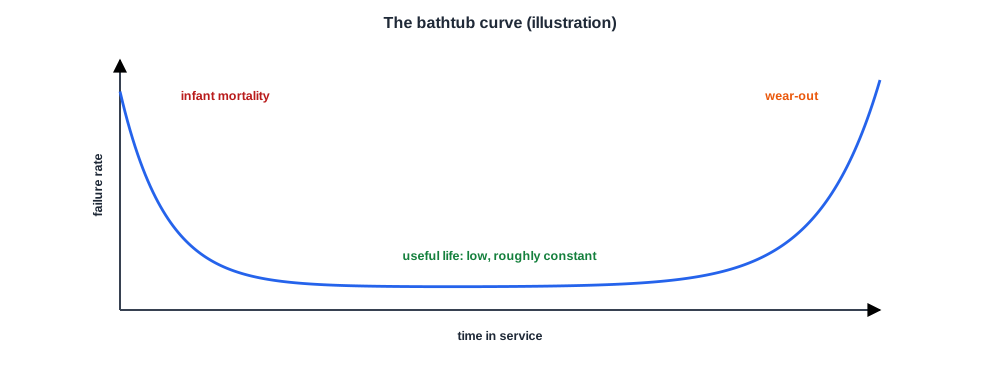
Failure rate over a product's life usually follows a bathtub shape:
- Infant mortality: weak parts with hidden defects fail early. Screening such as burn-in aims to remove them before shipping.
- Useful life: a low, roughly constant failure rate.
- Wear-out: failures rise as transistors and wires age, covered in Aging on Silicon.
Qualification checks both ends: that infant mortality is screened effectively, and that wear-out begins well after the intended lifetime.
Quick Check
Q: A chip is rated at 50 FIT. A data centre runs 200,000 of them. How many failures per year should it expect?
Show Answer
Total FIT = 50 x 200,000 = 107, that is 107 failures per 109 hours, or one per 100 hours. A year is about 8,760 hours, so about 88 failures a year.
Stress Tests
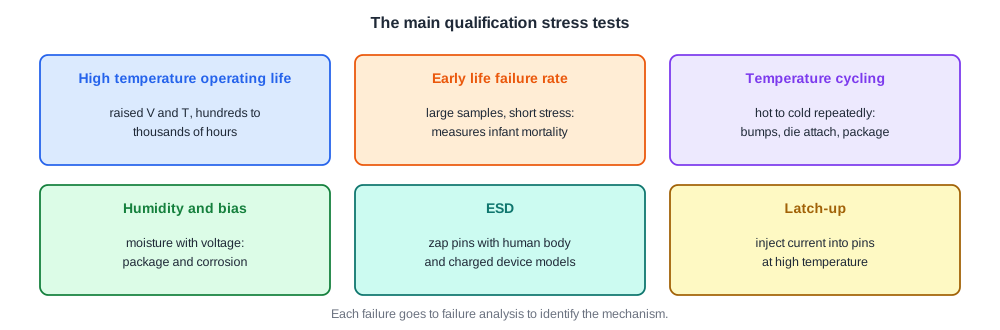
A typical qualification includes:
- High temperature operating life: parts run at raised voltage and temperature for hundreds or thousands of hours, then are tested again. This accelerates transistor and wire wear-out.
- Early life failure tests: large samples run for a shorter time to measure infant mortality.
- Temperature cycling and humidity: stress the package, the bumps and the die attach.
- ESD and latch-up: check the pins, as in ESD and Latch-Up Qualification.
Industry standards define common conditions and sample sizes, so that results from different suppliers can be compared.
Acceleration
Most wear-out mechanisms speed up roughly exponentially with temperature and voltage. A few weeks at high stress can therefore represent years of normal use.
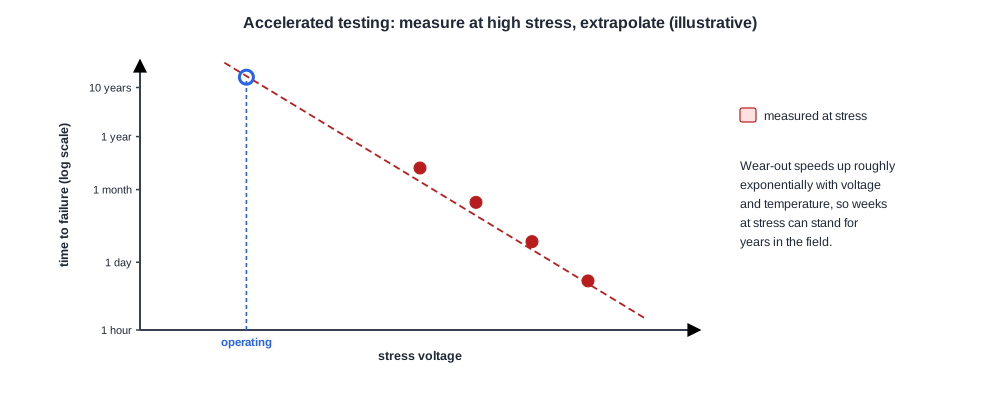
Teams measure time to failure at several stress levels and extrapolate to normal conditions. The acceleration factor, the ratio of lifetime at normal conditions to lifetime under stress, converts stress hours into equivalent field hours. A published example for gate oxides extrapolated a lifetime of more than ten years at 10 % above the nominal supply.
Quick Check
Q: A stress condition has an acceleration factor of 100. How many field hours does a 1,000-hour stress test represent?
Show Answer
100 x 1,000 = 100,000 hours, a little over 11 years. The extrapolation is only as good as the acceleration model, which must be measured for each mechanism.
What Zero Failures Proves
Qualification usually passes when no parts fail. With no failures in a total of D equivalent device-hours, the failure rate can be claimed to be below about 2.3 / D with 90 % confidence, or about 3 / D with 95 % confidence.
This links sample size, test time and acceleration to the FIT claim. More parts, longer tests or higher acceleration support a lower FIT.
In Practice
Qualification is planned early, because stress tests take weeks to months and come at the end of the program, when schedule pressure is highest. Burn-in boards, sockets and test programs must be ready when the first qualified parts arrive. Failures during qualification go to failure analysis to find the mechanism.
Common Mistakes
Mistake #1: Quoting chip FIT without the system view
Multiply by the number of chips and systems to see the real failure rate.
Mistake #2: Assuming one acceleration factor for all mechanisms
Each mechanism accelerates differently with voltage and temperature.
Mistake #3: Starting qualification late
Stress tests take months. Plan boards and parts early.
Practice Exercise
Challenge: What Can Be Claimed?
A test runs 231 parts for 1,000 hours at a stress with an acceleration factor of 50, with no failures. What failure rate in FIT can be claimed with 90 % confidence?
Hint
Equivalent device-hours D = parts x hours x acceleration; rate below 2.3 / D.
Solution
D = 231 x 1,000 x 50 = 1.155 x 10⁷ device-hours. 2.3 / D = 2.0 x 10⁻⁷ per hour, which is 200 FIT. Proving 20 FIT would need ten times the device-hours or the acceleration.
Summary
- FIT counts failures per billion device-hours; system rates multiply quickly.
- The bathtub curve has infant mortality, useful life and wear-out.
- Stress tests at high voltage and temperature accelerate wear-out to predict lifetime.
- Zero failures in D equivalent hours supports a rate below about 2.3 / D at 90 % confidence.
