
Academic verification projects have a clear sequence: the design is fully specified, you build the testbench, you run tests, you are done. Real chip projects do not work this way. RTL is delivered incrementally, specifications change after tests have been written, the tapeout date is fixed whether the coverage is closed or not, and five engineers are simultaneously modifying files that affect each other's work. Verification in an industry team is a continuous, parallel, deadline-driven activity — and understanding how to operate in that environment is as important as understanding UVM or SVA.
11 min read | Intermediate Level
What You'll Learn
- How tapeout schedules drive what gets verified, in what order, and to what depth
- How to work in parallel with a design team that is still writing and changing RTL
- How to manage RTL churn without breaking regression or losing coverage progress
- What the recurring team ceremonies are and what each one accomplishes
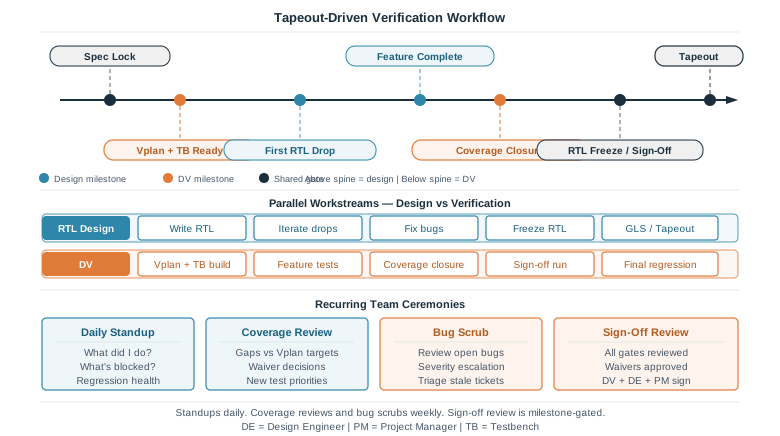
The Tapeout Schedule as the Master Constraint
In a chip design project, the tapeout date is typically set months or years in advance by product planning — driven by market windows, customer commitments, or manufacturing slot reservations at the foundry. That date does not move easily. Everything the verification team does is shaped by the distance between today and that date.
This has a direct consequence: not everything in the Vplan gets equal attention. A DV team three months from tapeout with 70% functional coverage does not have time to verify every feature to the same depth. Prioritisation is unavoidable. The question is whether it is done deliberately — by the DV lead in a coverage review, based on risk and impact — or by default, where the features that happen to be tested last receive the least coverage. Deliberate prioritisation produces better outcomes every time.
In practice, it is not uncommon for verification to be incomplete at the point the tapeout decision is made. When schedule pressure is severe enough, teams hold a formal risk mitigation review — sometimes called a risk sign-off or a go/no-go meeting — where the DV lead and design lead present every open coverage gap, unresolved bug, and untested scenario to the project lead and management. For each item, the team assesses: how likely is this gap to hide a silicon bug? What is the worst-case consequence if it does? Is a firmware workaround available? The outcome is a documented, conscious decision to tape out with known verification gaps rather than a missed gap discovered after the fact. This is not ideal, but it is a legitimate process — and it is far better than silently taping out with undocumented holes in the verification.
Verification Priority Framework
When schedule pressure forces prioritisation, the following framework guides which features get verified most thoroughly:
- Safety and correctness-critical paths first: Any feature whose failure causes data corruption, system hang, or security vulnerability takes absolute priority. These scenarios must close to full coverage regardless of schedule.
- High-traffic paths second: The most frequently exercised interfaces and datapaths in a real system — the primary read/write path, the main protocol interface — are verified deeply because bugs there affect every user of the chip.
- Error handling and recovery paths third: These are commonly underverified and a frequent source of post-silicon escapes. They deserve more attention than their apparent frequency of use suggests.
- Rarely-triggered configuration modes last: A mode that is set once at boot and never changed is low risk. Verify it, but not at the cost of the paths above.
Working in Parallel With the Design Team
On a real project, RTL and testbench development happen simultaneously. The design team does not hand over a completed design on day one — they deliver RTL in drops as features are completed, often over a period of weeks or months. The DV team must build and extend the testbench in parallel, testing features as soon as RTL exists for them.
Starting Before the RTL Exists
A DV team that waits for the first RTL drop before beginning testbench work will be weeks behind schedule before they start. The work that can and should begin immediately after spec lock includes:
- Writing the Vplan — feature extraction and test scenario definition do not require RTL
- Building the testbench infrastructure — the UVM environment skeleton, interface definitions, clock and reset generators, and scoreboard architecture can all be built against a behavioural model or a simple stub DUT
- Writing a reference model — the scoreboard's expected-output model is derived from the spec, not the RTL
- Writing directed sanity tests — tests that will immediately exercise basic functionality as soon as the first RTL drop arrives
A useful early milestone for a DV team is "day-zero readiness": the testbench compiles, applies reset, and produces a meaningful pass or fail verdict against a stub DUT before the first real RTL drop arrives. When the RTL drops, you run — you do not spend two weeks debugging compilation errors.
Incremental Feature Verification
As the design team delivers RTL drops — "drop 1 has the write path, drop 2 adds the read path, drop 3 adds error handling" — the DV team adds and activates tests incrementally. Constrained-random tests can be run with constraints that restrict stimulus to features whose RTL exists, gradually loosening as more RTL is delivered.
This incremental approach means bugs are found close to when the RTL was written. A bug found in drop 1 is fixed before drop 2 is built on top of it — which is far better than finding it in drop 4 when multiple features have since been layered over the same code.
Handling RTL Churn
RTL churn is the reality that the design changes frequently — sometimes daily — during active development. Each change carries risk: a fix for one bug may introduce another, a performance optimisation may alter a timing path, a feature addition may change interface behaviour. The DV team's response to churn is regression.
What RTL Churn Looks Like in Practice
In an active project phase, the design team may commit several RTL changes per day. Not every change requires a full regression — a localised fix to a single pipeline stage does not need the full chip-level regression suite. But some form of regression should run against every significant RTL commit, with the scope matched to the scope of the change:
- Targeted regression: For a change limited to one sub-block, run only that block's test suite. Fast turnaround — results within an hour — lets the design engineer confirm the fix quickly.
- Block regression: For broader changes, run the full block-level regression. This typically runs overnight in a CI (continuous integration) system and produces a morning report.
- Full regression: Run before sign-off milestones and after any change that touches interfaces between blocks. This is the full suite and may run for hours.
A common failure mode in fast-moving projects is regression debt: the team is making changes faster than regression results are being reviewed, so regressions accumulate unreported. When someone finally checks, there are dozens of failures, some of which are weeks old and now have multiple subsequent changes stacked on top. Triage becomes extremely difficult. Assign a rotation for daily regression review — someone must own it every morning.
Protecting Coverage During Churn
RTL changes can invalidate coverage. A feature that was 95% covered may drop to 40% if the RTL change altered the conditions under which a scenario is reachable. Coverage trends — not just the absolute number on today's report — must be monitored. A sudden drop in coverage on a block that had been stable is a signal that either the RTL changed significantly or the testbench has broken scenarios that were previously passing.
Quick Check
Q: Overnight regression shows three new failures on the AXI write path after the design engineer committed a performance fix to the write buffer. The DV engineer runs the three failing tests manually and confirms they reproduce. What is the correct sequence of actions?
Show Answer
1. Confirm the failures are reproducible and not infrastructure noise (re-run once to be sure).
2. Check whether the failures existed before the write buffer commit by running against the previous RTL commit — this confirms the commit is the cause.
3. Notify the design engineer immediately with the test names, simulation commands, and seeds. Do not wait for a meeting — the sooner the engineer knows, the sooner they can investigate.
4. File a bug report in the tracker with the commit hash, test names, and reproducer steps.
5. Do not merge or stack any further RTL changes on the write buffer until the regressions are resolved.
Communication in a Verification Team
Verification work is highly interdependent. A testbench change by one engineer can break another engineer's test. An RTL change by the design team can invalidate the testbench's reset model. A coverage gap found in a review needs to be prioritised and assigned. All of this coordination happens through a set of recurring ceremonies that structure communication within the team.
Daily Standup
The standup is a brief daily check-in — typically 15 minutes — where each team member answers three questions: what did I complete yesterday, what am I working on today, and is anything blocking me? The standup is not a status report to a manager — it is a coordination mechanism that surfaces blockers early and lets the team self-organise around them.
For a DV team, standups also serve as an early warning system for regression health. "Yesterday's regression had 12 new failures, I am triaging now" is the kind of signal that lets the DV lead decide whether to pause RTL integration until the failures are understood.
Coverage Review
A weekly or bi-weekly review of the coverage dashboard is one of the most valuable meetings on a verification project. The DV lead reviews coverage trends against the Vplan targets, identifies which uncovered bins are the highest priority, and assigns test development work to close gaps. The design engineer attends to clarify which coverage misses are genuinely unreachable — saving the DV team from writing tests for scenarios the design cannot enter.
Coverage reviews become more frequent as the tapeout milestone approaches. In the final weeks before sign-off, daily coverage reviews are common — the team is in active closure mode, closing bins and filing waivers as fast as they can be reviewed and approved.
Bug Scrub
A bug scrub is a periodic review of the open bug tracker — typically weekly during active development. The DV lead and design lead review every open ticket: is the severity still correct? Is the assignee making progress? Are any S1/S2 bugs approaching the sign-off milestone without a fix? Scrubs prevent tickets from going stale and ensure that priority decisions made during triage are still accurate as the project evolves.
Bug scrubs are particularly important for catching severity misclassification under schedule pressure. A bug that was filed as S3 early in the project may become effectively S2 as the tapeout date approaches and the workaround turns out not to be viable in the final product configuration. Scrubs are the mechanism that catches this before it becomes a sign-off surprise.
Sign-Off Review
The sign-off review is a formal milestone meeting — not a weekly ceremony but a gate that occurs at defined project milestones (block sign-off, integration sign-off, final tapeout sign-off). The DV lead presents the coverage numbers, waiver list, open bug status, and final regression results. The design lead reviews the open bugs and waivers. The project manager records the decision. All three sign before the RTL commit is cleared for the next phase.
Tools Used in a DV Team
Industry DV teams rely on a common set of tools that integrate into the workflow described above. A new DV engineer will encounter these within the first weeks on the job.
Bug Tracking — Jira
Jira is the most widely used bug and task tracker in the semiconductor industry. Every bug filed by the DV team becomes a Jira ticket with a severity, priority, assignee, and status. Jira's workflow states (Open, In Progress, In Review, Done) are customised per team to match the bug lifecycle. Sprint boards in Jira provide a visual overview of what the team is working on in the current period, and the backlog shows upcoming work.
Version Control — Git
Both RTL source and testbench source are versioned in Git. This is non-negotiable: without version control, it is impossible to know which version of the RTL a regression was run against, reproduce a bug that appeared three commits ago, or safely develop testbench changes in parallel with RTL changes. Most teams use a branching model where feature development happens on branches and changes are merged into a main integration branch only after passing a baseline regression check.
When filing a bug, always record the Git commit hash of the RTL alongside the simulation command and seed. This allows the design engineer to reproduce the exact state of the design when the bug was observed, even if several commits have since been merged.
Coverage Dashboards
Coverage data from simulation runs is aggregated into a dashboard — either a tool built into the EDA simulator suite (Cadence vManager, Synopsys Verdi Coverage) or a team-maintained internal tool. The dashboard shows coverage trends over time, per-block and per-feature breakdowns, and highlights the largest uncovered bins. Coverage dashboards are the primary input to coverage review meetings and are typically linked directly from the project's status reports to the project manager.
Continuous Integration
Most modern DV teams run a CI (Continuous Integration) system — tools like Jenkins, GitLab CI, or internal farm management software — that automatically launches a regression against every RTL commit merged to the main branch. CI results are posted to the team's communication channel (Slack or email) within hours of a commit. This keeps regression health visible without requiring an engineer to manually kick off runs after every change.
Quick Check
Q: A DV engineer has been working on a new constrained-random test for two days. They are ready to commit it to the shared testbench repository. Before committing, what steps should they take to avoid breaking the rest of the team's regression?
Show Answer
1. Pull the latest changes from the main branch and merge them into the working branch — ensure the new test is built on top of the current state of the testbench, not a two-day-old snapshot.
2. Run the full block-level regression locally (or on the compute farm) with the new test included — confirm it passes and does not introduce new failures in existing tests.
3. Check that the new test compiles cleanly with no warnings that could indicate a testbench issue.
4. Commit with a clear message describing what the test covers and which Vplan feature it addresses.
5. After merge, monitor the next CI regression run to confirm the integration did not introduce failures from any interaction with other recent changes.
Common Mistakes
Mistake 1: Starting testbench development only after the first RTL drop arrives.
Wrong: Treating spec lock and RTL arrival as the same event, and doing nothing until there is RTL to simulate against.
Right: Begin Vplan writing, testbench infrastructure, and reference model development at spec lock. The testbench should be ready to run the moment the first RTL drop arrives.
Why? A DV team that waits for RTL burns the time when they have the most freedom — no churn, no regressions to triage, no competing demands. That time is exactly when foundational decisions about testbench architecture should be made, not under pressure two weeks before sign-off.
Mistake 2: Not assigning a daily regression owner.
Wrong: Assuming everyone will check the regression results when they have time, with no explicit ownership.
Right: Assign a named owner for daily regression health — on smaller teams this may rotate, but on larger teams it is typically the DV lead or a senior engineer who monitors the overnight results, triages new failures, and ensures the design team is notified of real RTL bugs before end of day.
Why? Without explicit ownership, regression failures accumulate silently. By the time someone investigates, the failing scenario may have been obscured by subsequent RTL changes, making root cause analysis far harder and triage far more expensive.
Mistake 3: Treating coverage closure as a final-week activity.
Wrong: Running regression throughout the project and only opening the coverage dashboard in the last few weeks before sign-off.
Right: Review coverage weekly from the first RTL drop. Coverage gaps identified early can be closed with targeted tests during normal development. Gaps discovered two weeks before tapeout may not have time to be properly closed and analysed.
Why? Coverage closure is not an instantaneous activity — it is an iterative process of identifying gaps, writing tests, running regression, and re-checking. Starting late compresses this iteration cycle to a point where the team is forced to choose between waiving legitimate coverage misses or slipping the tapeout date.
Practice Exercise
Challenge: Plan the First Two Weeks
You have just joined a project as the DV engineer for a new DMA controller block. The spec was locked yesterday. The first RTL drop is expected in two weeks. The tapeout date is four months away.
Write a prioritised task list for your first two weeks, explaining what you will work on each week and why the ordering matters.
Hint
Think about what can be done without RTL, what needs to be ready the moment RTL arrives, and what decisions made now will be hardest to undo later.
Sample Answer
Week 1 — Specification and Architecture:
- Read the DMA controller spec in full. Annotate every ambiguity, unclear timing spec, and undefined error scenario. Log them all.
- Schedule a meeting with the design engineer to resolve the highest-priority ambiguities before RTL is written — fixing a spec misunderstanding now costs nothing; fixing it after RTL is written costs a bug report and an RTL change.
- Write the Vplan: extract verifiable features, define test scenarios, set initial coverage targets. The Vplan is the deliverable for week 1.
- Decide the testbench architecture: how many agents, what protocols are on the interfaces, whether to use an existing VIP or build an agent.
Week 2 — Testbench Infrastructure:
- Build the UVM environment skeleton: agent stubs, environment class, test base class. Confirm it compiles against a stub DUT.
- Write the reference model — a behavioural model of the DMA transfer logic based on the spec. This is the scoreboard's expected-output engine and must be spec-derived, not RTL-derived.
- Write five to ten directed sanity tests covering basic DMA read and write transfers. These run the moment the first RTL drop arrives.
- Set up the regression infrastructure: simulation scripts, coverage collection, seed management. On day one of RTL, a single command should compile, simulate, and report coverage.
Why the ordering matters:
Spec ambiguities resolved in week 1 mean the testbench architecture in week 2 is built on solid ground. A reference model written from the spec before seeing the RTL is an independent correctness check. Sanity tests ready before RTL arrives mean the first regression run happens within hours of the drop, not weeks.
Summary
In this article, you learned:
- Tapeout dates are fixed constraints — verification must be prioritised deliberately by risk and feature impact, not left to happen by default
- DV and RTL development run in parallel; testbench infrastructure, the Vplan, and the reference model should all be ready before the first RTL drop arrives
- RTL churn is managed through tiered regression — targeted, block-level, and full — with a daily owner who ensures failures are triaged before they accumulate
- Four recurring ceremonies structure team coordination: daily standup for blockers, weekly coverage review for gap prioritisation, bug scrub for tracker hygiene, and sign-off review for milestone gates
- Jira, Git, coverage dashboards, and CI systems are the standard toolchain — knowing how they fit together makes onboarding onto any industry DV team significantly faster
