
Simulation can run millions of test cases and still leave a gap: there is always one more seed, one more input combination, one more scenario that was never tried. Formal verification takes a different approach entirely — instead of running tests, it uses mathematical reasoning to prove that a property holds across every possible input, in every reachable state, for all time. Understanding what formal can and cannot do is essential for deciding when it belongs in your verification plan.
12 min read | Intermediate Level
What You'll Learn
- How formal verification works and what distinguishes it from simulation
- The difference between bounded model checking and full formal proof
- What formal can verify that simulation structurally cannot
- The state space explosion problem and the practical limits of formal
- The design scenarios where formal is the right tool to reach for
How Formal Verification Works
A simulator executes the design with specific inputs and observes specific outputs. A formal tool does something fundamentally different: it constructs a mathematical model of the design — representing every flip-flop as a variable and every gate as a logical relationship — and then uses automated reasoning algorithms to determine whether a given property can ever be violated, across all possible input sequences.
The inputs to a formal tool are:
- The RTL design — the same Verilog or SystemVerilog used for simulation
- Properties — written in SVA (SystemVerilog Assertions), describing what the design must always do or never do
- Assumptions — constraints on the input space, telling the tool which input sequences are legal
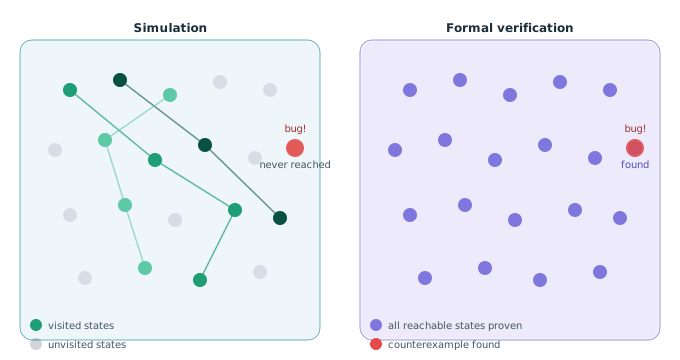
The tool then exhaustively searches the design's reachable state space. If the property holds in every reachable state, the tool reports a proof. If it finds any state where the property is violated, it produces a counterexample — a specific sequence of inputs that leads to the violation, which can be loaded directly into a waveform viewer for debug.
The counterexample produced by a formal tool is minimal — it represents the shortest possible input sequence that triggers the violation. This makes formal bugs significantly easier to debug than simulation failures, which may involve thousands of cycles of context before the symptom appears.
Formal vs Simulation: The Key Difference
Consider verifying that a 4-way arbiter never grants two requesters simultaneously. A simulation testbench might run 100,000 random request patterns and never observe a double-grant — but this only proves the bug did not appear in those 100,000 cases. A formal tool proves the property holds for every possible combination of request signals, in every state the arbiter can reach, without any exceptions. If the property holds, no counterexample exists anywhere.
Bounded Model Checking vs Full Formal Proof
Formal verification runs in two distinct modes, and understanding the difference is important for interpreting formal results correctly.
Bounded Model Checking (BMC)
Bounded model checking proves a property holds for all possible inputs up to a specified number of clock cycles — the bound. If the bound is set to 20, the tool proves that no sequence of up to 20 clock cycles can violate the property, regardless of what inputs are applied.
BMC is fast and highly practical. Most protocol bugs, handshake violations, and control logic errors manifest within a small number of cycles — typically fewer than 20–50. A BMC proof up to a reasonable bound gives very high confidence that the property is correct, and finding the bound at which the tool proves the property is a useful way to characterize how deeply the design needs to be checked.
A BMC result that says "no violation found within N cycles" is not a full proof. If a bug requires N+1 cycles of setup to trigger, BMC will miss it. Always check that the bound is large enough to cover the longest relevant scenario in the design before treating a BMC result as a sign-off quality proof.
Full Formal Proof
A full formal proof — sometimes called an unbounded proof or convergent proof — demonstrates that the property holds for all possible inputs across all reachable states, with no bound on time. This is the strongest possible verification result: a mathematical guarantee that no counterexample exists anywhere, ever.
Full formal proof is achieved when the tool can construct an inductive invariant — a set of states from which the property provably cannot be violated — and show that the design can never leave this set. For simple properties on focused blocks (an arbiter's mutual exclusion, a FIFO's count never exceeding its depth), full proofs are routinely achievable. For complex, deeply sequential designs, the proof may not converge within practical time or memory limits.
Quick Check
Q: A formal tool reports "proof complete" for an arbiter's mutual exclusion property. What exactly has been proven?
Show Answer
The tool has proven that no sequence of inputs — of any length, starting from any reachable state — can cause the arbiter to grant two outputs simultaneously. This is an exhaustive guarantee, not a statistical one. The proof is valid as long as the RTL does not change and the assumptions written alongside the property correctly describe the legal input space. If an assumption is overly restrictive and excludes a real input scenario, the proof may be vacuous — it proves the property under a constrained input space that does not reflect reality.
What Formal Can Verify That Simulation Cannot
The difference between formal and simulation is not just speed or coverage — it is structural. There are classes of properties that simulation is architecturally incapable of fully verifying:
- Exhaustive correctness over all inputs: A 32-bit adder has over 18 quintillion input combinations. Simulation samples; formal exhausts. For any property that must hold for all inputs — not just the inputs your testbench happens to generate — formal is the only tool that can provide a complete answer.
- Absence of bugs in unreachable scenarios: Simulation is stimulus-driven: it only explores states that the testbench reaches. Formal explores all reachable states of the design, including states that a random testbench might take millions of seeds to reach or might never reach at all. Reset sequences, error recovery paths, and deeply nested FSM states are common examples.
- Liveness and deadlock freedom: Proving that "every request is eventually granted" or "the design can never deadlock" requires reasoning about infinite time horizons. Simulation can only check scenarios of finite length. Formal can prove such properties hold unconditionally.
- Security information-flow properties: Proving that a secret value can never appear on a public output — regardless of any sequence of inputs — is an information-flow property. Simulation cannot prove this because it would need to test every possible input sequence. Formal can express and prove it directly.
The State Space Explosion Problem
Formal verification's fundamental challenge is that the number of reachable states in a digital design grows exponentially with the number of state elements. A design with N flip-flops has up to 2N possible states. For 100 flip-flops, that is more states than there are atoms in the observable universe — far beyond what any algorithm can explicitly enumerate.

Modern formal tools use techniques like Binary Decision Diagrams (BDDs), SAT solvers, and abstraction to reason about large state spaces without enumerating them explicitly. These techniques are powerful but have limits. As design complexity increases — more state elements, deeper sequential logic, more complex data paths — formal tools may hit one of two failure modes:
- Timeout: The tool runs for hours or days without finding a proof or a counterexample, then gives up. This is called a complexity wall — the problem was too large for the tool's algorithms to resolve within the available time.
- Memory exhaustion: The internal data structures required to represent the state space exceed available memory, and the tool aborts.
The practical response to state space explosion is not to abandon formal but to apply it strategically:
- Focus on small, well-bounded blocks — formal scales well when applied to individual blocks (an arbiter, a FIFO, a protocol checker) rather than entire subsystems
- Use abstractions — replace complex datapaths with simplified models that preserve the relevant behavior; this dramatically reduces state space without losing the property being proved
- Constrain with assumptions — well-written
assumeproperties eliminate impossible input sequences from the search space, focusing the tool's effort on reachable states - Use BMC as a fallback — when full proof does not converge, a deep BMC result still provides strong evidence that no short counterexample exists
A common misconception is that formal verification "doesn't scale." More precisely: full formal proof doesn't scale to entire SoCs. Applied to focused blocks with well-written properties and assumptions, formal routinely converges and provides exhaustive guarantees that simulation cannot match.
Quick Check
Q: A formal tool reports "inconclusive" after running for 12 hours on a large subsystem. Does this mean the design has bugs?
Show Answer
No — "inconclusive" means the tool could neither prove the property nor find a counterexample within the available time or memory. It is a resource limit result, not a verdict on correctness. The appropriate response is to scope the problem differently: apply formal to the individual blocks within the subsystem rather than the whole, simplify the properties, add assumptions to reduce the search space, or fall back to bounded model checking with a deep enough bound to cover the relevant scenarios.
Common Use Cases for Formal Verification
Formal is not the right tool for all verification tasks — but for certain classes of design and property, it is significantly more effective than simulation. The following scenarios are where formal verification delivers the most value in practice:
Arbiters and Mutual Exclusion
Arbiters must satisfy strict safety properties: never grant two requesters simultaneously, always grant within a bounded number of cycles, never starve a requester indefinitely. These properties are concise to express in SVA and small enough in state space for formal to prove exhaustively. A simulation-based approach requires enormous numbers of random tests to build confidence; formal proves the properties unconditionally in minutes.
// Mutual exclusion: no two grants ever simultaneously asserted
assert property (@(posedge clk) disable iff (!rst_n)
    $onehot0(gnt));   // at most one bit of gnt is high at any time

// Liveness: a request must be served within 8 cycles
assert property (@(posedge clk) disable iff (!rst_n)
    req[0] |-> ##[1:8] gnt[0]);
Reset Behavior
Proving that every register in a block reaches its specified reset value after reset is asserted is a natural formal task. It requires checking a specific value for every state element after a specific input condition — exactly the kind of exhaustive check formal excels at. In simulation, achieving reset coverage requires careful directed tests; a missed reset value may never be hit by random stimulus.
Protocol Checkers and Interface Compliance
AXI, APB, AHB, and other standard bus protocols have strict handshake rules that must never be violated. These rules — "VALID must not be deasserted until READY is seen," "AWADDR must be stable while AWVALID is high" — are naturally expressed as SVA properties and formally provable on individual protocol blocks. Formal protocol checkers are widely used in industry as a first line of defense before simulation environments are fully built.
Arithmetic and Datapath Units
Adders, multipliers, dividers, and barrel shifters must produce correct results for all input combinations. Expressing the correctness property (output equals the mathematical result for all inputs) and proving it formally eliminates the need for exhaustive directed tests. This is particularly valuable for operations with overflow or rounding behavior, where edge cases are easy to miss in simulation.
Control Logic and FSM Properties
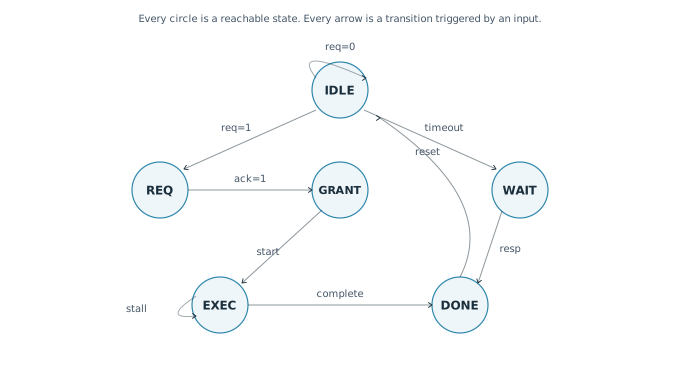
Finite state machines have properties that are difficult to exercise fully in simulation: every state must be reachable from reset, no state must be a deadlock, and transitions must follow the specification exactly. Formal can prove FSM properties exhaustively, including confirming that no unreachable states exist — a class of bug that simulation by definition cannot expose.
Security Properties
Proving that a cryptographic key can never appear on a debug port, or that a privilege escalation path does not exist in a security controller, requires checking all possible input sequences. These information-flow properties are uniquely suited to formal verification — they are impossible to prove by simulation and critical to get right.
Formal in the Verification Flow
Formal verification runs alongside simulation during the RTL stage — it is not a replacement for simulation and is not run after simulation is complete. The typical flow is:
- Early block-level: As each block is delivered, the formal team writes properties for the block's key invariants — mutual exclusion, reset behavior, interface protocol rules. Formal runs immediately, often finding bugs before the simulation environment is even fully built.
- Parallel with simulation: Formal and simulation run simultaneously throughout RTL development. Formal proves specific properties exhaustively; simulation explores broader functional behavior with random stimulus.
- Coverage closure support: When simulation coverage plateaus and specific scenarios remain uncovered, formal can determine whether those scenarios are reachable at all — if formal proves they are unreachable, the coverage miss can be waived without additional simulation effort.
- Post-ECO verification: After a netlist ECO, formal equivalence checking (LEC) proves the ECO'd netlist is functionally equivalent to the pre-ECO version for all inputs — a check that simulation cannot perform exhaustively.
Formal in Industry Practice
On a processor design project, the formal team targets the instruction decode unit, branch predictor control logic, and memory ordering arbiter — all blocks where exhaustive correctness proofs are both achievable and critical. Properties are written in SVA and proven during block-level verification, weeks before the full simulation environment is mature. Several bugs are found by formal that the simulation team later confirms they would not have reached without thousands of additional directed tests. The simulation team focuses on end-to-end program execution scenarios that are beyond formal's scope — the two techniques cover complementary territory.
Common Mistakes When Using Formal
Mistake #1: Writing assumptions that are too restrictive
Wrong: Constraining inputs so tightly that the bug scenario is excluded from the formal search space
Right: Writing assumptions that reflect only the actual protocol rules — no more, no less
Why? An over-constrained assumption produces a vacuous proof: the tool proves the property holds because the buggy input sequence was assumed away. The proof is technically correct but meaningless. Always verify that assumptions are necessary and that removing any single assumption still leaves legal behavior.
Mistake #2: Applying formal to an entire SoC
Wrong: Running a formal tool on a full chip netlist and expecting convergence
Right: Applying formal to individual blocks or small subsystems with focused properties
Why? State space explosion makes full-chip formal intractable. Formal scales to blocks, not full chips. The value of formal comes from exhaustive proofs on bounded, well-defined units — not from attempting to verify everything at once.
Mistake #3: Treating a BMC result as a full proof
Wrong: Reporting "formally verified" when the tool only completed bounded model checking up to 10 cycles
Right: Clearly documenting the bound, verifying it is deep enough for the property, and distinguishing BMC results from full proofs in sign-off documentation
Why? A BMC result of depth N means "no bug in the first N cycles." If the design takes N+1 cycles to set up the bug, BMC will not find it. The bound must be justified relative to the property being checked.
Practice Exercise
Challenge: Formal or Simulation?
For each scenario below, decide whether formal verification, simulation, or both is the most appropriate approach — and explain why.
- Proving that a 4-entry round-robin arbiter never grants two outputs simultaneously
- Verifying that a PCIe controller correctly handles 50,000 randomized TLP sequences
- Proving that every register in a power management block reaches its documented reset value after
rst_nis asserted - Verifying end-to-end data integrity across a full SoC memory subsystem with multiple masters
- Proving that a hardware security module never outputs its stored private key on any observable port, under any input sequence
Show Answers
1. Arbiter mutual exclusion: Formal. This is a concise safety property on a small, well-bounded block. Formal proves it exhaustively in minutes. Simulation can build confidence but cannot provide the same guarantee.
2. PCIe TLP sequences: Simulation (constrained random). The scenario space is large and involves complex sequencing across thousands of transactions — well suited to constrained random simulation with a scoreboard. Formal could verify specific protocol rules (handshake properties), but the full end-to-end TLP flow is better explored by simulation.
3. Reset values: Formal. Checking that every register reaches a specific value after reset is an exhaustive check over all state elements — exactly what formal is built for. A directed simulation test also covers this, but formal provides a stronger guarantee that no register was missed.
4. Full SoC memory integrity: Simulation. Full SoC scenarios with multiple masters and complex traffic patterns are beyond formal's practical scope due to state space explosion. Constrained random simulation with a memory model scoreboard is the right approach.
5. Private key leakage: Formal. This is an information-flow security property that must hold for all possible inputs. Simulation cannot prove absence of leakage — it can only confirm the key did not appear in the specific inputs tested. Formal is the only tool that can provide an exhaustive proof of non-leakage.
Summary
In this tutorial, you learned:
- Formal verification constructs a mathematical model of the RTL and exhaustively searches all reachable states — it proves properties rather than testing them with specific inputs
- Bounded model checking proves a property holds up to a specified number of cycles; full formal proof provides an unconditional guarantee across all reachable states
- Formal can verify properties that simulation structurally cannot: exhaustive correctness over all inputs, liveness, deadlock freedom, and information-flow security properties
- State space explosion limits formal to focused blocks and well-bounded properties — applying formal to a full SoC is not practical
- The strongest use cases for formal are arbiters, reset behavior, protocol checkers, arithmetic units, FSM properties, and security properties
- Formal and simulation are complementary — formal proves specific critical properties exhaustively while simulation explores broader functional behavior
