
If you have read through this tutorial series, you have encountered UVM references throughout — the UVM driver, the UVM scoreboard, the UVM factory. UVM is everywhere in modern chip verification, and for good reason: it is the result of over two decades of the industry learning, the hard way, what a shared verification methodology needs to provide. Understanding how UVM came to exist — and what problems it solved — gives context that makes working with it far more intuitive.
10 min read | Intermediate Level
What You'll Learn
- Why the absence of a standard verification methodology was a real, costly problem
- What VMM and OVM were, and why neither became the universal answer on its own
- How UVM unified the field and what makes it the IEEE standard today
- Why methodology standardisation matters beyond just the technology itself
The Problem: Everyone Had Their Own Approach
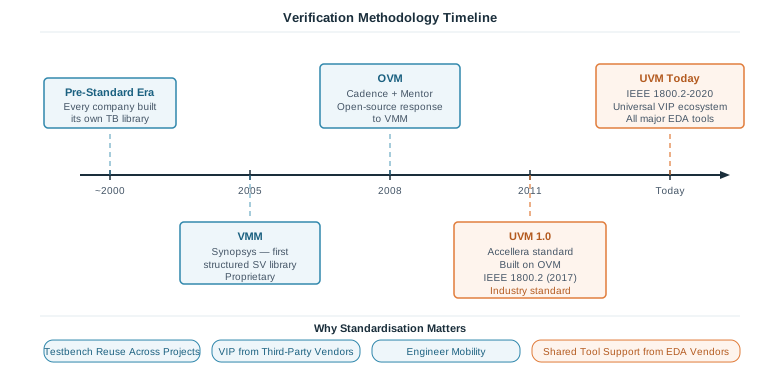
In the late 1990s and early 2000s, SystemVerilog was still being defined and simulation-based verification was maturing rapidly. Companies were moving away from directed Verilog testbenches toward constrained-random environments, but there was no agreed way to structure them. Every semiconductor company — and every verification team within a company — built their own testbench library from scratch.
This created several compounding problems:
- No reuse between projects: A testbench component written for one chip's AXI interface could not be transplanted to the next project without significant rework, because the two projects used different base classes and conventions
- No reuse between companies: An engineer moving from one company to another had to learn an entirely new internal methodology. Skills built on one proprietary framework did not transfer
- No VIP ecosystem: Third-party Verification IP (VIP) — pre-built, verified testbench agents for standard protocols like USB, PCIe, or DDR — could not exist at scale because there was no common interface for VIP to plug into
- Inconsistent quality: Internal libraries were maintained by whoever had time, were often underdocumented, and varied dramatically in quality between teams and companies
The cost of this fragmentation was real. Verification teams spent a significant fraction of every project reinventing infrastructure that had already been built — and rebuilt, and rebuilt again — elsewhere in the industry.
VMM — The First Attempt at Standardisation
In 2005, Synopsys published the Verification Methodology Manual (VMM), co-authored with ARM. VMM was a book and an accompanying SystemVerilog class library that proposed a structured, reusable way to build verification environments. It introduced concepts that are still recognisable in UVM today: a base transaction class, a generator-driver-monitor architecture, and a channel-based communication mechanism between components.
VMM was a genuine step forward. It gave teams a reference point and a shared vocabulary. Engineers who had been building bespoke random testbenches in isolation now had a documented pattern to follow and a library to build on.
However, VMM had a significant limitation: it was proprietary to Synopsys. Using it meant committing to Synopsys simulation tools. Companies using Cadence or Mentor simulators had no supported path to adopt VMM, and the competitive dynamics of the EDA industry meant Cadence and Mentor were not going to embrace a Synopsys library as the standard.
VMM introduced the concept of the vmm_data base class (the ancestor of UVM's uvm_sequence_item), the vmm_channel for inter-component communication (later replaced by TLM ports in OVM/UVM), and the vmm_scenario for sequencing stimulus. Many of these architectural ideas survived into UVM in evolved form.
OVM — The Open-Source Response
In 2008, Cadence and Mentor jointly released the Open Verification Methodology (OVM) as an open-source SystemVerilog library, hosted publicly on a shared repository. The key word was open: any company, using any simulator, could adopt OVM without vendor lock-in.
OVM made several architectural advances over VMM. The most significant was replacing VMM's proprietary channel-based communication with TLM (Transaction Level Modelling) ports — a communication standard borrowed from the SystemC world. TLM ports gave testbench components a clean, standardised interface for passing transactions between them, making components more modular and reusable.
OVM also introduced the factory pattern — a mechanism for substituting one component type with another at runtime without changing the testbench source code. This made it possible to override a default driver with a custom one for a specific test, which is a powerful capability for building configurable verification environments.
OVM gained rapid adoption across the industry precisely because it was tool-neutral. A testbench written to OVM conventions would run on Cadence Incisive, Mentor Questa, and Synopsys VCS. The VIP ecosystem began to form: third-party vendors could now write protocol agents in OVM and sell them knowing that their customers — regardless of simulator — could integrate them.
Synopsys initially backed VMM and was not an OVM contributor, which meant the industry was briefly split between two methodologies. This divided the VIP ecosystem and created real interoperability challenges for companies that used multiple simulators or purchased VIP from different vendors.
Quick Check
Q: What was the fundamental architectural advantage OVM had over VMM that drove its wider adoption?
Show Answer
OVM was open-source and tool-neutral — it could be used with any SystemVerilog simulator from any EDA vendor. VMM was proprietary to Synopsys, which limited adoption to teams using Synopsys tools. Additionally, OVM introduced TLM ports for inter-component communication and the factory pattern for component substitution, both of which became foundational to how modern UVM testbenches are structured.
UVM — The IEEE Standard That Unified the Field
By 2009, the split between VMM and OVM was recognised as a problem that hurt the entire industry. Accellera — a standards organisation that develops EDA standards before they are submitted to IEEE — convened a working group to define a single unified methodology. The result was the Universal Verification Methodology (UVM), released as Accellera UVM 1.0 in February 2011.
UVM was built primarily on OVM's architecture, adopting its TLM communication model and factory pattern. Synopsys contributed several extensions from VMM — most notably the sequence layering model and the register abstraction layer (RAL), which provides a standardised way to model and verify a chip's register map. The result was a methodology that combined the best of both predecessors.
In 2017, UVM was ratified as IEEE 1800.2, giving it formal international standards status. This was more than symbolic: IEEE standardisation meant EDA tool vendors were obligated to support it consistently, university curricula could teach it as a stable target, and companies could build long-term infrastructure investments on it without fear of the methodology being abandoned.
What UVM Standardised
UVM is not just a set of base classes — it standardises an entire way of thinking about testbench architecture:
- Component hierarchy: Tests, environments, agents, drivers, monitors, and sequencers all have defined roles and standard base classes
- Phase system: Simulation is divided into named phases (
build_phase,connect_phase,run_phase, etc.) that execute in a defined order, ensuring components are constructed before they are connected and connected before they run - TLM communication: Components communicate through standardised TLM ports and exports, making them interchangeable without modifying the surrounding environment
- Factory: Any component or object can be overridden at runtime, enabling test-specific customisation without changing the base environment
- Register Abstraction Layer (RAL): A standardised model for a chip's register map, enabling automated register tests and consistent register access across different testbench configurations
- Sequence library: Reusable stimulus generators that can be composed, layered, and overridden independently of the driver that executes them
Quick Check
Q: A verification team purchases a PCIe VIP from a third-party vendor. The VIP is delivered as a UVM agent. Their testbench environment also uses UVM. Without a standard methodology, what would the integration process have looked like, and why does UVM make it straightforward?
Show Answer
Without a standard: the VIP would be built on the vendor's proprietary base classes. Integrating it would require either rewriting the VIP to use the team's internal base classes, wrapping it with adapter code, or partially rebuilding the team's environment to accommodate the VIP's conventions — all expensive and error-prone. With UVM: the VIP's agent, driver, monitor, and sequence items are all derived from the same uvm_component and uvm_object base classes used in the team's environment. Integration is a matter of instantiating the agent inside the environment's build_phase and connecting its TLM ports — a task that typically takes hours, not weeks.
Why Methodology Matters Beyond the Technology
The impact of UVM standardisation extends well beyond the technical details of base classes and TLM ports. It changed the economics and logistics of verification in ways that are still felt today.
The VIP Ecosystem
Before UVM, the market for third-party Verification IP was fragmented and limited. After UVM, a VIP vendor could write a single implementation of a PCIe, USB, DDR, or Ethernet agent and sell it to any customer using any UVM-compatible simulator. Today, for virtually every standard interface protocol, multiple commercial UVM VIP options exist — allowing design teams to buy rather than build verification agents for complex protocols, and to focus their DV effort on the parts of the design that are unique to their chip.
Engineer Mobility
When every company used a different internal methodology, a DV engineer changing jobs faced a steep ramp-up learning a new framework before they could be productive. With UVM as the shared standard, a skilled DV engineer can join a new team and begin contributing from day one — the base classes, phase names, factory mechanism, and sequence architecture are the same everywhere. This has made the DV job market significantly more fluid and reduced onboarding costs for companies hiring experienced engineers.
Education and Training
UVM can be taught in university courses and professional training as a stable, well-documented target. Before standardisation, most academic curricula stopped at basic SystemVerilog because there was no agreed industry practice to teach above that level. Today, UVM is a standard topic in advanced digital design and verification courses — which is partly why you are reading this.
Tool Support
All three major EDA simulators — Synopsys VCS, Cadence Xcelium, and Siemens Questa — ship with UVM built in and actively maintained. Debug features, coverage collectors, and waveform viewers in these tools have UVM-aware modes that understand the testbench hierarchy and phase structure, making debugging a UVM environment significantly easier than debugging an equivalent home-grown framework. This level of tool investment only happens when the methodology is a stable, universal standard.
Where Things Stand Today
UVM IEEE 1800.2 was updated in 2020, addressing several limitations of the 2017 release. The core architecture — components, phases, TLM, factory, sequences, RAL — is stable and mature. New chip projects universally start with UVM as the default testbench framework for block-level and SoC-level verification.
VMM is effectively obsolete — Synopsys no longer promotes it and few new projects use it. OVM is also retired, though its architectural DNA lives on in UVM. Engineers occasionally encounter VMM or OVM testbenches on legacy projects or during due-diligence reviews of acquired IP, which is why understanding the history is practically useful as well as interesting.
Some companies maintain internal extensions on top of UVM — custom base classes, reporting frameworks, or coverage utilities — built over the standard library. These are compatible with UVM at the base level but add proprietary layers above it. Joining a team that uses such extensions requires learning the extensions, but the underlying UVM architecture is the same.
Common Mistakes
Mistake 1: Treating UVM as a simulator feature rather than a class library.
Wrong: Assuming UVM is automatically available and configured because the simulator supports SystemVerilog.
Right: UVM is a SystemVerilog class library that must be compiled and included in the simulation. Most simulators ship with a bundled version, but the compile command must explicitly include it.
Why? New DV engineers frequently encounter cryptic compilation errors on their first UVM project because the UVM package was not included in the compile step. Understanding that UVM is a library — not a simulator built-in — resolves this immediately.
Mistake 2: Mixing OVM and UVM classes in the same environment.
Wrong: Attempting to use an OVM-based VIP inside a UVM testbench without any adaptation, assuming they are interchangeable since UVM is based on OVM.
Right: Although UVM is architecturally derived from OVM, the class names, package namespaces, and some APIs differ. OVM classes (ovm_component, ovm_object) and UVM classes (uvm_component, uvm_object) are distinct types and cannot be directly mixed. OVM VIP must be migrated or wrapped before use in a UVM environment.
Why? This situation arises when integrating older VIP into a new project. The architectural similarity makes the error easy to make — the OVM and UVM code looks almost identical — but the simulator will reject the type mismatch.
Mistake 3: Learning UVM mechanics without understanding why the architecture exists.
Wrong: Memorising UVM phase names, base class hierarchies, and macro names as rote knowledge without understanding the problems each element was designed to solve.
Right: Each UVM mechanism — the factory, the phase system, TLM ports — exists because verification teams repeatedly encountered specific problems without it. Understanding the motivation makes the API intuitive rather than arbitrary.
Why? Engineers who understand why the factory exists write better overrides. Engineers who understand why phases are ordered correctly build environments that initialise properly. Rote knowledge produces copy-paste code that breaks in non-obvious ways.
Practice Exercise
Challenge: Trace the Design Decision
For each UVM feature below, identify which pre-UVM problem it directly addresses. Match each feature to one of the four problems listed in the "The Problem" section of this article (no reuse between projects, no reuse between companies, no VIP ecosystem, inconsistent quality).
- Standardised base classes (
uvm_component,uvm_sequence_item) with defined APIs - The UVM factory allowing component override at runtime
- TLM ports providing a standard inter-component communication interface
- IEEE 1800.2 ratification and consistent tool support across all major simulators
Hint
Think about which problem each feature makes easier to solve: engineer moving between companies, VIP vendor writing a single component for all customers, components being reused between projects, or quality and consistency of the base infrastructure.
Sample Answer
1. Standardised base classes → No reuse between companies. When every company uses the same base classes with the same APIs, an engineer joining a new team already understands the component structure. Their knowledge transfers directly.
2. Factory override → No reuse between projects. The factory allows a base testbench environment to be customised for a specific test or block without rewriting the environment. The same environment is reused across tests and projects by overriding specific components rather than rebuilding.
3. TLM ports → No VIP ecosystem. TLM ports define a standard interface for passing transactions between components. A VIP vendor can write a monitor that puts transactions on a TLM analysis port, and any scoreboard in any customer's environment can connect to that port — because both sides use the same standard interface.
4. IEEE ratification and tool support → Inconsistent quality. Internal libraries varied in quality and maintenance. An IEEE standard with mandatory tool support means the base library is documented, tested, and maintained to a consistent level by EDA vendors who have contractual and reputational incentives to keep it correct.
Summary
In this article, you learned:
- Before standardisation, every company built its own testbench library — causing wasted effort, poor reuse, and a fragmented VIP market
- VMM (Synopsys, 2005) introduced structured SV verification concepts but remained proprietary; OVM (Cadence and Mentor, 2008) addressed this with an open-source, tool-neutral library and added TLM ports and the factory pattern
- UVM (Accellera 2011, IEEE 1800.2 2017) unified both approaches, taking OVM's architecture and VMM's sequence and RAL extensions into a single, formally standardised library
- Standardisation enabled a VIP ecosystem, engineer mobility across companies, consistent tool support, and teachable university curricula — impacts that go well beyond the class library itself
