
The chip industry is not one kind of company but a chain of specialists, serving many markets at once. One company designs a chip, another sells it the tools to design it, a third makes it, a fourth packages and tests it, and a fifth builds it into a phone, a car, a factory machine or a data center. Knowing who does what in that chain is the first step in planning a career, because every link employs people for different work. This article walks through the links, describes the many markets chips are made for, and shows where the recent growth in AI computing fits among them.
9 min read | Beginner
What You'll Learn
- Name the main kinds of companies in the semiconductor industry
- Explain the difference between fabless, foundry and integrated companies
- Describe the product segments and markets that chips serve
- Place AI computing in the context of the whole industry
How the Chain Formed
Until the mid-1980s, most chip companies were integrated device manufacturers (IDMs): they designed chips and made them in their own factories. In 1981, engineers who had built design software inside large electronics companies founded the first commercial design-tool companies[1]. In the mid-1980s the first chip companies without factories appeared, and in 1987 the first company dedicated to manufacturing other companies' designs was founded in Taiwan[2].
Manufacturing cost is one reason the split lasted. A 2025 industry estimate put a factory for the 2 nm generation at about 28 billion dollars, against about 20 billion for the 3 nm generation[3], so few companies can afford to build them.
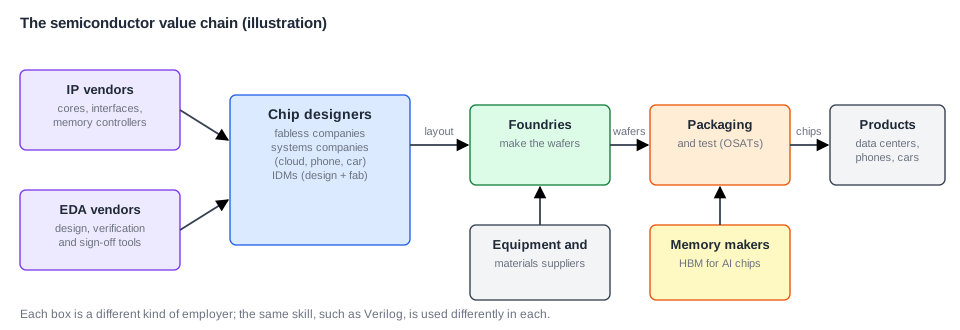
The picture shows the main links. Designs flow from left to right, while tools, building blocks, machines and memory flow in from the sides. Each box is a different kind of employer. Inside the design box sit both digital and analog engineers; this site focuses on the digital design and verification flow, and From Idea to Silicon: Who Does What explains where analog work fits.
Designing Chips
A company that designs chips but owns no factory is called fabless. It specifies, designs and verifies the chip, turns it into a layout, and sends the layout to a foundry. Fabless companies serve many markets, from phone processors and wireless chips to networking chips and AI accelerators, as the examples later in this article show.
A second group designs chips for its own products: systems companies. Apple designs the processors in its phones and computers, and in 2025 began shipping its own modem and wireless chips in place of chips it had bought from other companies[4]. Cloud providers design their own AI accelerators, and in 2025 and 2026 several car makers announced self-driving chips of their own design[5].
A third group designs and manufactures: integrated device manufacturers. Memory makers are one example. Many leading makers of analog, power, microcontroller and automotive chips are also IDMs, and some of them are building new factories[6].
The Suppliers to Designers
Designers license IP, intellectual property: ready-made blocks such as processor cores and interface controllers, which IP companies design once and sell to many customers. Buy, Reuse or Build: Choosing IP explains how teams choose between them.
They also buy EDA tools, electronic design automation: simulation, synthesis, layout, timing and verification software. Three companies account for more than three quarters of EDA spending, and in 2025 one of them completed a 35-billion-dollar acquisition of a simulation software company[7].
Quick Check
Q: A company designs network switch chips, licenses its high-speed interface blocks from another company, and has its chips made by a foundry. Which three kinds of company are involved?
Show Answer
A fabless designer (the switch company), an IP vendor (the interface supplier) and a foundry (the manufacturer). EDA vendors are involved too, through the design tools the switch company uses.
Making, Packaging and Testing Chips
A foundry manufactures chips designed by other companies and publishes the process design kit that tells designers what each process can do. Foundry revenue is highly concentrated: in 2025, one company earned about seven in every ten dollars of pure-foundry revenue, and the second-largest held a single-digit share[8]. Other foundries focus on mature processes, 28 nm and larger, used for microcontrollers, power, analog and many other chips. Mature-process capacity has grown fastest in China, forecast to hold about 28 percent of it by the end of 2025[9].
Foundries rely on equipment makers, which build lithography, deposition, etching and inspection machines, and materials suppliers, which provide wafers, chemicals and gases. Finished wafers are then tested, cut apart and packaged, much of it by specialist OSATs, outsourced semiconductor assembly and test companies. Chiplets, Packaging and System Partitioning describes the packages themselves.
Where the Chips Go
The industry's official sales statistics divide chips into product segments. In 2025, the market was worth about 800 billion dollars[10]. Memory accounted for about 230 billion and logic for about 300 billion[11]. The rest, about a third of the total, came from analog chips (about 87 billion), optoelectronics (about 43 billion), sensors (about 21 billion), microprocessors and microcontrollers, and discrete devices such as power transistors[10].
These chips go into phones, PCs, cars, factory equipment, networks, storage and consumer products as well as data centers, and many companies design chips for these markets. Some of the largest, with their most recent annual results:
Processors for PCs, servers and AI:
- Nvidia, a fabless company: about 216 billion dollars in fiscal 2026, about 194 billion of it from data centers and about 16 billion from gaming graphics[12].
- AMD, a fabless company: about 34.6 billion dollars in 2025, about 16.6 billion from data centers, 10.6 billion from PC processors, 3.9 billion from gaming and 3.5 billion from embedded chips[13].
- Intel, an IDM that also runs a foundry business: about 52.9 billion dollars in 2025, about 32.2 billion from PC processors and 16.9 billion from data center and AI products[14].
Phones, cars, industry and communications:
- Qualcomm, a fabless company best known for phone chips: in fiscal 2025 its chip business earned about 38 billion dollars, of which about 28 billion from handsets, about 6.6 billion from IoT products and about 4 billion from cars, its fastest-growing market, up 36 percent[15].
- MediaTek, a fabless company in Taiwan: record 2025 revenue, a little over half of it from smartphone chips, with the rest from chips for TVs, Wi-Fi, PCs, cars and other devices[16].
- Texas Instruments, an IDM: about 17.7 billion dollars in 2025, about four fifths from analog chips and about a seventh from embedded processors, with industrial, automotive and data center markets together making up about three quarters of revenue[17].
- Analog Devices, an IDM: about 11 billion dollars in fiscal 2025, 45 percent from industrial, 30 percent from automotive, 13 percent from consumer and 13 percent from communications markets[18].
- NXP, which makes automotive, industrial and IoT chips: about 12.3 billion dollars in 2025, nearly three fifths of it from automotive[19].
- Infineon, which makes power, automotive and microcontroller chips: about 14.7 billion euros in fiscal 2025, about half from automotive[20].
In the United States alone, the semiconductor industry directly employs about a quarter of a million people[21], across all of these markets.
Where Is This Used?
A modern car shows how many kinds of chip one product needs. Market reports list microcontrollers, application processors, power semiconductors for battery management and motor control, image sensors, radar chips, memory and connectivity devices, and an industry outlook for 2025 reported that the chip content of each vehicle keeps rising with electric drive and driver assistance[22]. These chips come from many different companies, fabless and integrated.
Where AI Computing Fits
AI computing is the fastest-growing part of the industry. The industry's main forecast, published in mid-2026, expected the market to grow about 90 percent in 2026, to about 1.5 trillion dollars, driven mainly by memory, forecast to grow about 250 percent, and logic, about 37 percent, both pulled by AI data centers[10]. Cloud and AI companies design their own accelerators, and companies that design custom chips for them have grown quickly[23]. AI accelerators also made memory and advanced packaging bottlenecks: the leading foundry more than doubled its advanced packaging capacity in 2025[24].
Growth elsewhere was more modest. The same forecast expected analog to grow about 10 percent in 2026, discrete devices about 8 percent and sensors and optoelectronics about 3 percent[10]. One bank's 2026 outlook expected automotive chip demand to stay weak, with recovery likely delayed to 2027, while describing the 2026 market as "not solely about AI"[25]. The industry is therefore uneven: very fast growth in AI-related memory and logic, slower growth in most other segments, and job cuts at some companies, such as one large chipmaker whose workforce fell by about a fifth during 2025[26]. Chip Companies and Where the Jobs Are looks at the job market in more detail.
Quick Check
Q: If memory and logic grew very fast in 2026, why does the rest of the industry still matter for someone choosing a career?
Show Answer
Analog, microcontrollers, sensors, optoelectronics and discrete devices made up about a third of the market in 2025, and the companies that make them design new chips every year for phones, PCs, cars, factories and networks. Fast growth in one area doesn't stop work in the others.
Summary
- The chip industry is a chain of designers, IP and EDA suppliers, foundries, equipment and materials makers, memory makers, and packaging and test houses.
- Fabless companies design but don't manufacture; systems companies design chips for their own products; IDMs design and manufacture.
- About a third of 2025 sales came from analog, microcontrollers and microprocessors, sensors, optoelectronics and discrete devices, serving phones, PCs, cars, factories, networks and more.
- AI-related memory and logic are the fastest-growing part, while other segments grow more slowly.
- Every link and every market employs chip engineers, so look at what a company sells before judging its jobs.
Sources
- Daisy Systems, Wikipedia (founding of the first commercial EDA companies, 1981).
- Foundry model, Wikipedia (first fabless companies and the first pure-play foundry, 1987).
- Firm predicts it will cost $28 billion to build a 2nm fab, Tom's Hardware (IBS estimate).
- Apple unveils its first in-house modem, TrendForce, February 2025; Apple executives detail A19 Pro, in-house modem and wireless chips, iClarified.
- Rivian unveils its own in-house RAP1 AI chip, Tom's Hardware, December 2025.
- TI widens its lead as world's top analog IC supplier, EE Power; Infineon's 5 billion euro Dresden fab, Futurum.
- Synopsys acquires simulation specialist Ansys for $35 billion, Tom's Hardware.
- Global foundry revenue surged to $41.7 billion in Q2 2025, TrendForce via Design & Reuse.
- China's mature chips to make up 28 percent of world production, Tom's Hardware.
- WSTS Semiconductor Market Forecast, Spring 2026, World Semiconductor Trade Statistics, June 2026.
- WSTS raises semiconductor forecast to $1.51 trillion in 2026, TelecomLead, June 2026 (segment values for 2025).
- Nvidia posts record $215 billion annual revenue, Tom's Hardware, February 2026 (fiscal 2026 results).
- AMD reports fourth quarter and full year 2025 financial results, AMD press release, February 2026.
- Intel fourth quarter and full-year 2025 earnings release, Intel.
- Qualcomm annual report (10-K), fiscal 2025, SEC filing.
- MediaTek 2025 results, DIGITIMES, February 2026; MediaTek annual results, Taiwan News.
- Texas Instruments annual report (10-K), 2025, SEC filing; TI Q4 2025 earnings summary, Quartr.
- Analog Devices annual report (10-K), fiscal 2025, SEC filing.
- NXP reports fourth quarter and full-year 2025 results, NXP press release.
- Infineon annual report, fiscal 2025, Infineon.
- 2025 SIA Factbook, Semiconductor Industry Association.
- Automotive chip market report, P&S Intelligence; Automotive semiconductor market, Meticulous Research, May 2026 (citing Infineon's 2025 automotive market outlook).
- Broadcom fiscal Q3 2026 results, TIKR.
- Why TSMC grew four times faster than its foundry rivals in 2025, Tom's Hardware.
- Semiconductor market 2026: it is not solely about AI, BNP Paribas CIB.
- Intel annual report (10-K), fiscal 2025, SEC filing.
