
Once a master has started an AHB transfer, the slave decides how it ends. It can finish at once, insert wait states with HREADYOUT, or fail the transfer with an ERROR response. Because AHB is pipelined, each of these also affects the transfer behind it, and the ERROR response takes two cycles for exactly that reason. This article explains the three outcomes and what the master may and may not change while it waits.
9 min read | Intermediate
What You'll Learn
- Combine
HRESPandHREADYinto the three possible slave responses - Insert wait states and know what the master must hold meanwhile
- Explain why an ERROR response takes two cycles
- Cancel the rest of a burst after an error
Three Ways a Transfer Can End
The complete response is a combination of HRESP and HREADYOUT (which the master sees as HREADY):
| HRESP | HREADY | Meaning |
|---|---|---|
| 0 (OKAY) | 1 | Transfer done, successfully |
| 0 (OKAY) | 0 | Transfer pending: a wait state |
| 1 (ERROR) | 0 | First cycle of an ERROR response |
| 1 (ERROR) | 1 | Second and last cycle of an ERROR response |
A master cannot cancel a transfer once it has started; the slave always gets to finish it. Every slave must also answer IDLE and BUSY transfers with OKAY and no wait states, since there is nothing to do for them.
Wait States
A slave that needs time holds HREADYOUT low in the data phase and keeps HRESP at OKAY. Each such cycle is a wait state. While HREADY is low:
- the master holds
HWDATAfor a write; - the slave only has to drive valid
HRDATAin the final cycle of a read; - the next transfer's address phase is held too.
The specification recommends that a slave inserts no more than 16 wait states, so that one access cannot lock the bus for long, and that every slave has a known maximum. A boot ROM read only at startup is the usual exception.
Here the memory slave inserts two wait states on the first beat of a read burst and one on each following beat. Writes are buffered and never wait. The burst before it is an INCR4 write with a BUSY cycle:
35  write 0x0010 = 0x000000a0  OKAY
55  write 0x0014 = 0x000000a1  OKAY
65  write 0x0018 = 0x000000a2  OKAY
75  write 0x001c = 0x000000a3  OKAY
105  read  0x0010 = 0x000000a0  OKAY
125  read  0x0014 = 0x000000a1  OKAY
145  read  0x0018 = 0x000000a2  OKAY
165  read  0x001c = 0x000000a3  OKAY
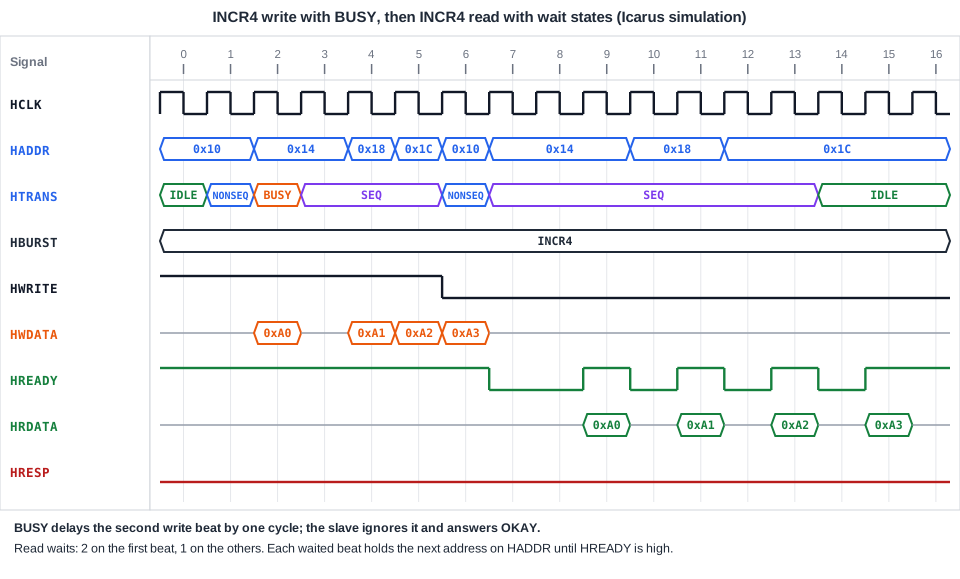
The read burst starts straight after the last write beat, and each waited beat holds the next address on HADDR: 0x14 stays for three cycles while the first beat waits twice. The four reads take 90 ns instead of 40 ns.
What the Master May Change During a Wait
Normally the master holds its address phase while HREADY is low. The specification allows a few changes:
- IDLE to NONSEQ: a master showing IDLE may change its mind and start a transfer. Once it shows NONSEQ, it must hold it until
HREADYis high. The address of an IDLE transfer may also change during the wait. - BUSY to SEQ: in a fixed-length burst, a master showing BUSY may switch to SEQ, and must then hold it.
- BUSY to anything: in an INCR burst, a master showing BUSY may switch to SEQ to continue, or to IDLE or NONSEQ to end the burst.
- After an ERROR: the master may change the address and switch to IDLE.
Everything else, including an address or a NONSEQ/SEQ type, stays put until HREADY is high.
Quick Check
Q: During a wait state, a slave drives HRESP high for one cycle and then low. Is that a legal response?
Show Answer
No. During wait states HRESP must be OKAY. An ERROR must be held for two cycles: first with HREADYOUT low, then with HREADYOUT high.
The Two-Cycle ERROR Response
Why two cycles? By the time a slave decides a transfer has failed, the master has already put the next address on the bus. If that next transfer is the following beat of a burst, the master may not want it to happen. The first ERROR cycle, with HREADY low, freezes the pipeline and tells the master; in the second cycle, the master can replace the pending transfer with IDLE before it is accepted.
The memory slave reports ERROR for any write to its read-only region at 0x300 and above. This INCR4 write starts at 0x2F8, so its third beat lands at 0x300:
45  write 0x02f8 = 0x000000c0  OKAY
55  write 0x02fc = 0x000000c1  OKAY
75  write 0x0300 = 0x000000c2  ERROR
105  read  0x02f8 = 0x000000c0  OKAY
125  read  0x02fc = 0x000000c1  OKAY
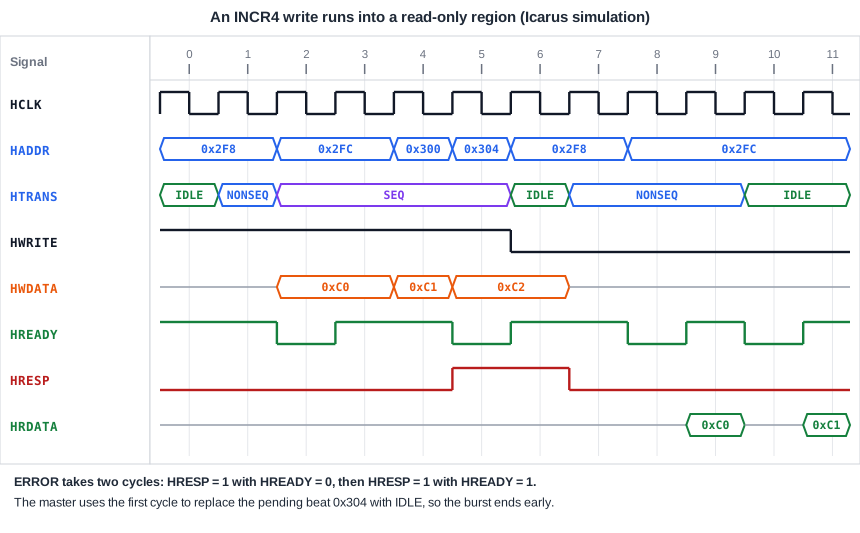
The beat to 0x300 takes two cycles, both with HRESP high. The master sees the first cycle (ERROR with HREADY low) and drives HTRANS = IDLE in the second cycle instead of SEQ, so the beat to 0x304 never happens. Cancelling is the master's choice: the specification also allows it to continue the burst, and it does not have to repeat the missing beats later.
In the slave, the ERROR response is two flags:
wire start = HREADY && HSEL && HTRANS[1];        // NONSEQ or SEQ accepted
wire bad   = start && HWRITE && (HADDR[9:0] >= RO_BASE);

always @(posedge HCLK) begin
  // ... reset and the normal address-phase capture ...
  err2 <= err1;                          // second cycle follows the first
  if (err1)
    err1 <= 1'b0;
  else if (HREADY)
    err1 <= bad;                         // first cycle starts in the data phase
end

assign HREADYOUT = err1 ? 1'b0 : (wait_left == 4'd0);
assign HRESP     = err1 || err2;
A slave that needs more time to discover the error can insert ordinary wait states first, with HRESP at OKAY, and then give the two ERROR cycles. For a read that ends with ERROR, the read data does not have to be valid.
Quick Check
Q: The address after the failing beat is a NONSEQ transfer to a different slave. Must the master cancel it?
Show Answer
No. The two-cycle response gives the master the chance to cancel, but it is not required. A master that does not care about the failed burst can let the next transfer go ahead.
Running It in ChipVerify Lab
The example runs the INCR4 write into the read-only region and the reads that follow. Find the two ERROR cycles and the IDLE that replaces the last beat.
Common Mistakes
Mistake #1: A one-cycle ERROR
Driving HRESP high for a single cycle with HREADYOUT high gives the master no time to react to the pipelined transfer behind it. ERROR always takes two cycles.
Mistake #2: Wait states on IDLE or BUSY
A slave must answer IDLE and BUSY with OKAY and no wait states. A slave that counts every selected cycle as a transfer stalls the bus for nothing.
Mistake #3: Changing HTRANS from NONSEQ during a wait
Once a master shows NONSEQ or SEQ, it must hold it until HREADY is high. The exceptions are only IDLE to NONSEQ, BUSY to SEQ (and, in an INCR burst, BUSY to anything), and the change after an ERROR.
Practice Exercise
Challenge: Do Not Cancel
The testbench master has a flag, cancel_on_error, which is 1 in the example. Set it to 0 so that the master continues the burst after the error. Predict what happens to the beat to 0x304, then run it.
Hint
The region from 0x300 upwards is read-only, and 0x304 is in it.
Solution
45  write 0x02f8 = 0x000000c0  OKAY
55  write 0x02fc = 0x000000c1  OKAY
75  write 0x0300 = 0x000000c2  ERROR
95  write 0x0304 = 0x000000c3  ERROR
115  read  0x02f8 = 0x000000c0  OKAY
135  read  0x02fc = 0x000000c1  OKAY
The last beat now happens and fails as well, with its own two-cycle ERROR. Both behaviours are legal; cancelling simply saves the bus cycles.
Open the ready-made example in the lab and run the simulation.
Summary
HRESPandHREADYtogether give three outcomes: done, pending (wait state) and ERROR.- During wait states
HRESPis OKAY, write data is held, and the next address phase is held. - IDLE and BUSY always get a zero-wait OKAY.
- ERROR takes two cycles,
HREADYlow then high, so the master can cancel the transfer behind it. - After an ERROR, the master may cancel the rest of the burst or continue it.
