
An AXI write transaction uses three channels: the master sends the address and burst description on AW, the data beats on W, and the slave confirms the whole burst with a single response on B. This article walks through each channel's signals, follows two write bursts through a simulation, and explains when a write counts as complete.
8 min read | Intermediate
What You'll Learn
- Describe the signals of the AW, W and B channels
- Explain how
AWLENandWLASTdefine the burst - Match a write response to its transaction with
BID - Know when a master may treat a write as finished
The Write Address Channel (AW)
One AW handshake describes the whole burst:
| Signal | Meaning |
|---|---|
| AWID | Transaction ID, returned on BID |
| AWADDR | Address of the first byte of the burst |
| AWLEN[7:0] | Number of beats minus one: 0 means 1 beat, 255 means 256 |
| AWSIZE[2:0] | Bytes per beat: 2 to the power AWSIZE (1, 2, 4 ... 128) |
| AWBURST[1:0] | Burst type: FIXED, INCR or WRAP |
| AWLOCK | 1 for an exclusive access |
| AWCACHE[3:0] | Memory type: bufferable, modifiable, allocation hints |
| AWPROT[2:0] | Privileged, Non-secure, instruction (same bits as APB's PPROT) |
| AWQOS, AWREGION, AWUSER | Optional: quality of service, region, user-defined |
| AWVALID, AWREADY | Handshake |
Only the start address is sent. The slave calculates the address of every following beat from AWSIZE and AWBURST, as described in AXI Burst Types.
The Write Data Channel (W)
Each W handshake moves one beat: WDATA, a byte strobe WSTRB with one bit per byte lane, and WLAST, which the master must assert on the final beat. AXI4 has no WID: the beats of one burst are always consecutive on W, and bursts arrive in the same order as their addresses. The master may still pause between beats by lowering WVALID.
The Write Response Channel (B)
After the last beat, the slave sends one response for the whole burst: BID repeats the AWID, and BRESP is OKAY, EXOKAY, SLVERR or DECERR. Every write transaction gets exactly one response, never one per beat.
Quick Check
Q: AWLEN = 3 and AWSIZE = 2. How many W beats follow, and how many bytes can they carry in total?
Show Answer
Four beats (AWLEN + 1) of 4 bytes each (2 to the power 2): up to 16 bytes. The strobes decide how many of them are actually written.
Two Writes in a Simulation
The master writes four words with ID 1 to 0x100, then two words with ID 2 to 0x200. It pauses for two cycles before the last beat of the second burst. Both are then read back.
write(1, 12'h100, 3, WORD, INCR, 32'h10, 0, 0, 0);   // INCR, 4 beats, ID 1
write(2, 12'h200, 1, WORD, INCR, 32'h20, 0, 0, 0);   // INCR, 2 beats, ID 2
w_delay[5] = 2;                                      // the master pauses before the last beat
35  AW  id=1 addr=0x100 len=3 size=4 INCR
45  W   data=0x00000010 strb=1111
55  W   data=0x00000011 strb=1111
65  W   data=0x00000012 strb=1111
75  W   data=0x00000013 strb=1111 last
85  B   id=1 OKAY
95  AW  id=2 addr=0x200 len=1 size=4 INCR
105  W   data=0x00000020 strb=1111
135  W   data=0x00000021 strb=1111 last
145  B   id=2 OKAY
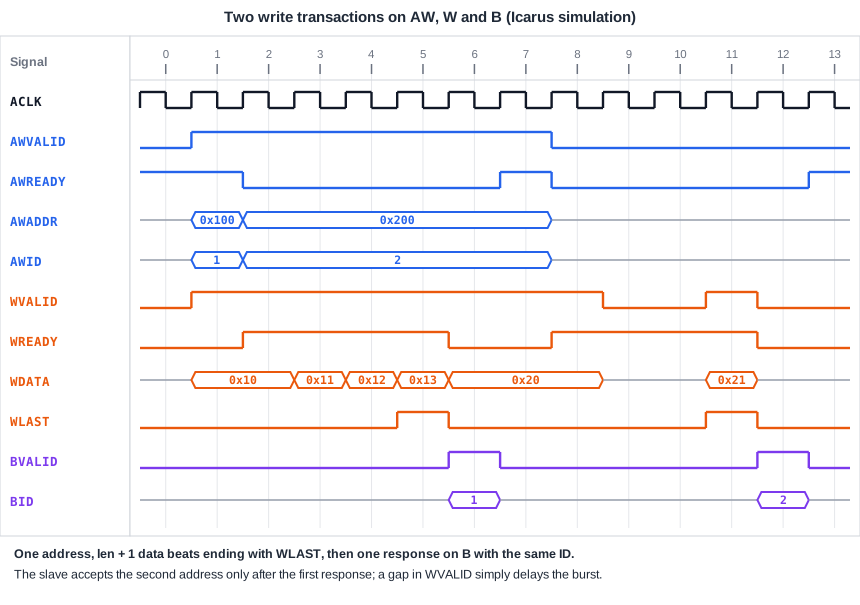
Several things are visible in the waveform:
- The master raises
AWVALIDfor the second burst straight after the first address. It waits, withAWVALIDhigh, until the slave can take it: this slave handles one write at a time. - The master's write data for both bursts is ready early;
WVALIDwaits forWREADY. - The gap before the last beat of ID 2 simply delays
WLASTand the response. - Each burst gets one B handshake, carrying its own ID.
Inside the Slave
The memory slave's write side registers the burst description on AW, then handles one beat per W handshake and raises BVALID on the last one:
if (AWVALID && AWREADY) begin
  w_active <= 1'b1;
  w_id     <= AWID;
  w_addr   <= AWADDR;
  // ... AWLEN, AWSIZE, AWBURST, AWLOCK
end
if (WVALID && WREADY) begin
  // write the bytes enabled by WSTRB at w_addr ...
  w_addr <= next_addr(w_addr, w_size, w_burst, w_len);
  if (WLAST) begin
    w_active <= 1'b0;
    BVALID   <= 1'b1;
    BID      <= w_id;
    // BRESP: OKAY, EXOKAY or SLVERR
  end
end
With AWREADY = !w_active && !BVALID and WREADY = w_active, the response can never come before the address, as AXI4 requires. Designing an AXI4 Memory Slave shows the complete design.
When Is a Write Complete?
Sending the last data beat does not finish a write. The master may only treat a write as complete when it receives the write response. This matters when a later transaction depends on it, such as a read of the same address or a write to a peripheral's "go" register after its configuration. AXI does not order reads against writes, even with the same ID, so the master must wait for B before it issues the dependent transaction.
Quick Check
Q: A master writes a buffer and then writes "start" to a DMA register on a different slave. Why must it wait for the buffer write's response first?
Show Answer
The two writes go to different slaves through the interconnect and are not ordered against each other. Without waiting for B, the DMA could start before the buffer data has arrived.
Running It in ChipVerify Lab
The example runs these two writes and reads them back. Look at how long AWVALID waits for the second burst.
Common Mistakes
Mistake #1: AWLEN off by one
AWLEN is the number of beats minus one. A master that sends AWLEN = 4 for four beats leaves the slave waiting for a fifth.
Mistake #2: WLAST on the wrong beat
The master must assert WLAST exactly on the final beat. A slave that trusts WLAST responds too early or too late if the master gets it wrong, and a checker should compare it with AWLEN.
Mistake #3: One response per beat
A write burst gets a single response. A slave that sends a B handshake per beat confuses every master and interconnect.
Practice Exercise
Challenge: A Slow BREADY
Add bready_pat = 32'hFFFFF83F;, which holds BREADY low in cycles 6 to 10. Predict what happens to the second write, then run it.
Hint
This slave does not accept a new write address while its previous response is waiting.
Solution
35  AW  id=1 addr=0x100 len=3 size=4 INCR
45  W   data=0x00000010 strb=1111
55  W   data=0x00000011 strb=1111
65  W   data=0x00000012 strb=1111
75  W   data=0x00000013 strb=1111 last
135  B   id=1 OKAY
145  AW  id=2 addr=0x200 len=1 size=4 INCR
155  W   data=0x00000020 strb=1111
185  W   data=0x00000021 strb=1111 last
195  B   id=2 OKAY
The first response waits until 135 ns, and the second address with it: a master that is slow to take responses slows down this slave's writes. A slave with a response queue could accept more writes meanwhile.
Open the ready-made example in the lab and run the simulation.
Summary
- A write uses AW for the burst description, W for the data beats and B for one response.
AWLEN+ 1 beats of 2 to the powerAWSIZEbytes follow, the last one marked withWLAST.- In AXI4, write data is never interleaved, so W carries no ID.
BIDmatches the response to the transaction, and the response comes after the address and the last beat.- A write is complete only when its response arrives.