
A memory may need several cycles to answer a read. If the master waits for every answer before asking again, the bus sits idle most of the time. Pipelining splits a transfer into an address phase and a data phase so that the next address can go out while the previous data is still coming back. Allowing several transactions to be outstanding takes the idea further. This article measures both on a memory with a latency of three cycles.
9 min read | Intermediate
What You'll Learn
- Explain latency and throughput on a bus
- Describe pipelined address and data phases
- Explain outstanding transactions and how many a master needs
- Measure the effect in a simulation
Latency and Throughput
Two numbers describe a bus slave. Latency is the time from a request to its answer. Throughput is how many requests it can finish per cycle. A memory with a latency of three cycles can still have a throughput of one read per cycle, if it accepts a new request every cycle while older ones are still in progress, just like an assembly line.
The memory model in this article does exactly that. Each request enters a three-stage pipeline and comes out three cycles later, in order:
module lat_mem #(
  parameter LAT = 3
) (
  input            clk,
  input            rst,
  input            req_valid,      // a read request is presented this cycle
  input      [7:0] req_addr,
  output           rsp_valid,      // read data returns LAT cycles later, in order
  output     [7:0] rsp_data
);
  reg [LAT-1:0] v;                 // one stage per cycle of latency
  reg [7:0]     a [0:LAT-1];
  integer       i;

  always @(posedge clk) begin
    if (rst) begin
      v <= 0;
    end
    else begin
      v[0] <= req_valid;
      a[0] <= req_addr;
      for (i = 1; i < LAT; i = i + 1) begin
        v[i] <= v[i-1];
        a[i] <= a[i-1];
      end
    end
  end

  assign rsp_valid = v[LAT-1];
  assign rsp_data  = a[LAT-1] ^ 8'hA0;   // stand-in for memory contents
endmodule
Address and Data Phases
A pipelined bus separates every transfer into two phases. In the address phase, the master presents the address and control. In the data phase, which follows later, the data moves. Because the phases use different signals, the address phase of the next transfer can overlap the data phase of the current one. AHB has exactly this structure, with a data phase one cycle behind the address phase. AXI goes further and uses entirely separate channels for addresses and data.
Outstanding Transactions
A transaction is outstanding from the moment its request is accepted until its response returns. A master that allows only one outstanding transaction waits for each response before the next request. A master that allows several keeps issuing requests while earlier ones are still in flight. The master model limits itself to MAX_OUT transactions in flight:
wire [3:0] outstanding = issued - done;

assign req_valid = (issued < N) && (outstanding < MAX_OUT);
Quick Check
Q: A master has issued 5 requests and received 3 responses. How many transactions are outstanding?
Show Answer
Two: requests that were accepted but whose responses have not returned yet.
Measuring It
The testbench does eight reads from the 3-cycle memory three times, with 1, 2 and 4 reads allowed in flight:
1 read in flight:  8 reads took 32 cycles
2 reads in flight: 8 reads took 17 cycles
4 reads in flight: 8 reads took 11 cycles
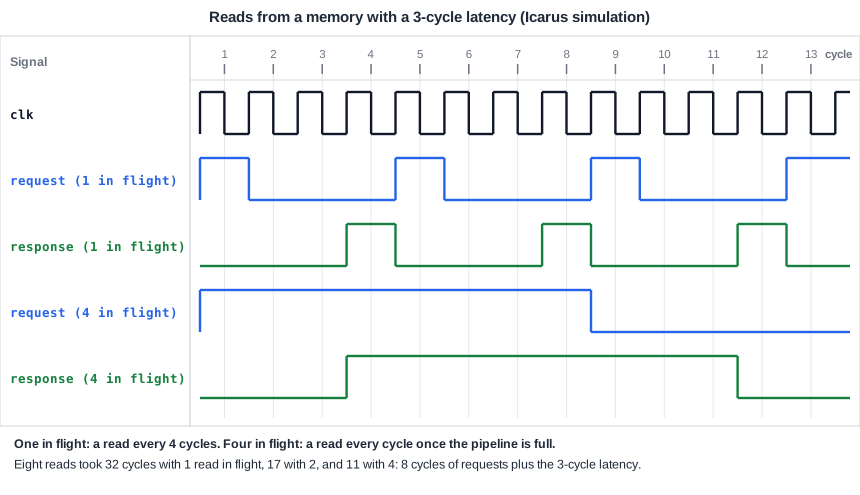
With one read in flight, every read costs four cycles: one to issue, three of latency, and the next request only after the response. With four in flight, a request goes out in every cycle, and eight reads take eight cycles of requests plus the three-cycle latency of the last one. The memory was the same in all three runs; only the master's willingness to have reads in flight changed.
The rule of thumb: to keep a pipelined slave busy, a master needs at least as many outstanding transactions as the round-trip time in cycles. Here, the memory answers three cycles after a request, and the master can react one cycle after that, so four in flight are enough and more would not help.
Quick Check
Q: Why does going from 2 to 4 reads in flight help, but going from 4 to 8 would not?
Show Answer
With 4 in flight the master already issues a request in every cycle, the most the bus allows. Extra capacity for outstanding reads cannot make requests go out faster than one per cycle.
Running It in ChipVerify Lab
The example runs the three masters side by side, each with its own copy of the memory. Run it and compare the request and response patterns in the waveform.
Common Mistakes
Mistake #1: Confusing latency with throughput
A slow answer does not mean a slow slave. A pipelined memory with a long latency can still finish one transfer per cycle, if the master keeps enough requests in flight.
Mistake #2: Too few outstanding transactions
A master that allows only one outstanding read wastes most of the bandwidth of a pipelined slave. Size the limit from the round-trip latency.
Mistake #3: Forgetting that responses must be matched to requests
With several transactions in flight, each response must be matched to its request. In-order slaves make that easy; slaves that answer out of order need transaction IDs, as AXI provides.
Practice Exercise
Challenge: A Slower Memory
Open the example. Change the memory latency from 3 to 5 cycles in all three instances, and the second master from 2 to 6 reads in flight. Predict the cycle counts for 1, 6 and 4 reads in flight, then run it.
Hint
One read in flight costs latency plus one cycle per read. With enough reads in flight, eight reads take eight cycles plus the latency.
Solution
One in flight: 48 cycles, six per read. Six in flight: 13 cycles, eight requests plus a latency of 5. Four in flight: 15 cycles, because four is now fewer than the round trip of six, so the master has to pause. The longer the latency, the more outstanding transactions a master needs.
Open the ready-made example in the lab and run the simulation.
Summary
- Latency is the time to an answer; throughput is answers per cycle. A pipelined slave can have a long latency and full throughput.
- Pipelined buses split transfers into address and data phases that overlap between consecutive transfers.
- Outstanding transactions let a master keep requesting while earlier responses are on their way.
- Eight reads from a 3-cycle memory took 32 cycles with 1 in flight, 17 with 2 and 11 with 4.
