
When a cache misses, there is a reason, and the reason decides the cure. Some misses are unavoidable, some mean the cache is too small, and some mean the blocks happen to collide. This three-part view of misses, together with the average memory access time formula, lets an engineer predict what a change will do before making it. This article explains the three kinds of miss, measures them on real programs, works through multi-level AMAT, and shows how the miss rate turns into CPI.
12 min read | Intermediate
What You'll Learn
- Classify a miss as compulsory, capacity or conflict
- Choose the right cure for each kind of miss
- Calculate AMAT for one and two levels of cache
- Convert a miss rate into cycles per instruction
The Three Cs
A classification proposed by Mark Hill in the 1980s splits misses into three kinds, known as the three Cs:
- A compulsory miss, also called a cold miss, is the very first access to a block. The block has never been in the cache, so nothing could have prevented the miss, short of fetching it early.
- A capacity miss happens because the program needs more data than the cache can hold. Even a fully associative cache of the same size would have missed: the block was evicted earlier for lack of room.
- A conflict miss happens because of how blocks map to sets. A fully associative cache of the same size would have hit, but in this cache too many active blocks fell in one set.
The definitions suggest how to measure them. Run the address trace through three models. A block never seen before counts as compulsory. Otherwise, if a fully associative LRU cache of the same size also misses, it is capacity. If that cache would have hit, it is conflict.
What Real Programs Show
Here is that measurement for a 1 KB direct-mapped data cache on four small programs, with 16-byte lines:
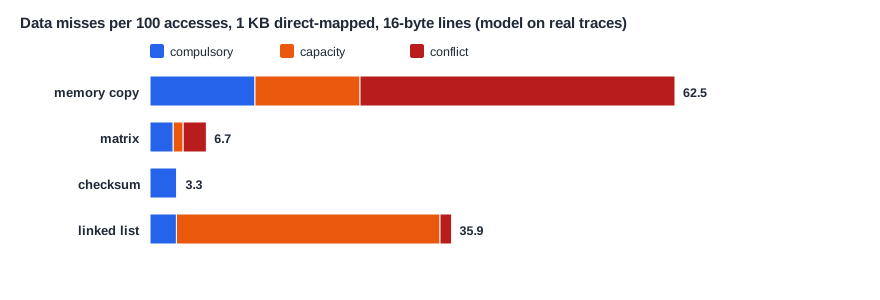
Each program has a different problem.
The checksum reads a table and a buffer that fit in the cache. Nearly all of its misses are compulsory: it pays once to bring each block in, and it never misses on it again. The 3 percent left is the price of the first touch.
The memory copy is mostly conflict misses. Its two arrays are each larger than the cache, so it has capacity misses too. But its source and destination elements also keep landing on the same lines, pushing each other out. With a 4-way cache of the same size, its conflict misses disappear, and the miss rate falls from 62.5 to 25 percent.
The linked list is mostly capacity misses. Its data spans about 6 KB, six times the cache size. In this case, associativity does nothing: at 4 ways, it had 36.6 percent misses compared with 35.9 at direct-mapped, a slight worsening. The only cure is more capacity.
A strange thing appears here. A direct-mapped cache can sometimes beat a fully associative one, so a "conflict" count can be odd in detail, because LRU replacement is not perfect. The three Cs are a useful way to think, rather than exact physics.
Curing Each Kind
Once you know the type, the cure follows:
| Miss type | What helps | What does not |
|---|---|---|
| compulsory | longer lines, prefetching | a larger or more associative cache |
| capacity | a larger cache, or code that uses less data at a time | more associativity |
| conflict | more associativity, a larger cache, changing where data is placed | longer lines may make it worse |
Software can help too. A programmer who knows the cache can split a large computation into blocks that fit in it, which is called loop tiling or blocking. It is a standard trick in matrix libraries. Moving a buffer can cure a conflict. Packing the fields of a structure together improves spatial locality.
Quick Check
Q: A program's miss rate falls sharply when the cache goes from direct-mapped to 2-way, with the same size. What kind of miss was it, and why?
Show Answer
Conflict misses. Size did not change, so capacity did not change, and the same blocks are touched, so compulsory misses did not change. Only the mapping of blocks to sets changed.
Average Memory Access Time
The Memory Hierarchy and Locality introduced this formula:
AMAT = hit time + miss rate x miss penalty
Its value is that it shows how the three parts trade against each other. Say a 1-cycle, 8 KB cache misses 8 percent of the time, with a 40-cycle penalty: AMAT = 1 + 0.08 x 40 = 4.2 cycles. A 32 KB cache misses 3 percent of the time, but it takes 2 cycles to hit: AMAT = 2 + 0.03 x 40 = 3.2 cycles. The larger cache wins, despite the slower hit. If the penalty were only 10 cycles, the numbers would be 1.8 against 2.3, and the smaller one would win. These numbers are assumptions for this example, but the logic holds: the larger the penalty, the more a low miss rate is worth.
Two Levels
With two levels of cache, the penalty of the first level is itself an AMAT:
AMAT = L1 hit time + L1 miss rate x (L2 hit time + L2 miss rate x L2 miss penalty)
The L2 miss rate here is the local miss rate: of the accesses that reach L2, the share that miss. Take L1: 1 cycle, 5 percent misses. L2: 10 cycles, 40 percent local misses. DRAM: 100 cycles more:
AMAT = 1 + 0.05 x (10 + 0.40 x 100)
     = 1 + 0.05 x 50
     = 3.5 cycles
Without the L2, it would be 1 + 0.05 x 100 = 6 cycles, or more with a slow memory. A 40 percent local miss rate looks terrible, but L2 sees only the accesses that L1 could not handle, so it is a hard stream by nature. The global miss rate, the share of all accesses that reach DRAM, is 0.05 x 0.40 = 2 percent, and that is the number to compare with a one-level design.
From Miss Rate to CPI
Each instruction is fetched, and some access data, so:
stall cycles per instruction =
      instruction misses per instruction x penalty
    + data accesses per instruction x data miss rate x penalty
Take the linked-list program from above, where about 8 percent of the instructions are loads or stores. With a 1 KB data cache missing 36 percent of the time and a 20-cycle penalty, the data stalls come to about 0.08 x 0.36 x 20 = 0.58 cycles per instruction. On a core with a CPI of 1.1 otherwise, that is about a third of the run time. With an 8 KB cache, the miss rate falls to about 3 percent, and the stalls to 0.05 cycles per instruction. The penalty here is an assumption, and it would be several times higher with DRAM on a fast clock.
A warning: this works well for a simple pipeline, in which every miss freezes everything. In a large out-of-order core, the processor keeps working during a miss and several misses can overlap, so the true cost is less than the formula says. Out-of-Order Execution and Register Renaming explains why. MPKI, misses per thousand instructions, is the usual way to report it, for caches just as for branches.
Where Does This Matter?
Performance engineers use exactly this reasoning to read a profile. If the data-cache miss count is high but does not change when a data structure is reordered, the misses may be capacity, and the program needs a smaller working set. If two threads make each other slower for no clear reason, conflict in a shared cache may be the cause. Tools such as perf read the processor's hardware counters of misses per level, which give these numbers for real programs.
Classifying a Miss by Hand
A short example shows how the definitions work. Take a direct-mapped cache of 2 lines, where blocks 0 and 2 map to line 0 and blocks 1 and 3 map to line 1. The program reads blocks 0, 2, 0, 2:
| Access | Direct-mapped | Fully associative, 2 lines | Kind |
|---|---|---|---|
| 0 | miss | miss | compulsory (first touch) |
| 2 | miss, evicts 0 | miss | compulsory (first touch) |
| 0 | miss, evicts 2 | hit | conflict |
| 2 | miss, evicts 0 | hit | conflict |
Both blocks would fit in a 2-line cache, so the last two misses have nothing to do with capacity. A fully associative cache hits on them, so they are conflict misses. With 2 ways, this sequence would have only the two compulsory misses.
A script applies the same rule to every access of a real trace, which is how the chart in this article was produced.
What Happens During a Miss
A simple cache is blocking: while one miss is being served, it can do nothing else, and the pipeline waits. Larger processors use a non-blocking cache, which goes on serving hits, and even further misses, while earlier misses are outstanding. A small table of miss status holding registers (MSHRs) tracks each outstanding miss: which line is coming and which instructions are waiting for it. If a second access hits a line already on its way, it just joins the same entry. This matters because a real program's misses often come in bursts, and overlapping them reduces their total cost.
Non-blocking caches change how a miss rate should be read. Two misses that overlap cost less than two misses one after the other, so the same number of misses can cost a very different number of cycles, depending on how they cluster. This is one reason a simple AMAT figure is only a first estimate for a large core.
A Fourth C
With several cores, a fourth kind of miss appears. A coherence miss happens when another core writes to a block, which removes the copy from this core's cache. No size or associativity can stop that. Cache Coherence Protocols explains it. Also, the operating system switching between programs refills the cache with other data, so a program returning to a core may suffer many misses that are not compulsory in any deep sense.
Quick Check
Q: L1 misses 4 percent of accesses and L2's local miss rate is 25 percent. What is the global L2 miss rate? If L1 is made larger and misses only 2 percent, while the same number of accesses reach DRAM, what happens to L2's local miss rate?
Show Answer
Global rate: 0.04 x 0.25 = 1 percent. With fewer accesses reaching L2 but the same 1 percent going to DRAM, the local rate becomes 0.01 / 0.02 = 50 percent. The L2 looks worse, although the system is unchanged or better. Local rates depend on what the level above filters out.
Common Mistakes
Mistake #1: Adding associativity to fix capacity misses
If the data does not fit, moving it around the sets does nothing. Find out what kind of miss you have, by comparing with a fully associative model, before choosing a cure.
Mistake #2: Comparing local miss rates between levels
A local miss rate of 40 percent in an L2 is normal and does not mean it is failing. Use global miss rates or AMAT to compare designs.
Mistake #3: Ignoring the hit time
A larger or more associative cache may lower the miss rate but lengthen the hit time, and on a first-level cache, the hit time affects every access. Compare AMAT, not the miss rate alone.
Practice Exercise
Challenge: One Level or Two?
A core has a 2-cycle L1 with a 6 percent miss rate. DRAM takes 120 cycles. These numbers are assumptions for this exercise. Option A is to double L1, which lowers its miss rate to 4 percent but raises its hit time to 3 cycles. Option B is to add an L2 of 12 cycles with a 30 percent local miss rate. (a) What is the AMAT today? (b) With option A? (c) With option B? (d) Which is better, and what does it do to the global miss rate?
Hint
For option B, the L1 miss penalty becomes 12 + 0.30 x 120.
Solution
(a) 2 + 0.06 x 120 = 9.2 cycles. (b) 3 + 0.04 x 120 = 7.8 cycles. (c) 2 + 0.06 x (12 + 36) = 4.88 cycles. (d) Option B is far better. Its global miss rate is 0.06 x 0.30 = 1.8 percent, against 4 percent for option A. That is why almost all fast processors have at least two levels of cache.
Summary
- Misses are compulsory (first touch), capacity (too little room) or conflict (too many blocks in a set).
- The type decides the cure: associativity fixes conflict but not capacity.
- On real programs, one was all compulsory, one mostly conflict and one mostly capacity.
- AMAT = hit time + miss rate x penalty, and the penalty of one level is the AMAT of the next.
- Use global miss rates and AMAT to compare designs, not local miss rates.
