
Most interesting rules span several clock cycles: "after a start, done comes within 3 cycles", "a request is held until it is granted", "busy is never high for more than 4 cycles in a row". SVA describes such behavior with sequences, built from cycle delays and repetitions, and with implication, which says when a sequence must hold. This article explains the operators you will use every day and checks a latency rule on a small job unit with a real bug.
11 min read | Beginner to Intermediate
What You'll Learn
- Build sequences with
##N,##[m:n]and the repetition[*N] - Use the implications
|->and|=>and explain the difference - Write a latency rule with a window, such as "done within 1 to 3 cycles"
- Express the same rules in the lab with helper counters and
$past
Sequences
A sequence is a pattern of conditions over consecutive clock cycles. The basic operator is the cycle delay ##:
a ##1 b:ain one cycle andbin the next.a ##2 b:btwo cycles aftera. The cycle in between can hold anything.a ##[1:3] b:bone, two or three cycles aftera. The range is inclusive.a ##[1:$] b:bat some point aftera, with no upper limit.
Repetition says that a condition holds over several cycles in a row:
a [*3]:ain three consecutive cycles, the same asa ##1 a ##1 a.a [*2:4]:ain two to four consecutive cycles.
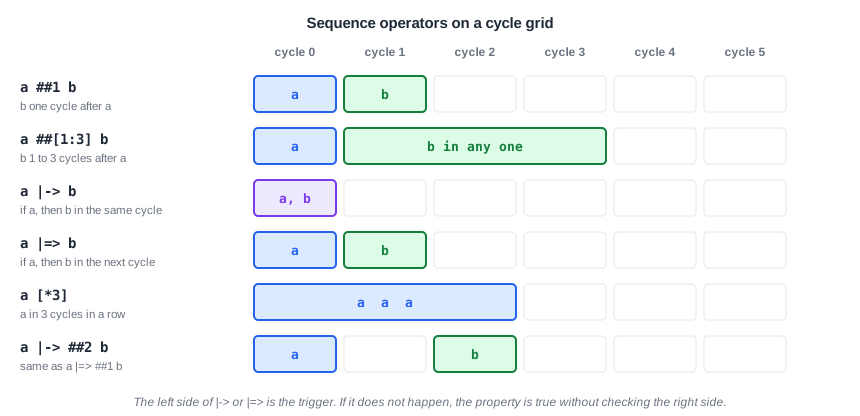
A sequence on its own is not a rule. It describes a pattern that may or may not happen. To turn it into a property, you either say it must never happen, as in not (busy [*5]), or you use an implication.
Implication
Implication connects a trigger to a consequence. It is written trigger |-> consequence or trigger |=> consequence:
a |-> bis the overlapping implication: wheneveraholds,bmust hold in the same cycle.a |=> bis the non-overlapping implication: wheneveraholds,bmust hold in the next cycle. It is the same asa |-> ##1 b.
Both sides can be sequences. When the trigger is a sequence, the consequence starts in the last cycle of the trigger (for |->) or the cycle after it (for |=>). For example, req ##1 !ack |=> req says: if there is a request and no acknowledge in the next cycle, the request must still be there one cycle later.
The most important property of implication: if the trigger does not happen, the property passes in that cycle without checking anything. This is called a vacuous pass. It is what you want most of the time, but it also means that a trigger that never happens makes the whole property meaningless. Chapter 4 covers vacuity and how covers protect you from it.
Quick Check
Q: Are a |=> b and a |-> ##1 b the same property? And a |-> b and a ##0 b?
Show Answer
The first two are the same. The second pair is not: a ##0 b is a sequence that requires a and b together, so as an assertion it fails in every cycle where a is low. a |-> b only checks b when a is high.
The Design: a Job Unit With Two Latencies
This unit accepts a job on start and signals done when it is finished. A short job takes 1 cycle and a long job, marked by long, takes 3. It is the kind of timing a memory controller has for a hit and a miss. The counter is loaded with the remaining time and done is high when it reaches 1:
module delay_unit (input clk, input rst, input start, input long, output done, output busy);
  reg [2:0] cnt;
  assign busy = (cnt != 3'd0);
  assign done = (cnt == 3'd1);
  always @(posedge clk)
    if (rst)                 cnt <= 3'd0;
    else if (start && !busy) cnt <= long ? 3'd4 : 3'd1;   // bug: a long job should load 3
    else if (busy)           cnt <= cnt - 3'd1;
endmodule
The long job loads 4, so it takes one cycle more than the specification allows.
The Properties
The specification says: a new job only starts when the unit is idle, and every job is done within 1 to 3 cycles.
m_nostart: assume property (@(posedge clk) disable iff (rst) busy |-> !start);
a_lat:     assert property (@(posedge clk) disable iff (rst) start |-> ##[1:3] done);
The assumption keeps the tool from starting a job while one is running, which the unit does not support. The assertion is a latency window. It does not care whether the job is short or long, only that it finishes in time. You can also state each latency exactly:
a_short: assert property (@(posedge clk) disable iff (rst) start && !long |=> done);
a_long:  assert property (@(posedge clk) disable iff (rst) start && long |=> !done [*2] ##1 done);
a_long reads: after a long start, done is low for two cycles and then high. The window rule is looser and easier to keep when the design changes. The exact rules catch more bugs, as the exercise shows.
Running It in ChipVerify Lab
The lab engine has no ##. Multi-cycle rules are written with a small helper counter that measures time, plus an ordinary assertion on the counter. For the latency window, the counter waited counts the cycles since the start, and the rule says it never passes 3:
`ifdef FORMAL
  reg init = 1'b1;
  always @(posedge clk) init <= 1'b0;
  always @(*) if (init) assume (rst);
  always @(*) if (busy) assume (!start);           // no new job while busy
  // start |-> ##[1:3] done, written with a helper counter: cycles waited since the start
  reg [2:0] waited = 3'd0;
  always @(posedge clk)
    if (rst || done)           waited <= 3'd0;
    else if (start || waited)  waited <= waited + 3'd1;
  always @(posedge clk) if (!init) assert (waited <= 3'd3);
  // done never comes without a job
  always @(posedge clk) if (!init && done) assert (waited != 3'd0);
`endif
This pattern, a counter that measures time and an assertion on its value, is how bounded multi-cycle rules are written in any language without sequences. Commercial tools build the same kind of monitor internally from the SVA. The second assertion checks the other direction: a done with no job waiting is also a bug.
The run fails at step 6:
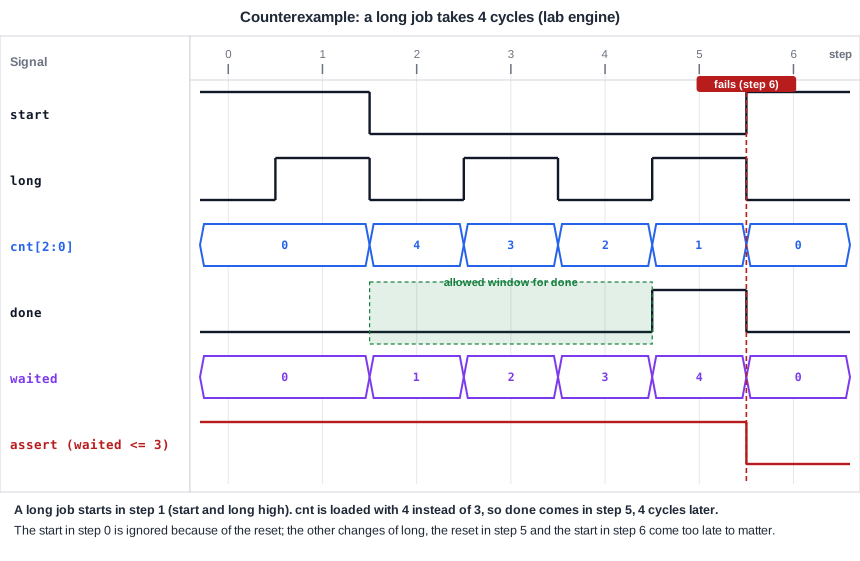
A long job starts in step 1. The counter is loaded with 4, counts down, and reaches 1 in step 5, so done comes four cycles after the start. waited is 4 in step 5, and the assertion reports it in step 6. Load 3 instead of 4 and the run passes.
Quick Check
Q: How would you change the helper counter version to check start |-> ##[1:5] done?
Show Answer
Keep the counter and change the assertion to waited <= 3'd5. The counter needs enough bits to count past the limit, so 3 bits are still enough here.
Translating Other Operators
The same idea works for the other operators:
| SVA | Lab form |
|---|---|
a |-> b | if (a) assert (b); |
a |=> b | if ($past(a)) assert (b); |
a |-> ##3 b | if ($past(a, 3)) assert (b); |
not (a [*4]) | a counter of consecutive cycles with a, asserted <= 3 |
a |-> ##[1:N] b | a counter of cycles since a without b, asserted <= N |
Remember the reset guard for every $past: a check that looks back n cycles must skip cycles whose history includes a reset or the start of the trace.
Common Mistakes
Mistake #1: Confusing |-> and |=>
For a registered output, the result appears in the cycle after the trigger, so the rule needs |=>. With |-> the check runs one cycle too early and fails on correct designs, or passes on wrong ones by accident.
Mistake #2: Using an unbounded delay in a bounded check
start |-> ##[1:$] done can never fail within a bounded run, because the tool can always claim that done comes after the last cycle it looks at. Use a bounded window such as ##[1:3] whenever the specification gives a limit.
Mistake #3: Forgetting that a missing trigger passes
If start can never happen, for example because of an assumption that is too strong, the latency rule passes without ever being checked. Add a cover for the trigger, such as cover property (@(posedge clk) start && long);.
Practice Exercise
Challenge: Exact Latencies
Open the example and run it. Then write the exact rules a_short and a_long in the lab form and remove the window assertion. Run on the buggy design, then on a design where a long job loads 2 instead of 3, so it is too fast. Which rules catch which bug?
Hint
A long job started 3 cycles ago is visible as $past(start, 3) && $past(long, 3). Guard against resets in each of those cycles. For "not before", check that done is low one cycle after a long start.
Solution
// a short job is done exactly 1 cycle after the start
always @(posedge clk)
  if (!init && !rst && !$past(rst) && $past(start) && !$past(long))
    assert (done);
// a long job is done exactly 3 cycles after the start, and not before
always @(posedge clk)
  if (!init && !rst && !$past(rst) && !$past(rst, 2) && !$past(rst, 3) && $past(start, 3) && $past(long, 3))
    assert (done);
always @(posedge clk)
  if (!init && !rst && !$past(rst) && $past(start) && $past(long))
    assert (!done);
On the original bug the exact rules fail at step 5, one step earlier than the window rule, because done is missing in the third cycle. On the too-fast design the window rule passes, since 2 cycles is inside the window of 1 to 3, but the exact rules fail at step 5. A window is the right rule when the specification gives a range. When it gives an exact latency, check the exact value.
Open the ready-made example in the lab and run the formal check from the formal panel. The free tier allows a depth of up to 10 cycles, and PRO allows up to 100.
Summary
##Nand##[m:n]delay a condition by a fixed number or a range of cycles.[*N]repeats it in consecutive cycles.|->checks the consequence starting in the same cycle as the trigger,|=>starting in the next one.- An implication whose trigger never happens passes vacuously. Cover the trigger.
- A latency window such as
start |-> ##[1:3] donefound a job unit that needed 4 cycles. - In the lab, multi-cycle rules use helper counters and
$past(x, n), with reset guards for the history they need.
