
Control properties check that signals behave: counts stay in range, handshakes are held. Data integrity properties check what the design is for: every word that goes in comes out, unchanged, in the right order. They are harder to write, because a FIFO or a pipeline can hold many words at once. This article shows the standard formal technique for them, the tracked value, also called the magic value, and uses it to find a FIFO bug that every count-based check misses.
11 min read | Intermediate
What You'll Learn
- Explain why data integrity needs more than control properties
- Check a fixed-latency pipeline with
$past(data, N) - Follow one freely chosen value through a FIFO with the tracked value technique
- Find a write-pointer bug that leaves the count of a FIFO correct
The Simple Case: Fixed Latency
When a block always takes the same number of cycles, data integrity is one line. A pipeline with two register stages must output what it received two cycles earlier:
a_pipe: assert property (@(posedge clk) disable iff (rst) ##2 dout == $past(din, 2));
With a valid signal, the rule only applies to valid words: out_valid |-> dout == $past(din, 2). In the lab form this is if (...) assert (dout == $past(din, 2)); with the usual reset guards for two cycles of history.
Many blocks are not that simple. A FIFO holds a word for as long as the reader is busy, so the delay between input and output depends on the traffic. $past with a fixed number of cycles cannot describe that.
The Idea of the Tracked Value
A simulation scoreboard keeps a copy of every word in a queue and compares each output with the oldest copy. A formal tool cannot keep an unbounded queue, and it does not need to. It is enough to follow a single word, as long as the tool may choose which word.
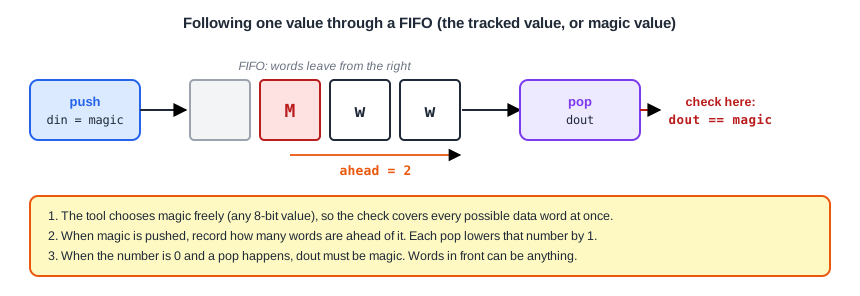
- Declare a value
magicthat the tool chooses freely at the start and that never changes. - When
magicis pushed for the first time, record how many words are in front of it. - On every pop, lower that number by 1.
- When the number is 0 and a pop happens, the word that comes out must be
magic.
Because the tool chooses magic and the inputs freely, it effectively tries every data value in every position. If any word could be lost, overwritten, duplicated or reordered, there is a choice of magic and inputs that shows it. One small counter replaces a full scoreboard.
Quick Check
Q: The check follows only one word. Why does it still cover every word that passes through the FIFO?
Show Answer
The tool chooses magic and the input sequence freely. Any word in any position can be the tracked one, so a failure for any word is a failure for some choice of magic, and the tool finds that choice.
The Design: a 4-Entry FIFO
The FIFO stores up to 4 bytes in a small memory, with a write pointer, a read pointer and a count. A push writes at wptr, a pop reads at rptr:
module fifo4 (input clk, input rst,
              input push, input [7:0] din, input pop,
              output [7:0] dout, output full, output empty);
  reg [7:0] mem [0:3];
  reg [1:0] wptr, rptr;
  reg [2:0] count;
  assign full  = (count == 3'd4);
  assign empty = (count == 3'd0);
  assign dout  = mem[rptr];
  wire do_push = push && !full;
  wire do_pop  = pop && !empty;
  always @(posedge clk)
    if (rst) begin
      wptr <= 2'd0; rptr <= 2'd0; count <= 3'd0;
    end else begin
      if (do_push) mem[wptr] <= din;
      if (do_push && !do_pop) wptr <= wptr + 2'd1;   // bug: should be if (do_push)
      if (do_pop)  rptr <= rptr + 2'd1;
      count <= count + do_push - do_pop;
    end
endmodule
The designer treated a push and a pop in the same cycle as "nothing changes", which is true for the count but not for the pointers. When both happen, the word is written but the write pointer does not move, so the next push overwrites it.
The Tracked Value in SVA
The tracking logic is ordinary RTL. Only the final check is an assertion. In SVA flows, magic is often an undriven signal that the tool may set freely, with an assumption that keeps it constant:
m_magic: assume property (@(posedge clk) $stable(magic));
a_order: assert property (@(posedge clk) disable iff (rst)
                          tracking && ahead == 3'd0 && do_pop |-> dout == magic);
Here tracking is 1 while magic is inside the FIFO and ahead is the number of words in front of it, both computed by the helper logic below.
Running It in ChipVerify Lab
Yosys has a direct way to declare a value that the tool chooses once and keeps: the attribute (* anyconst *). The whole check:
`ifdef FORMAL
  reg init = 1'b1;
  always @(posedge clk) init <= 1'b0;
  always @(*) if (init) assume (rst);
  always @(posedge clk) if (!init) assert (count <= 3'd4);

  // tracked value: one word, chosen freely by the tool, followed through the FIFO
  (* anyconst *) reg [7:0] magic;
  reg       tracking = 1'b0;   // magic is inside the FIFO
  reg       done     = 1'b0;   // magic has already been through once
  reg [2:0] ahead;             // number of words in front of magic
  always @(posedge clk)
    if (rst) begin
      tracking <= 1'b0; done <= 1'b0;
    end else if (!tracking && !done && do_push && din == magic) begin
      tracking <= 1'b1;
      ahead    <= count - do_pop;
    end else if (tracking && do_pop) begin
      if (ahead == 3'd0) begin tracking <= 1'b0; done <= 1'b1; end
      else               ahead <= ahead - 3'd1;
    end
  // when magic reaches the head of the FIFO and is popped, the output is magic
  always @(posedge clk) if (!init && !rst && tracking && ahead == 3'd0 && do_pop) assert (dout == magic);
`endif
Two details matter. When magic is pushed in the same cycle as a pop, one of the words in front leaves at once, so ahead starts at count - do_pop. And only the first push of magic is tracked. If the same value is pushed again later, the first copy still comes out first, so the check stays correct.
The run fails at step 5. The tool chose magic = 255:
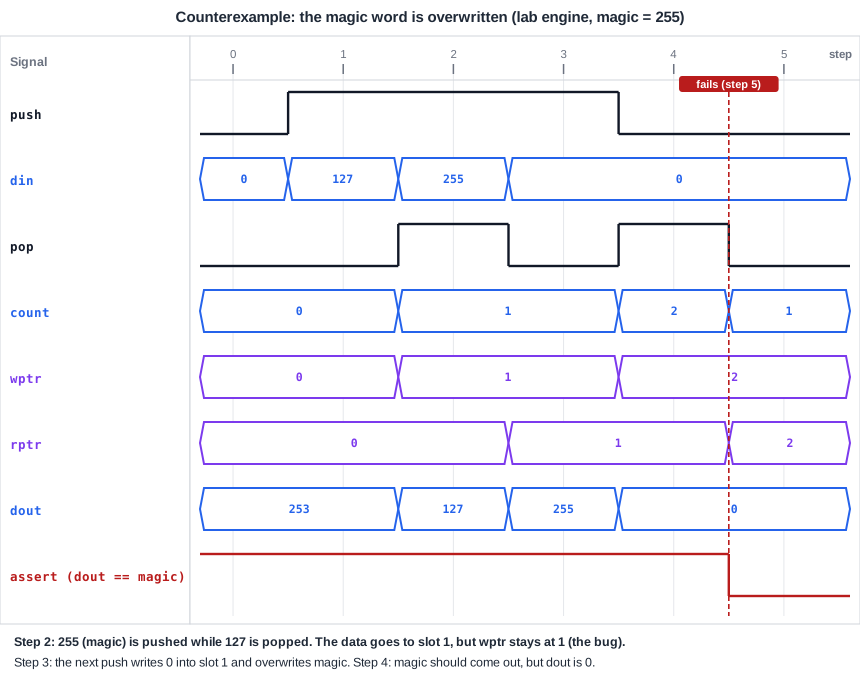
In step 1, 127 is pushed into slot 0. In step 2, 255 is pushed while 127 is popped: 255 goes into slot 1, but the write pointer stays at 1. In step 3, the next push writes 0 into slot 1, overwriting 255. In step 4, 255 should come out, but dout is 0. The word was lost.
The count assertion passes on this trace, and it passes on the buggy FIFO at any depth: the count is updated correctly, only the data is wrong. Remove the tracked value and the run is a clean PASS. With the fix, if (do_push) wptr <= wptr + 2'd1;, the full check passes.
Quick Check
Q: Why is ahead set to count - do_pop and not just count?
Show Answer
If a pop happens in the same cycle as the push of magic, the oldest word leaves in that cycle, so one fewer word is in front of magic afterwards.
Common Mistakes
Mistake #1: Checking only the count and the flags
Count, full and empty can all be right while the data is wrong, as this FIFO shows. Every storage block needs a data property.
Mistake #2: Letting magic change during the run
If magic is an ordinary free input, the tool can change it after the push and report a false failure. Keep it constant with (* anyconst *) in the lab, or with an assumption $stable(magic) in SVA.
Mistake #3: Getting the position wrong in corner cases
Simultaneous push and pop, a push into a full FIFO and a pop from an empty one all change the position of magic. Base the tracking on the accepted operations, do_push and do_pop, not on the raw requests.
Practice Exercise
Challenge: A Different Data Bug
Open the example, run it, and fix the write pointer. Then introduce a new bug: read the output from the wrong slot, with assign dout = mem[rptr + 2'd1];. Before you run, predict which of the two assertions fails. Then run and read the counterexample.
Hint
Does the new bug change count in any way?
Solution
Only the tracked value assertion fails, at step 3. The count logic is untouched, so the count assertion passes. In the counterexample, magic reaches the head of the FIFO, but dout shows the next slot, which holds a different value. Restore mem[rptr] and the run passes again.
Open the ready-made example in the lab and run the formal check from the formal panel. The free tier allows a depth of up to 10 cycles, and PRO allows up to 100.
Summary
- Control properties do not check data. Storage and transport blocks need data integrity properties.
- For a fixed latency,
dout == $past(din, N)is enough. - For variable latency, the tracked value technique follows one freely chosen word and checks it comes out when it reaches the head.
- The tool chooses
magic, so the check covers every value in every position. Keep it constant with(* anyconst *)or$stable. - A write pointer that did not move on a simultaneous push and pop passed every count check and was found by the tracked value at step 5.
