
Two more standard questions are often answered with formal apps. X-propagation asks whether an unknown value, from a register without a reset or an uninitialized memory, can reach an output that matters. Unreachable code asks which parts of the RTL can never execute, such as a case branch for an input value that never arrives. This article answers both with plain property checks: the first with two copies of a design, the second with meant-to-fail checks for each branch.
8 min read | Intermediate
What You'll Learn
- Explain the X-propagation problem and why simulation handles it badly
- Check that unknown start values cannot reach the outputs, with two copies of a design
- Find code that can never execute under the environment assumptions
- Decide what to do with unreachable code
The X Problem
In simulation, a register without a reset starts as X, meaning unknown. Simulators propagate X through logic, but not exactly: an if (x) with an X condition takes the else branch, and some operators turn X into 0 or 1. So simulation can hide an X that would be a real random value in silicon, or report an X that cannot matter. This is called X-optimism and X-pessimism, and it is why X-propagation apps exist.
Formal has no X: every register has a real 0 or 1 value, chosen freely if there is no reset. That is a precise model of silicon. To ask "can an unknown start value matter?", compare two copies of the design that start with different free values.
The Two-Copy Check
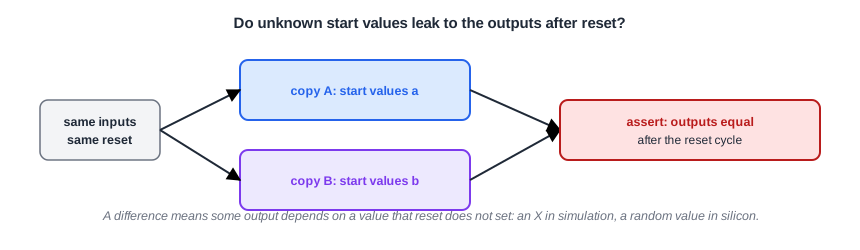
Two instances of the design get the same inputs and the same reset. The formal tool gives the registers of each instance their own free start values. If, after the reset, any output can differ between the copies, then that output depends on a value the reset does not set.
module xprop_two (input clk, input rst, input in_valid, input [7:0] in_data);
  // two copies of the same design, same inputs; registers without a reset start at independent free values
  wire v_a, v_b; wire [7:0] d_a, d_b;
  valid_pipe u_a (.clk(clk), .rst(rst), .in_valid(in_valid), .in_data(in_data), .out_valid(v_a), .out_data(d_a));
  valid_pipe u_b (.clk(clk), .rst(rst), .in_valid(in_valid), .in_data(in_data), .out_valid(v_b), .out_data(d_b));
`ifdef FORMAL
  reg init = 1'b1;
  always @(posedge clk) init <= 1'b0;
  always @(*) if (init) assume (rst);
  // after reset, the start values must not matter: valid outputs agree, and so does valid data
  always @(*) if (!init && !rst) assert (v_a == v_b);
  always @(*) if (!init && !rst && v_a && v_b) assert (d_a == d_b);
`endif
endmodule
Applied to the pipeline from the reset and initial state article, whose second valid bit has no reset, the check fails at step 1: one copy shows a valid output right after reset, the other does not. The data registers have no reset either, but that is fine: the second assertion only compares data when it is valid. With the valid bit added to the reset, the check passes.
Quick Check
Q: Why does the data comparison only apply when the output is valid?
Show Answer
Data registers without a reset may legally hold different values in the two copies until real data arrives. The specification only cares about data marked valid, so the check compares exactly that.
Unreachable Code
Code that can never execute is either dead logic, which wastes area and confuses readers, or a sign of a bug: a condition that was meant to happen but cannot. Simulation coverage reports such code as "not covered" without saying whether it ever could be. Formal answers the question.
This decoder has a branch for a reserved opcode that the upstream block never sends:
module dec_dead (input clk, input rst, input [1:0] op, input [7:0] x, output reg [7:0] y);
  always @(posedge clk)
    if (rst) y <= 8'd0;
    else case (op)
      2'd0: y <= x;
      2'd1: y <= x + 8'd1;
      2'd2: y <= x << 1;
      2'd3: y <= 8'hFF;                       // reserved opcode: upstream never sends it
    endcase
endmodule
With the environment assumption op != 3, a meant-to-fail check per branch shows which are reachable:
always @(*) assume (op != 2'd3);                         // environment: opcode 3 is reserved
always @(*) if (!init && !rst) assert (op != 2'd2);       // branch 2: fails, so reachable
always @(*) if (!init && !rst) assert (op != 2'd3);       // branch 3: passes, so unreachable
Branch 2 fails at step 1: reachable. Branch 3 passes: under the assumptions, it can never execute. An unreachable-code app does this for every branch, condition and expression automatically.
What to Do With Unreachable Code
- Intended defensive code, such as a reserved-opcode branch or a
defaultrecovery, stays, and is excluded from coverage with a note. - Dead code left from an older version is removed.
- Code that should be reachable points to a bug, or to an over-constraining assumption, and must be investigated.
Quick Check
Q: A branch is unreachable only because of an assumption. What does that mean for the design if the assumption is ever violated?
Show Answer
The branch becomes reachable, and its behavior suddenly matters. Defensive branches like the reserved-opcode case exist exactly for that situation, which is why they are kept rather than deleted.
Running It in ChipVerify Lab
The example contains the pipeline with the missing reset and the two-copy check. Set the top module to xprop_two and run: it fails at step 1. The decoder example from this article is included as a second file; set the top module to dec_dead to run it.
Common Mistakes
Mistake #1: Trusting simulation X results
Simulators can be both too optimistic and too pessimistic about X. Formal models real 0 and 1 values, which is what silicon has.
Mistake #2: Comparing all data in the two-copy check
Data registers without a reset differ legitimately. Compare data only where the specification requires it, such as when it is marked valid.
Mistake #3: Deleting every unreachable branch
Some unreachable code is defensive by design. Decide branch by branch, and document the ones you keep.
Practice Exercise
Challenge: Stop the Leak
Open the example and run the two-copy check. Read the counterexample: which copy shows a valid output right after reset? Fix the pipeline by adding the second valid bit to the reset, and run again.
Hint
Look at v_a and v_b in step 1.
Solution
In step 1, one copy has a valid output and the other does not: their second valid bits started with different free values, and the reset did not clear them. With if (rst) begin v1 <= 1'b0; v2 <= 1'b0; end else begin v1 <= in_valid; v2 <= v1; end the check passes: after reset, no output depends on a start value.
Open the ready-made example in the lab and run the formal check from the formal panel. The free tier allows a depth of up to 10 cycles, and PRO allows up to 100.
Summary
- Simulation treats unknown values imprecisely; formal uses real free values, as in silicon.
- Two copies of a design with independent start values reveal any output that depends on a value the reset does not set.
- The pipeline with an unreset valid bit failed the two-copy check at step 1.
- Meant-to-fail checks per branch separate reachable code from unreachable code under the assumptions.
- Keep defensive unreachable code, remove dead code, and investigate code that should be reachable.
