
Long valid/ready pipelines have a timing problem: the ready signal travels backwards through every stage in one clock cycle. A skid buffer breaks that path by registering ready, at the cost of a second register that catches the one word that arrives while the output stalls. The control logic is small and full of corner cases, exactly the kind of block where formal finds bugs that tests miss. This article checks a skid buffer for protocol rules and data integrity and finds a word that is sent twice.
10 min read | Intermediate
What You'll Learn
- Explain what a skid buffer does and why its ready signal is a register
- Check a pipeline stage with input assumptions and output assertions
- Use a tracked value to detect lost, duplicated and reordered words
- Find a duplication bug that appears when a word arrives and leaves in the same cycle
Why a Skid Buffer
In a plain pipeline stage, in_ready is a function of out_ready: the stage can accept a word if its output is being taken. Chain ten such stages and the ready signal passes through ten levels of logic in one cycle. A skid buffer makes in_ready a register instead. Because the sender sees the stall one cycle late, one more word may arrive after the output stops, and the skid register holds it.
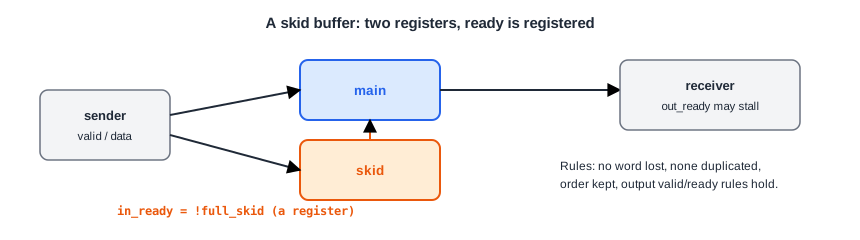
The Properties
A pipeline stage sits between two interfaces, so it gets assumptions on one side and assertions on the other, as in the input protocol assumptions article:
- Input side (assumptions): the sender holds
in_validandin_datawhilein_readyis low. - Output side (assertions): the buffer holds
out_validandout_datawhileout_readyis low. - Data integrity (assertion): every accepted word comes out exactly once, in order, unchanged.
m_in_hold:  assume property (@(posedge clk) disable iff (rst) in_valid && !in_ready |=> in_valid && $stable(in_data));
a_out_hold: assert property (@(posedge clk) disable iff (rst) out_valid && !out_ready |=> out_valid && $stable(out_data));
The data check uses a tracked value: when the word magic is accepted, record how many words are ahead of it in the buffer, count them down as words leave, and check that the next word out is magic when the count reaches 0.
The Design
module skid (input clk, input rst,
             input in_valid, output in_ready, input [7:0] in_data,
             output out_valid, input out_ready, output [7:0] out_data);
  reg       full_main, full_skid;
  reg [7:0] main, skid_r;
  assign in_ready  = !full_skid;
  assign out_valid = full_main;
  assign out_data  = main;
  wire take = in_valid && in_ready;
  wire give = out_valid && out_ready;
  always @(posedge clk)
    if (rst) begin
      full_main <= 1'b0; full_skid <= 1'b0;
    end else begin
      if (full_skid) begin                       // drain the skid register first
        if (give) begin main <= skid_r; full_skid <= 1'b0; end
      end else if (take) begin
        if (!full_main)         begin main <= in_data; full_main <= 1'b1; end   // bug: ignores a word leaving main in the same cycle
        else                    begin skid_r <= in_data; full_skid <= 1'b1; end
      end else if (give) full_main <= 1'b0;
    end
endmodule
When a word arrives while main is full, the design parks it in the skid register. That is right if main is stalled, but wrong if main is handing out its word in the same cycle: then the new word should go straight into main.
Running It in ChipVerify Lab
The example contains the input assumption, the output assertion and the tracked-value check, written in the lab form. The run fails at step 3, and the tool chose magic = 254:
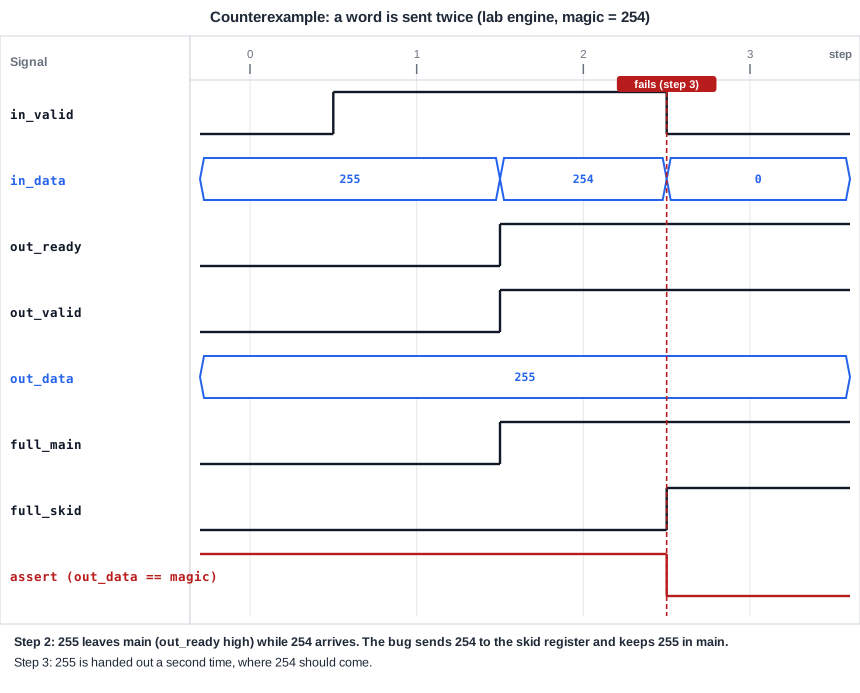
In step 1, the word 255 is accepted into main. In step 2, 255 is handed out (out_ready is high) while 254 arrives. The bug sends 254 to the skid register and leaves full_main set, so in step 3 the old word 255 is handed out a second time. The tracked value expected 254. With the fix, if (!full_main || give), all checks pass.
Quick Check
Q: Which property would catch this bug if the tracked-value check were missing?
Show Answer
None of the protocol rules. The output holds its data while stalled, and the input rules are assumptions. A duplicated word is a data error, and only a data property sees it. A reference count of words in and out would also catch it.
Corner Cases the Tool Explores
- A word arrives and leaves in the same cycle, at every fill level.
- The output stalls for one cycle, for many cycles, or toggles every cycle.
- The skid register fills and drains while new words wait at the input.
- Reset in the middle of all of these.
A simulation test would need a carefully designed traffic pattern for each. The formal run explores all of them in seconds, and the meant-to-fail check assert (!full_skid) confirms that the skid register is really used, at step 3.
Quick Check
Q: Why is there no assumption on out_ready?
Show Answer
A valid/ready receiver may drive ready however it likes. Leaving it free lets the tool try every stall pattern, which is where the bugs of a skid buffer hide.
Common Mistakes
Mistake #1: Testing only with a receiver that is always ready
The skid register is never used then, and its bugs never appear. Leave out_ready free.
Mistake #2: Checking only the protocol rules
A buffer can follow the handshake rules perfectly and still duplicate or drop words. Add a data property.
Mistake #3: Getting the "words ahead" count wrong in the tracked-value logic
A word that leaves in the same cycle as magic arrives is no longer ahead of it. Base the count on the accepted transfers, take and give.
Practice Exercise
Challenge: Fix the Skid Buffer
Open the example and run it. Fix the condition so that a new word goes into main when main is empty or is being emptied in the same cycle. Run again, then add a meant-to-fail check that the skid register is never full.
Hint
In the take branch, main can accept the new word if !full_main || give.
Solution
With if (!full_main || give) begin main <= in_data; full_main <= 1'b1; end all assertions pass at depth 10. The meant-to-fail check always @(*) if (!init) assert (!full_skid); fails at step 3, which shows that the skid register is used: two words arrive in a row while the output stalls.
Open the ready-made example in the lab and run the formal check from the formal panel. The free tier allows a depth of up to 10 cycles, and PRO allows up to 100.
Summary
- A skid buffer registers
in_readyand catches one extra word in a skid register. - Check a pipeline stage with assumptions on its input and assertions on its output, plus a data property.
- A buffer that parked a new word while handing out the old one sent the old word twice, found at step 3.
- Protocol rules alone did not see the bug; the tracked value did.
- Leave the receiver's ready signal free so the tool explores every stall pattern.
