
The depth of a bounded check is the one number that decides whether the check means anything. Too small, and the interesting behavior of the design never happens within the run, so every assertion passes vacuously. Too large, and the run is slow or times out. This article shows three practical ways to choose a depth: counting from the design, measuring with covers, and reasoning about the longest path from reset. A debouncer with an off-by-one bug shows all three.
9 min read | Intermediate
What You'll Learn
- Estimate the depth a check needs from reset latency, counters and pipeline stages
- Measure the depth with covers for the behaviors that matter
- Explain the reachability diameter and when a bounded check becomes complete
- Find a debouncer bug that appears only at depth 7 or more
The Design: a Debouncer
A mechanical button bounces: for a few milliseconds after a press, its contact opens and closes many times. A debouncer passes the input to its output only after the input has been stable for a number of cycles. This one should follow din after 4 stable cycles:
module debounce (input clk, input rst, input din, output reg dout);
  reg [2:0] cnt;
  always @(posedge clk)
    if (rst) begin
      cnt <= 3'd0; dout <= 1'b0;
    end else if (din == dout) begin
      cnt <= 3'd0;
    end else if (cnt == 3'd4) begin          // bug: should be 3
      dout <= din; cnt <= 3'd0;
    end else begin
      cnt <= cnt + 3'd1;
    end
endmodule
The counter counts the cycles in which din differs from dout. Comparing with 4 means it waits one cycle more than the specification allows.
The rule: once din has kept its value for 4 clock edges, dout equals it. A small helper, stab, counts how many edges in a row din has not changed:
`ifdef FORMAL
  reg init = 1'b1;
  always @(posedge clk) init <= 1'b0;
  always @(*) if (init) assume (rst);
  // helper: for how many clock edges in a row din has kept its value
  reg       prev = 1'b0;
  reg [3:0] stab = 4'd0;
  always @(posedge clk) begin
    prev <= din;
    stab <= (rst || din != prev) ? 4'd0 : (stab == 4'd15 ? stab : stab + 4'd1);
  end
  // once din has been stable for 4 edges, dout has followed it
  always @(posedge clk) if (!init && stab >= 4'd4 && din == prev) assert (dout == din);
`endif
Method 1: Count From the Design
Add up the cycles the behavior needs, starting from reset:
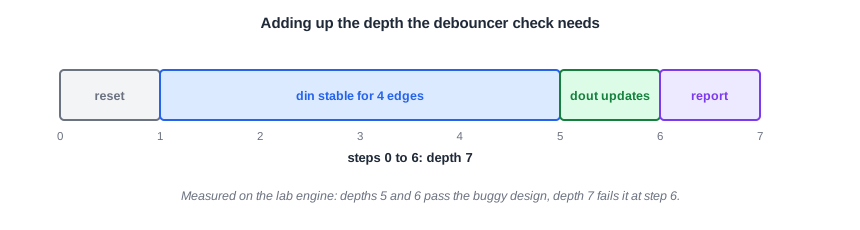
- 1 cycle of reset.
- 4 edges with a stable new value on
din. - 1 cycle in which
doutshould have changed. - 1 step for the clocked assertion to report.
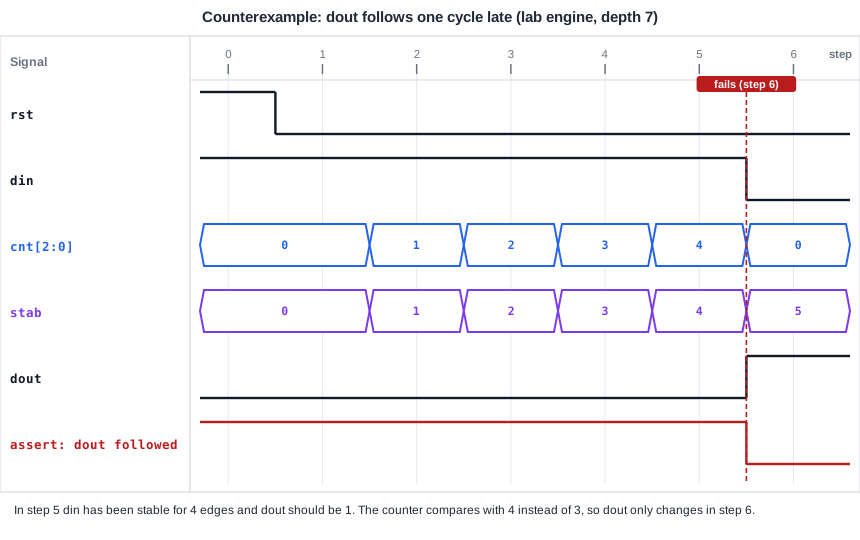
That gives 7. The lab engine agrees: the buggy debouncer passes at depths 5 and 6 and fails at depth 7, in step 6.
Counting works well for blocks with clear latencies: timers, pipelines, protocol engines. The general recipe is: reset cycles, plus the longest counter or timeout the property depends on, plus pipeline stages between cause and effect, plus a few cycles of margin.
Quick Check
Q: A FIFO with 8 entries has the rule "a push when full is ignored". Roughly what depth does the check need?
Show Answer
At least 1 reset cycle, 8 pushes to fill it, 1 more push while full, and a step to report: about 11, plus a few cycles of margin. A depth of 10 cannot even make the FIFO full.
Method 2: Measure With Covers
A cover tells you exactly when a behavior first becomes possible. For the debouncer, cover the event the rule is about, "dout changes":
c_change: cover property (@(posedge clk) disable iff (rst) $changed(dout));
On the fixed design, SymbiYosys reports it reached in step 6. Any depth below 7 cannot contain a single change of dout, so every rule about such changes would pass vacuously. Covers turn depth from a guess into a measurement. Cover each behavior your assertions talk about, and set the depth above the largest reached step.
In the lab, use a meant-to-fail assertion, assert (dout == $past(dout)) with the usual guards: the step at which it fails is the same measurement.
Method 3: The Longest Path From Reset
Every reachable state has a shortest path from reset. The longest of these shortest paths is called the reachability diameter of the design. A bounded check whose depth is larger than the diameter has seen every reachable state, so for invariants it is as good as a full proof.
For small control blocks, the diameter is easy to estimate: for the debouncer it is a handful of cycles, because every state is reachable within a few steps. For a 32-bit counter it is over four billion. The diameter explains why BMC is complete for some blocks at small depths and hopeless for others, and why the deep bugs article and Chapter 6 exist.
Quick Check
Q: The reachability diameter of a block is 12. An invariant passes at depth 15. Is it proven?
Show Answer
Yes, for an invariant. Every reachable state is reachable within 12 cycles, and the check looked at all states up to 14 cycles. The hard part in practice is knowing the diameter, which tools usually cannot compute for real designs.
Running It in ChipVerify Lab
The example below is the buggy debouncer with the stability helper and the rule. Run it at depth 6 and depth 7 and compare. Then fix the compare value to 3 and check that depth 10 passes.
Common Mistakes
Mistake #1: Using the same depth for every block
A default depth that suits an arbiter is useless for a block with a 100-cycle timeout. Derive the depth from the block, every time.
Mistake #2: Choosing the depth without covers
Counting can miss a cycle, as an off-by-one in the design itself shows. A cover for each behavior measures the depth the tool really needs.
Mistake #3: Forgetting the reporting step
A clocked assertion reports in the step after the bad value. Add one step to every estimate, or a failure at the very end of the run is missed.
Practice Exercise
Challenge: Find the Minimum Depth
Open the example. Run at depths 5, 6 and 7 and note where the failure first appears. Fix the debouncer. Then add a meant-to-fail check that dout never changes, and use it to find the earliest step at which the fixed debouncer can change its output.
Hint
"dout never changes" in the lab form: if (!init && !$past(rst)) assert (dout == $past(dout));. The step at which it fails is the step after the first change.
Solution
The buggy design passes at depths 5 and 6 and fails at depth 7, in step 6. The fix is else if (cnt == 3'd3). With it, the meant-to-fail check fails at step 6: dout first changes in step 5, after din has differed for 4 cycles (steps 1 to 4). Any rule about dout changing therefore needs a depth of at least 7.
Open the ready-made example in the lab and run the formal check from the formal panel. The free tier allows a depth of up to 10 cycles, and PRO allows up to 100.
Summary
- The depth decides whether a check is meaningful: below the depth a behavior needs, rules about it pass vacuously.
- Count it from the design: reset, counters and timeouts, pipeline stages, the reporting step and a margin.
- Measure it with covers: the step at which each behavior is first reached is the minimum depth for rules about it.
- Above the reachability diameter, a bounded check of an invariant is complete.
- The debouncer bug was invisible at depth 6 and found at depth 7.
