
A property that spans several blocks pulls all of them into its cone. Assume-guarantee reasoning splits it: each block is checked on its own, assuming what its neighbors promise and proving what it promises in return. If every promise that is assumed somewhere is proven somewhere else, the separate checks together cover the whole design. This article splits the source-and-sink example into two checks, and shows how the split forces the interface contract to be complete.
9 min read | Intermediate
What You'll Learn
- Explain assume-guarantee reasoning and when the split is sound
- Write the guarantees of a block as assertions and the same rules as assumptions on its neighbor
- Find a gap in an interface contract from a false failure
- Check a two-block design as two independent, smaller runs
The Idea
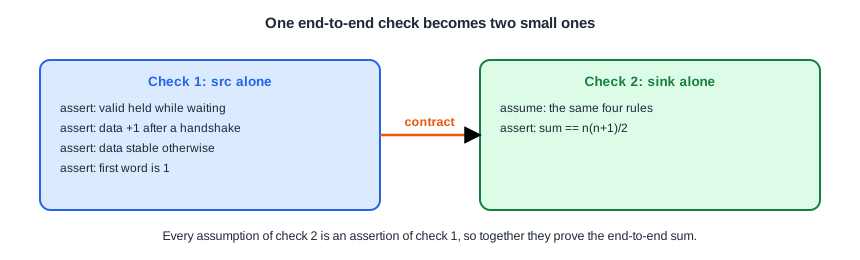
Block A guarantees some rules on its outputs; block B assumes those rules on its inputs. Check A with its guarantees as assertions. Check B with them as assumptions, plus B's own properties. If both checks pass, B's properties hold in the combined design, because the inputs B really receives satisfy the rules A was proven to keep.
The two checks are smaller than one combined check, and each block can be changed and rechecked without the other. That is how formal scales to subsystems: not with one huge run, but with many small ones connected by contracts.
Two conditions keep the method sound. Every assumption of one block must be proven as an assertion of the block that drives those signals. And the reasoning must not be circular: A's guarantees must not depend on assuming B's guarantees, which in turn depend on A's.
Quick Check
Q: Block B is checked with an assumption about its input. Nobody checks that assumption on block A. What is the status of B's properties?
Show Answer
They are proven only under that assumption. Until A is shown to guarantee it, B's result is conditional, and a bug in A that breaks the assumption would go unnoticed.
The Example: Source and Sink
The debugging article checked a source that sends 1, 2, 3 and so on, and a sink that adds them up, with one end-to-end property: after n words, the sum is n(n+1)/2. Here the two blocks are checked separately.
The Source and Its Guarantees
module src (input clk, input rst, input ready, output reg valid, output reg [7:0] data);
  always @(posedge clk)
    if (rst) begin
      valid <= 1'b0; data <= 8'd1;
    end else begin
      valid <= 1'b1;
      if (valid && ready) data <= data + 8'd1;
    end

`ifdef FORMAL
  reg init = 1'b1;
  always @(posedge clk) init <= 1'b0;
  always @(*) if (init) assume (rst);
  // GUARANTEES of the source, proven here
  always @(posedge clk) if (!init && !$past(rst) && $past(valid) && !$past(ready)) assert (valid && data == $past(data));
  always @(posedge clk) if (!init && !$past(rst) && $past(valid && ready)) assert (data == $past(data) + 8'd1);
  always @(posedge clk) if (!init && !$past(rst) && !$past(valid && ready)) assert (data == $past(data));
  always @(posedge clk) if (!init && !$past(rst) && valid && !$past(valid)) assert (data == 8'd1);
`endif
endmodule
The guarantees: valid is held while waiting, the data goes up by one after each handshake, the data does not change without a handshake, and the first word is 1. The check uses the source alone, with ready free.
The Sink and Its Assumptions
The sink check turns the same four rules into assumptions on valid and data, and asserts the sum:
`ifdef FORMAL
  // ... reset ...
  // ASSUMPTIONS: what the source guarantees
  always @(posedge clk) if (!init && !$past(rst) && $past(valid) && !$past(ready)) assume (valid && data == $past(data));
  always @(posedge clk) if (!init && !$past(rst) && $past(valid && ready)) assume (data == $past(data) + 8'd1);
  always @(posedge clk) if (!init && !$past(rst) && !$past(valid && ready)) assume (data == $past(data));
  always @(*) if (!init && n == 8'd0 && valid) assume (data == 8'd1);
  // the sink's own property
  always @(posedge clk) if (!init) assert (sum == ({8'd0, n} * ({8'd0, n} + 16'd1)) / 16'd2);
`endif
Both checks pass on the lab engine. Together they prove the end-to-end property, without ever putting both blocks in one run.
The Contract Must Be Complete
The first version of this split left out the third rule, "the data does not change without a handshake". The source check passed, but the sink check failed at step 5. In the trace, valid drops for a cycle and the data jumps from 2 to 66 while it is low. The real source never does that, but nothing in the assumptions forbade it, because the rules only talked about cycles with valid high.
That false failure was useful: it showed a gap in the interface contract. Adding the missing rule as a guarantee of the source, proven there, and as an assumption of the sink closed it. Writing contracts precisely enough for assume-guarantee is one of the main benefits of the method, because the same contract documents the interface for everyone who uses it.
Quick Check
Q: The sink check fails from an input sequence the real source never produces. What are the two possible fixes, and which is right here?
Show Answer
Either strengthen the contract, adding a rule the source guarantees and proving it there, or make the sink robust to that input. Here the source really does keep its data stable, so the contract was incomplete: add the rule on both sides.
Catching a Bug in the Source
Put back the bug from the debugging article: the source advances its data on valid alone. The source check fails at step 4 on its guarantees: data changes while waiting. The sink check is unaffected, because it relies only on the contract. The bug is found in the block where it lives, with a short trace, which is the second benefit of the method.
Running It in ChipVerify Lab
The example contains the source with its guarantees, and a second file with the sink and its assumptions. Each module is checked on its own: set the top module to src and run, then to sink and run.
Common Mistakes
Mistake #1: Assuming a rule that no block proves
Every assumption must be an assertion somewhere else. Keep a list of the contract rules and where each is proven.
Mistake #2: Circular reasoning
If A's proof assumes B's guarantees and B's proof assumes A's, the two can support each other without either being true. Break the cycle, for example with rules about different cycles or a separate proof of one side.
Mistake #3: Fixing a false failure by weakening the property
When a split check fails from inputs the neighbor never produces, the contract is missing a rule. Add the rule; do not relax the property.
Practice Exercise
Challenge: Break the Contract
Open the example. Run the source check and the sink check. Then remove the rule "the data does not change without a handshake" from the sink's assumptions and run the sink again. Finally, put the bug back into the source (advance data on valid alone) and run the source check.
Hint
Set the top module in the formal panel to the module you want to check.
Solution
Both checks pass. Without the stability assumption, the sink fails at step 5 with data that jumps while valid is low: a gap in the contract, not a bug. With the bug in the source, the source check fails at step 4 on its guarantees, while the sink check still passes, since it only depends on the contract.
Open the ready-made example in the lab and run the formal check from the formal panel. The free tier allows a depth of up to 10 cycles, and PRO allows up to 100.
Summary
- Assume-guarantee checks each block separately: guarantees as assertions on the driver, the same rules as assumptions on the receiver.
- It is sound when every assumption is proven on the other side and the reasoning is not circular.
- The source and sink were proven in two small runs that together cover the end-to-end property.
- A false failure in the sink check revealed a missing rule in the contract.
- A bug in the source fails the source's own check, close to its cause.
