
Most designs have sizes: data width, number of entries, counter width, number of channels. Formal difficulty often grows steeply with them, while the logic that matters stays the same. Shrinking means checking a smaller configuration of the same design, through its parameters, so the check finishes. This article measures how a FIFO check scales with its width and depth on the lab engine, and shows which reductions are safe and what to do when even the small check is not enough.
8 min read | Intermediate
What You'll Learn
- Shrink a design through its parameters without changing its logic
- Predict which size parameter drives the cost of a check
- Decide when a shrunk result transfers to the full size
- Use induction to remove the depth that large sizes demand
Shrinking Through Parameters
If every size in the RTL comes from a parameter, the formal setup can choose small values: a 4-entry FIFO instead of 64, 8-bit data instead of 64, a 4-bit timeout counter instead of 20. The control logic is the same code, so most bugs in it appear in the small version too, and much sooner. The deep bugs article used this to find a watchdog wrap in 6 steps instead of 1024.
The precondition is design discipline: no hard-coded constants that should follow a parameter, no special cases that only exist at the full size. Reviews for formal readiness check exactly this.
What Drives the Cost
The FIFO from the FIFO capstone, with flag checks against a reference count and a tracked-value order check, at several sizes. The bounded depth is chosen so the FIFO can be filled: a few cycles more than the number of entries.
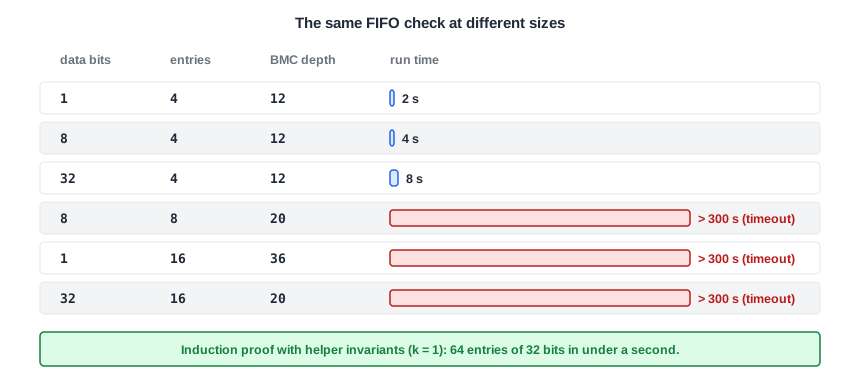
- Data width costs little: 1, 8 and 32 bits at 4 entries take 2, 4 and 8 seconds. The FIFO is data independent, and the tracked value only needs to be told apart from other words.
- Number of entries costs a lot, directly and through the depth needed to fill the FIFO: 8 entries already time out at 300 seconds, even with 8-bit data, and 16 entries time out even with 1-bit data.
So for a FIFO, shrink the depth of the memory first. The data width can often stay realistic.
Quick Check
Q: A 1024-entry FIFO with 64-bit data must be checked. Which parameter would you shrink, and to what?
Show Answer
The number of entries, to 4 or so, which the lab engine checks in seconds. The data width can stay at a few bits, or even at 64, since it barely affects the cost. Then use induction, below, to cover the full size.
When Does a Small Result Transfer?
A check of the 4-entry FIFO says nothing, formally, about 1024 entries. It transfers in practice when:
- the logic is the same code, with sizes from parameters only;
- nothing in the design behaves differently at specific sizes, such as power-of-two optimizations or special full-size handling;
- the small size still reaches every interesting situation: full, empty, wrap-around, simultaneous push and pop.
Covers at the small size confirm the last point. Some bugs depend on size, such as an overflow of a counter that is too narrow for the full depth, so shrinking is combined with a few targeted checks at the real size.
Induction Removes the Depth
A bounded check must unroll enough cycles to fill the FIFO, which is what makes large sizes expensive. An induction proof does not: with the right helper invariants, the step looks at a single cycle from any state. On the lab engine, the FIFO capstone's proof with its three helpers passes with k = 1 for 4 entries, for 16 entries of 32 bits, and for 64 entries of 32 bits, each in under a second. The sizes that defeated the bounded check are no problem for the proof.
The usual workflow combines both: shrink to find bugs quickly and to develop the helpers, then prove at the real size.
Quick Check
Q: Why does the induction proof barely get slower when the FIFO grows from 4 to 64 entries?
Show Answer
The step checks one transition from an arbitrary state that satisfies the properties and helpers. It never needs the many cycles that fill the FIFO, and the memory is handled as an array, so its size hardly affects the formula.
Running It in ChipVerify Lab
The example is the parameterized FIFO with flag and order checks, at W = 8 and AW = 2 (4 entries). Run it at depth 10. Then change W to 32 and run again; with PRO, try AW = 3 at depth 20 and watch the run hit the time limit.
Common Mistakes
Mistake #1: Hard-coded sizes in the RTL
A literal 10'd1000 next to a parameter LIMIT breaks shrinking. Every size-dependent value must come from a parameter.
Mistake #2: Shrinking the wrong parameter
Data width is often cheap; depth, entries and counter widths are expensive. Measure before deciding.
Mistake #3: Reporting a shrunk result as a full-size result
State the configuration checked. If the full size matters, prove it with induction, or argue explicitly why the small result transfers.
Practice Exercise
Challenge: Measure the Cost
Open the example. Run it with W = 1, 8 and 32 at AW = 2, depth 10, and note the times. With PRO, try AW = 3 at depth 20. Explain which parameter drives the run time.
Hint
How many cycles does it take to fill the FIFO, and how does that change with AW?
Solution
The width changes the time only a little: a few seconds in each case. With AW = 3 the run hits the 300 second limit, because the FIFO has twice the entries and the check needs about twice the depth to fill it. The number of entries, through the depth, drives the cost. The FIFO capstone shows the way out: an induction proof with helpers, which does not need that depth.
Open the ready-made example in the lab and run the formal check from the formal panel. The free tier allows a depth of up to 10 cycles, and PRO allows up to 100.
Summary
- Shrinking checks a smaller configuration of the same RTL, through its parameters.
- For a FIFO, data width barely matters; the number of entries and the depth it forces dominate.
- 4 entries took seconds, 8 and 16 entries timed out at 300 seconds in a bounded check.
- A small result transfers when the logic is size-independent and covers show the small size reaches every situation.
- Induction with helpers removes the depth: the 64-entry FIFO was proven in under a second.
