
For control logic, properties describe rules: one grant at a time, no overflow. For a datapath such as an ALU, the rule is the whole function: the output must equal the correct result for every input. The standard formal technique is a reference model, a second description of the function written differently from the RTL, and a single assertion that the two agree. This article checks an 8-bit ALU against a model and finds a signed comparison that was implemented as unsigned.
8 min read | Intermediate
What You'll Learn
- Check a datapath against a reference model with one assertion
- Write a reference model that does not copy the RTL
- Find a signed-versus-unsigned comparison bug
- Know when a reference model check is practical and when the width makes it too slow
The Reference Model Check
The same inputs drive the design and the model, and an assertion compares the outputs:
The model is formal-only code, so it can be written for clarity rather than speed or area. Its value comes from being different from the RTL: if it repeats the RTL expression, it repeats its bugs, as the writing good properties article warned. Good models use a different formulation: subtraction as adding the two's complement, AND through De Morgan's law, a shift as a multiplication by a power of two, comparisons with explicit $signed.
The Design: an 8-Bit ALU
module alu8 (input [2:0] op, input [7:0] a, input [7:0] b, output reg [7:0] y);
  // ops: 0 add, 1 sub, 2 and, 3 or, 4 xor, 5 shift left by b[2:0], 6 set-less-than (signed), 7 pass b
  always @(*)
    case (op)
      3'd0: y = a + b;
      3'd1: y = a - b;
      3'd2: y = a & b;
      3'd3: y = a | b;
      3'd4: y = a ^ b;
      3'd5: y = a << b[2:0];
      3'd6: y = (a < b) ? 8'd1 : 8'd0;      // bug: compares unsigned, the spec says signed
      default: y = b;
    endcase
endmodule
The specification says set-less-than compares signed numbers, as a processor needs for if (x < 0). In Verilog, a < b on unsigned vectors compares them unsigned.
The Model and the Check
`ifdef FORMAL
  // reference model, written independently of the RTL
  reg [7:0] model;
  always @(*) begin
    case (op)
      3'd0: model = a + b;
      3'd1: model = a + ~b + 8'd1;                       // two's complement subtraction
      3'd2: model = ~(~a | ~b);                          // De Morgan
      3'd3: model = ~(~a & ~b);
      3'd4: model = (a | b) & ~(a & b);
      3'd5: model = a * (8'd1 << b[2:0]);                // shift as multiplication
      3'd6: model = ($signed(a) < $signed(b)) ? 8'd1 : 8'd0;
      default: model = b;
    endcase
  end
  always @(*) assert (y == model);
`endif
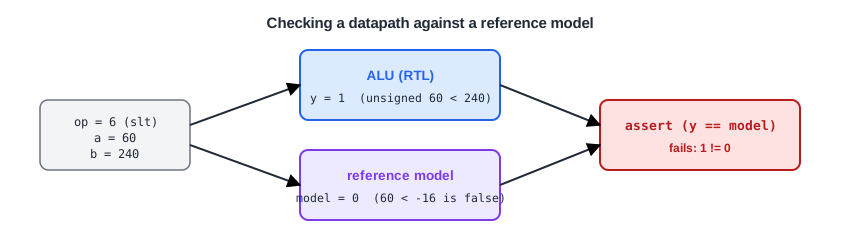
In SVA the check is one line, assert property (@(posedge clk) y == model);, or an immediate assertion in always_comb for a purely combinational block. The run fails in step 0 with op = 6, a = 60 and b = 240. As unsigned numbers, 60 is less than 240, so the ALU outputs 1. As signed numbers, 240 is -16, and 60 is not less than -16, so the model outputs 0.
Quick Check
Q: A random test drives a and b with values from 0 to 100. Does it find this bug?
Show Answer
No. Signed and unsigned comparison agree whenever both numbers are below 128, so the test never sees a difference. The bug needs one operand with the top bit set, which the formal tool chooses at once.
The Fix and the Run Time
The fix is 3'd6: y = ($signed(a) < $signed(b)) ? 8'd1 : 8'd0;. With it the check passes, in under a second on the lab engine. This works well because the ALU is combinational and 8 bits wide: the solver handles adders, logic and shifts of this size easily, and even the multiplication in the model is by a power of two.
A full multiplier or divider, or a 64-bit datapath, is a different story. As the performance article measured, a multiplier comparison stops finishing at about 10 bits. For wide arithmetic, check a narrow version of the datapath against the model, and check the full width by simulation or by equivalence against a trusted implementation.
Quick Check
Q: The ALU of a processor is 32 bits wide and has a multiply operation. How would you use a reference model check?
Show Answer
Make the width a parameter and check the 8-bit version against the model, including multiply. Check the 32-bit adds, logic and shifts against the model formally if they finish, and the 32-bit multiply by simulation against the model.
Running It in ChipVerify Lab
The example below is the buggy ALU with the reference model. Since the block is combinational, any depth finds the bug in step 0.
Common Mistakes
Mistake #1: Copying the RTL into the model
A model that says a < b where the RTL says a < b passes with the same bug. Write each operation in a different way, ideally from the specification.
Mistake #2: Forgetting signedness in the model
Verilog decides signed or unsigned from the operands. Make the model explicit with $signed wherever the specification talks about signed values.
Mistake #3: Running wide arithmetic models at full width
Multiplication and division models explode with width. Scale the datapath down for formal.
Practice Exercise
Challenge: Fix the Comparison
Open the example and run it. Check the counterexample values by hand, as signed and as unsigned numbers. Fix the ALU and run again. Then introduce a new bug in the shift, a << b instead of a << b[2:0], and see whether the model catches it.
Hint
For the shift bug, think of a value of b whose low 3 bits are small but whose full value is 8 or more.
Solution
The fixed ALU passes. With a << b, the model catches the shift bug in step 0: for a b of 8 or more, the RTL shifts everything out and returns 0, while the model shifts by b[2:0] as specified.
Open the ready-made example in the lab and run the formal check from the formal panel. The free tier allows a depth of up to 10 cycles, and PRO allows up to 100.
Summary
- A reference model and one assertion check the complete function of a datapath for every input.
- The model must be written differently from the RTL, or it shares its bugs.
- An unsigned comparison where the specification required a signed one was found in step 0 with
a= 60,b= 240. - Small, narrow datapaths check in seconds; wide multipliers and dividers need scaling down or other methods.
