
Many designs repeat the same logic for many channels, lanes, entries or addresses. Writing the same property eight times is tedious, and checking eight copies makes the run larger. A symbolic value lets you write the property once, for one index that the tool chooses freely. Because the tool can pick any index, one property covers all of them. This article applies the idea to an 8-channel interrupt controller and finds a bug that only affects one channel.
8 min read | Intermediate
What You'll Learn
- Use a symbolic index to check every channel of a design with one property
- Explain why a freely chosen constant covers all values
- Recognize data independence and use it to shrink data widths
- Find a cross-channel bug in an interrupt controller
Symbolic Constants
A symbolic constant is a value that the tool chooses at the start of a run and keeps for the whole run. You have already used two: the tracked value magic in the data integrity article, and the tracked address ta in the register file article. The same trick works for any index.
The reasoning is always the same. The property must hold for every value of the constant. If it fails for any value, the tool can choose that value and show the failure. So one property with a symbolic index is as strong as one property per index.
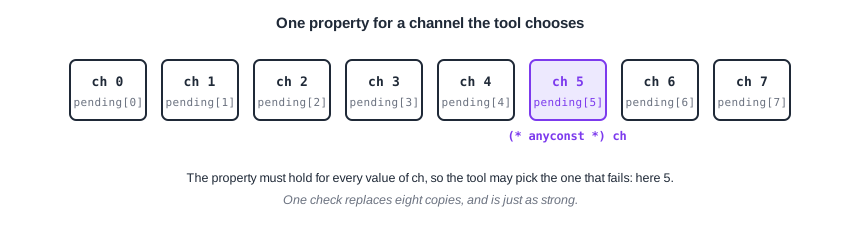
In the lab, symbolic constants are declared with (* anyconst *). In SVA flows, they are undriven inputs with an assumption that keeps them stable, assume property (@(posedge clk) $stable(ch));.
The Design: an Interrupt Controller
Eight peripherals signal interrupts with a one-cycle pulse on irq[i]. The controller sets pending[i], and the processor clears it with an acknowledge carrying the channel number:
module irq8 (input clk, input rst, input [7:0] irq, input ack_en, input [2:0] ack_id,
             output reg [7:0] pending, output any);
  assign any = |pending;
  integer i;
  always @(posedge clk)
    if (rst) pending <= 8'd0;
    else
      for (i = 0; i < 8; i = i + 1)
        if (irq[i])                                         pending[i] <= 1'b1;
        else if (ack_en && (ack_id == i || (i == 5 && ack_id == 3'd4)))
                                                            pending[i] <= 1'b0;   // bug: an ack for 4 also clears 5
endmodule
The bug is planted in one channel: acknowledging channel 4 also clears channel 5, as a copy-and-paste error in a hand-written decoder would. A lost interrupt is one of the worst bugs a system can have, and a test that never has channels 4 and 5 pending together will not see it.
One Property for Eight Channels
`ifdef FORMAL
  reg init = 1'b1;
  always @(posedge clk) init <= 1'b0;
  always @(*) if (init) assume (rst);
  // one symbolic channel instead of eight copies of every property
  (* anyconst *) reg [2:0] ch;
  // a pending interrupt stays pending until its own ack
  always @(posedge clk)
    if (!init && !$past(rst) && $past(pending[ch]) && !($past(ack_en) && $past(ack_id) == ch))
      assert (pending[ch]);
  // an irq always sets its pending bit
  always @(posedge clk) if (!init && !$past(rst) && $past(irq[ch])) assert (pending[ch]);
`endif
The run fails at step 4, with the tool's choice ch = 5. Interrupts arrive on channels 4 and 5 together in step 1 (irq = 0011_0000), both are pending in step 2, the processor acknowledges channel 4 in step 2, and in step 3 both pending bits are gone. Channel 5's interrupt was lost.
Quick Check
Q: The run with the symbolic channel fails. Does that mean every channel has the bug?
Show Answer
No. It means at least one channel has it, the one the tool chose: here channel 5. To see whether others are affected, fix it and rerun; or add an assumption ch != 5 and rerun to look for a second failing channel.
Data Independence
Many blocks only move data around without looking at it: FIFOs, buffers, crossbars, register files. Their control never depends on the data values. For such blocks, a check with a tracked value does not need wide data: whether the data is 1 bit or 64 bits, the control behaves the same, and the tracked value catches loss, duplication and reordering as long as it can be told apart from other words.
That is why the FIFO checks in this tutorial use 8-bit data, and why the shrinking the problem article can cut the width further. Be careful with blocks that do look at the data, such as a packet parser or an ECC unit: there, the data width is part of the behavior.
Quick Check
Q: Is a FIFO with an "almost full" flag data independent? And a FIFO that drops packets with a bad checksum?
Show Answer
The first is: the flag depends on the count, not on the data. The second is not: its control decisions depend on the data values, so the data width cannot simply be shrunk.
Running It in ChipVerify Lab
The example below is the buggy controller with the symbolic-channel properties. It fails at step 4 with ch = 5.
Common Mistakes
Mistake #1: Letting the symbolic value change
An index that changes during the run lets the tool switch channels between the set and the check, which gives false failures. Use (* anyconst *), or assume it stable.
Mistake #2: Writing eight copies of each property
It is longer, easier to get wrong, and makes no stronger statement than one property with a symbolic index.
Mistake #3: Shrinking data in a block that is not data independent
If control decisions depend on data, a smaller width changes the behavior. Check data independence before cutting widths.
Practice Exercise
Challenge: Find All the Faulty Channels
Open the example and run it. Add an assumption that excludes channel 5, always @(*) assume (ch != 3'd5);, and run again. Then remove it and fix the decoder.
Hint
If the run with ch != 5 passes, no other channel is affected.
Solution
With channel 5 excluded the run passes, so only channel 5 is affected. The fix is else if (ack_en && ack_id == i) pending[i] <= 1'b0;, after which the run passes for every channel.
Open the ready-made example in the lab and run the formal check from the formal panel. The free tier allows a depth of up to 10 cycles, and PRO allows up to 100.
Summary
- A symbolic constant, chosen by the tool and kept for the run, lets one property cover every index or value.
- One symbolic channel found an interrupt controller that lost channel 5 when channel 4 was acknowledged.
- Excluding a failing value with an assumption tells you whether other values fail too.
- Data-independent blocks can be checked with narrow data and a tracked value.
